
The most important factor in human affairs is social status, so whatever its other qualities it’s no surprise that one of the key uses we’ve found for the technological marvel of the internet is the enforcement of norms, the monitoring of behaviour and to elicit acts of submission to our ideals of respectability. People still fly under the radar; but if you live a lot of your life online you exist surrounded by social landmines - say the wrong thing to the wrong audience it will be seen and punished. Even if it doesn’t cause a stir at the time, it can be remembered and held against you later. This is life in our gossipy little village, but the impact of this environment on the village residents does not always unfold as expected.
In the case of men, I wrote this month about how it creates a dynamic of extreme withdrawal and passivity on the one side, but by perverse necessity a current of intense recklessness on the other; because it concentrates all the recklessness in one place and says to the people inclined to be that way that you’re in for a penny, in for a pound. Intense oversight of what people say and think and how they express themselves also has the counterintuitive effect in certain circumstances of making not caring what people think a kind of superpower. Of course, caring what people think is good, normal and important so if this is a superpower it’s a volatile one, and one that comes with a price attached, for the user and for everyone else - I’ll get to that. First I want to talk about some of the key human examples of this phenomenon.
Trump is the logical place to begin because he set the template for all of this - that of a person whose willingness to be disreputable in a time of intense social scrutiny is a source of power. Since he first came down the escalator you’ve had people wondering how someone so wilfully awful could also be so appealing, and how it is that he has not collapsed under the weight of his own shamelessness. This question is posed in different ways by different groups. Middle of the road right-wing and conservative people have wondered why they can’t get what they consider the good parts of Trump - his determination, his indifference to what people think, his issue selection, all that stuff - without the coarseness, the cruelty, the taboo-breaking, the carelessness.
It’s depressing to think that the end of the second Trump term is in sight and people still haven’t realised that the defining feature of his awfulness is that it’s an inevitable and essential part of the whole package. It’s true in any environment but in particular in the internet panopticon that if you’re going to raise taboo issues you can’t be sensitive or protective of your own social status amongst respectable people - to some extent you have to position yourself in opposition to those things. Those concepts are code words for decency and propriety, and the people who exercise the greatest level of control over what passes for propriety are the exact people who don’t want you talking about the things you’re talking about. If you accept you can only raise a given point where it doesn’t inflame decency then you have begun by conceding power to the people who determine and enforce what constitutes decency, and you accept that their priorities will always be beyond criticism. You are also ignoring the reality of social media as a tool of control, used to punish people by monitoring their behaviour and coordinating condemnation of those who step outside of consensus. If you begin by accepting the primacy of decency and propriety as considerations, by making those things your red lines, then it’s already over.
With Trump you could look at this from the other direction. His indecency was a source of his appeal because it proved to his audience that he couldn’t be sidelined by playing on his fear about social status, or with claims that he is at risk of violating sacred norms and would be thought poorly of as a result. This had been a recurring concern (and actually still is) with more mainstream and less populist right-wing politicians everywhere - that they cave when they see themselves being accused of racism in the New York Times (or local equivalent) opinion page, or when it looked like such a thing was on the horizon. It was a selling point for Trump that he didn’t cave to that stuff, and he could do that because he was already an unhip and disgusting piece of shit - you can’t cast out an outcast. His general indecency was a signal of vitality and security - even if his voters didn’t agree about the specific issue he was being indecent about, it shows them that he instinctively understood that monitoring and enforcing accusations of impropriety to limit the conversation was a key tactic for narrative control.
Calling someone a nazi, or a transphobe, or a misogynist works very well as a rhetorical tactic and will kill most people’s willingness to talk about certain things where such an accusation can be a risk - though it doesn’t kill their interest in talking about them. What you are also doing here is incentivising the social importance of people who don’t care about being accused of indecency, who will proceed in spite of those accusations, or who (for whatever reason) kind of like it. Those people also become more important because they’re the only ones who can function under a system that weaponsies social opprobrium on an industrial scale, facilitated by technology. A complicating factor is that those people are of course more likely (though not certain) to actually be bad things they’re accused of because it’s not normal to constantly risk or revel in disrespectability, and the personality that lacks sensitivity about that issue is often also missing other things. But that doesn’t diminish their utility.
Something similar can be said of Nick Fuentes: I’ve written before that viewers like his more extreme statements because the reputational cost of those statments is the guarantee that he’s the real deal, even if they can see he’s purposely exaggerating a point or directly contradicting something he’s said already; expressing himself in the most confrontational, outrageous or vulgar way possible has a value for his audience that is not connected to the literal truth (or not) of what he’s saying. I haven’t done a survey of his audience but would guess as men who have grown up online that they feel their opinions (and lives) are policed and patrolled to an intense degree so when a person who speaks in a way that upset the patrollers, that’s not just funny but is the exact thing that guarantees the speaker can be trusted and is worth listening to.
You will often see videos of Nick going viral and accompanied by text from presumably left-leaning people saying “remember - you don’t agree with him, he agrees with us” or “I hate that he’s so right”, something Fuentes himself often acknowledges and speaks to. This is a variant of the Trump phenomenon of people saying “he’s got the right instincts in some areas, can we not get a version of him that doesn’t say all those awful things!??” Again the answer is no, in part for the reasons stated above. But even aside from that, when Fuentes says unforgiveable or forbidden things, he is acting on the checklist of topics that he has been given by the enemy, who have told him through long engagement that these are the tools, ideas, red-lines and so on that they use - in the form of decency - to police you out of the discourse. The controversial things he says are some mixture of sincere, humorous, and calculatedly nasty/ obnoxious. But he’s also being tactical and proceeding with logical purpose based on the priorities given to him by his enemy. If you keep saying to people “all immigration skepticism naturally trends in the direction of nazism and is an embryonic form of it; therefore you can’t have someone advocate for immigration-skeptical politics because it will lead to a recurrence of A Certain Historic Event”, what you’re trying to do is discourage, and that will work for most people who think about these issues. But then what you’re also essentially doing is telling people that decentering the event in question, being calculatedly impious about it, is the target you need to hit. And you are by default both empowering and training people who are crazy or disagreeable or nasty or determined enough about their political goals to try and hit it.
Michael Tracey is a third example. He has been an all-purpose thorn in the side for as long as I can remember. He turbocharged this role when he began questioning some of the narratives around Jeffrey Epstein and the Epstein files, including the popular consensus that Epstein was a child trafficker and whether the evidence speaking to this had been widely misinterpreted, blown out of proportion or cynically exploited in a way that constitutes a moral panic and mass hysteria. He questioned the accuracy of some of the claims of people who identified themselves as (and profited from identifying themselves as) “Epstein Surviors”. This - irritation of all sides - seems to be the Tracey sweet spot, thought from my personal observation he has in recent times been slightly more of an irritation to the left, since implicit within his journalism was the idea that someone can identify themselves as a victim but actually be full of shit, which is not a respectable position for anyone to hold.
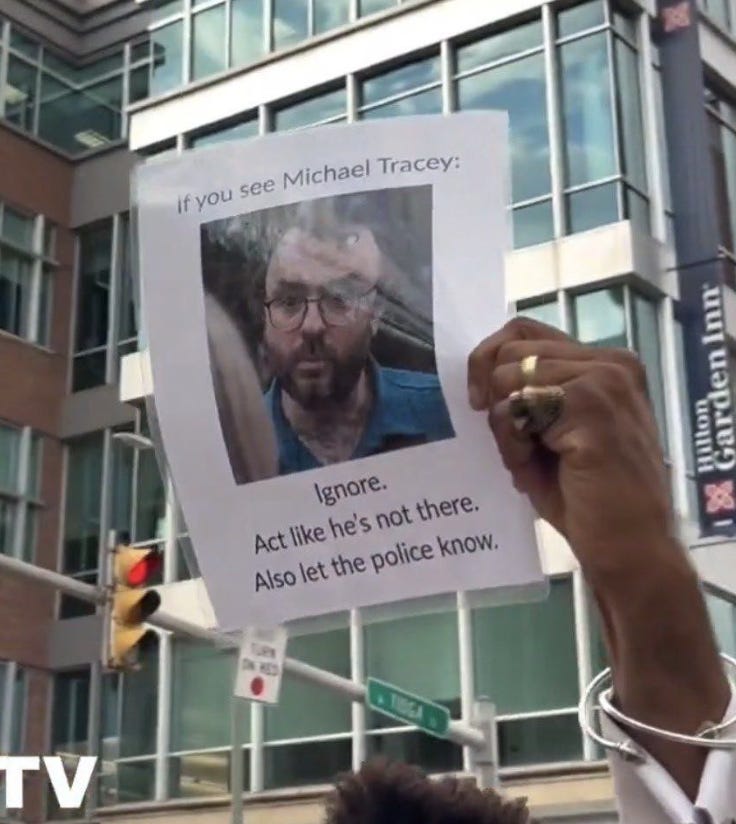
His position as a public hate figure has gone into overdrive with the Cornell seven case, where Tracey has again spent his time just pointing out a lot of the obvious discrepancies with the facts of the case and how it’s been reported, and the ways in which these facts are being intentionally and ourtageously misrespresented, often by prominent public figures who should know better. He published the name of Jane Doe - his rationale for doing so seems to have been that it had been made public in court documents; that it was not illegal to print it; and that there was a lot of hypocrisy abroad in publishing the accused name but not the accuser. He subsequently deleted it - I shudder to think how much pressure must have been brought to bear on a person of Michael’s character for him to do that but it included people doxxing him and his address, which turned out to be a house his family had formerly lived at, resulting the harrassment of the people who lived there. He turned up at Ithaca town council in New York to loudly protest their moratorium on student events, which in turn was based on the idea that with collegiate gang rapists at large and the area therefore wasn’t safe. In the meeting he shouted at the mayor “you ought to resign for impugning the seven men total on the basis of a civil complaint that was filed by a notoriously unscrupulous lawyer”. He was escorted out having not been given the formal opportunity to speak. He next turned up at a pro-Jane Doe rally and following confrontations with protestors who were specifically looking for him (see picture above), he had to be escorted away by police for his own safety.
Again, as with the other examples - the environment around the Epstein and Cornell issues is oppressively patrolled from a propriety point of view while still allowing people the maximal ability to find out inconvenient facts if they want to, that it kind of demands the existence of someone like Michael Tracey. It’s true that Michael is a modern manifestation of a type of needling, bolshy, incorrigible journalist that has always existed to some degree. But he has a particular role in the time of social media, and it’s role in turn of managing consensus. After all, the first time I became aware of the Cornell Seven case it was not as an emerging story which unfolded into a moral scandal as more details emerged. It was an oven-ready (to use Boris Johnson’s phrase) outrage, we were to trust that the work had been done and it was already correctly identified as one, and that questions on that front were unnecessary and unseemly. Yet it was clear from the details that did leak out that there were threads to pull at, and that the way it was being reported to the public was evasive.
Michael Tracey is of course a human being, and he wasn’t willed into existence as a psychic response to the social pressure cooker of the internet… but he’s not not that either. The tension of the situation demands someone who deprioirtises the standards of respectablity, decency, and appropriateness, since that mostly just means what progressive people are happy to about. The situation demands a kind of pressure release valve.
I’m not trying to say that these three are all the same type of guy, or that each of them uses their talent for disagreeability in the same way, within the same moral framework. I’m sure Michael Tracey in particular would emphasise he is not very like Trump or Fuentes politically, and is just doing the most basic and essential tasks of a normal journalist - and that he only seems unusual because we’ve forgotten what that looks like. I concede that point while noting he *is* similar, in that all three are part of a collective response to two contradictory impacts of the internet. Those are that it provides the maximal ability to control and direct public conversation through tone policing, social pressure, signalling etc, while also providing maximal access to information that contradicts and undermines that control. The result is a population of incorrigible people pleasers but also a more limited number of disagreeability supersoldiers of the type outlined here.
I’d love to tell you that my primary literary reference for any given event is Shakespeare or Tolstoy or Yeats or whatever, and you’ll have to believe that stuff is in here somewhere (taps head) - but I grew up reading comics, so it is what it is. In thinking about this situation my mind kept straying back to the phase DC went through in the early 90s, of seeming to kill off its most storied characters with new villains who were their dark mirror images. Batman was taken out of action by Bane, and Superman was killed by a creature called Doomsday, described thus by Wikipedia:
Doomsday was born in prehistoric times on Krypton, long before the humanoid Kryptonian race gained dominance over the planet about 250,000 years ago. It was at that time a violent, hellish world, where only the absolute strongest of creatures could survive. In a cruel experiment involving evolution, intended to create the perfect living being, an alien scientist released a humanoid infant onto the surface of the planet, where he was promptly killed by the harsh environment. The baby’s remains were collected and used to clone a stronger version. This process was repeated over and over for decades as a form of accelerated natural evolution. The agony of these repeated deaths was recorded in his genes, driving the being insane and instilling hatred of all life.
Ignore the silliness and implausibility of the above for a moment. We tell ourselves, and it’s true, that we get the behaviour we incentivise; but it’s also true that for a certain type of person who is always with us, punishment (repression, rejection, denial) is itself a kind of incentive, which certainly explains some of the indestructible supervillains we have on the scene, and should encourage us to expect more like them in future.
Articles on similar subjects
Fuentes Vs Morgan, and Liberalism Choosing the Form of It’s Own Destructor

At the end of the movie Ghostbusters (the 1980s one) the heroes confront the Mespotamian demon intent on destroying New York. Instead of battling the team directly, she tells Bill Murray and company that she will pull an image from the forbidden depths of their minds, make it real, and that they will be forced to fight. I get the logic: the thing they have always turned their minds from, that has grown powerful through their failure to confront it, is exactly the thing that they will be forced to stare down. In issuing this challenge, she
High Status Beliefs and Resisting the Urge To Scold

Bono went on Joe Rogan last week to confront Joe and his audience about USAID cuts, and Rogan’s support for Trump. The interview provides us with a great worked example of why the progressive end of liberalism is adrift from a big slice of popular culture, and in particular why participation in bro-friendly podcast culture with its long-form interviews presents a challenge that’s not likely to soon be overcome. In other words this is as good an opportunity as any to check in on the “Left-Wing Joe Rogan” discourse - headlines below, in case you’ve forgotten.
The Golden Age of Emotional Blackmail is Over

Deportations began within the last week, so singer and actress Selena Gomez (instagram follower count: 142 Million) posted a video on social media, crying, face close to the camera, squeezing out distraught gasps about children, “my people” and her inability to stop what was happening. So far, so 2016; this kind of reaction was not just run of the mill during Trump’s first term but that era became a monotonous thrum of tears, demands and outrage issuing from every corner of popular culture; in terms of setting a cultural tone and swamping the administration, it was successful. But this is 2025: within the hour the backlash had been such that the post had been removed, and replaced with a black screen bearing the message “Apparently it’s not OK to show empathy for people.”