
The return of Lindy West to the discourse has me thinking about the Body Positivity, Fat Acceptance and Health at Any Size movements, of which she has been and still is an advocate. One of the most intriguing and indicative social changes of my lifetime is that these movements went from being aimed at women to aimed at everyone - despite the fact that men seem to hate and deride these ideas, and despite the fact that in practice they are only ever really applied to or used by women.
Fat Acceptance as an idea is not something that never would have taken root in a world where men’s preferences were paramount. Men’s self-help tends to be aspirational in an obvious way, which we see at its most basic in the imagery of cars, steaks and cigars for which the manosphere is known.
Even where it blames external forces, male self-help it always comes down to the importance of the subject sucking it up, accepting their own inadequacy as intolerable, and saving yourself because no one is going to do it. This plays on men’s innate sense that the default attitude of the world toward them is one of uselessness, contempt, and disposability and that making yourself admirable and essential through personal achievement is the only way to change that.
But I don’t think it’s remarked on enough that men actually enjoy being told what useless pieces of shit they are (mostly not in so many words). It’s not just that that’s the only way they’ll hear a self-improvement message: they like it. They are energised and thrilled by the implication that they are alone against a cruel world with one or two other comrades, backs against the wall.
So men’s attitudes toward male fatness has always been one of shame except in instances where it could be associated with physical strength. In the old, male-oriented media, fat people were buffoons, de-sexualised sidekicks, archetypes of greed, or some combination of all three (still often the case, but less so). Of course, men constantly fail to live up to the version of themselves idealised messaging aimed at them, but the ideal is there nonetheless and indicative of a particular value system.
Just as men are motivated by fear of their own disposability, women are often motivated by their own sense of vulnerability. So any messaging aimed at women, but especially self-help, self-improvement and aspirational stuff, often implicitly celebrates the idea of banding together with other vulnerable people as a protective measure, buoying each other up by presenting that vulnerability as a positive good and a uniting factor.
The incompatibility (in concentrated form) of these two perspectives wouldn’t matter except for the misunderstood problem of online and social media bubbles. We know that our online lives throw us into digital environments with similar people in a way that tends to concentrate and harden existing tendencies, reward extreme in-group dedication and shut out dissenting voices. What’s less remarked on is that this really becomes a problem because we can still see what is happening in everyone else’s bubble and become enraged by rubbing up against a concentrated dose of a foreign moral outlook.
So fat acceptance was developed by women for women and that’s fine, but it has intruded into the public sphere as something for everyone. Many men are too afraid of seeming gauche to complain about this tension, but this Joe Rogan video is a good example of what men think about normalising and tolerating fatness, and how it legitimises people’s bad decision making and looks to make a basic betrayal of normal human health into a lifestyle.
Obviously one of the criticisms here is that this is a veiled attempt at the usual policing of women’s bodies, expressing visceral disgust at women being obese, and voicing the implicit perspective that women’s function in the public sphere is to be pretty and that pretuiness itself is synonymous with usefulness, goodness, human worth and so on. I’m sure there probably is an element of that.
But I think it’s clear in that video, and other iterations where people push back on these concepts, that having had this messaging pumped at him from a variety of media sources means he thinks these concepts are intended to apply to people like him as well. He’s right to be confused; if you look up “body positivity” online here are the first five definitions you get:
Body positivity is a social movement and personal philosophy advocating that all individuals deserve to have a positive body image, regardless of societal ideals of size, shape, skin tone, or ability. It promotes self-love, acceptance of physical diversity, and challenges unrealistic beauty standards, often rooting itself in fat liberation. (National Institutes of Health)
Body positivity is a movement to accept bodies of all sizes and types, rather than those that conform to societal ideals of beauty. (Psychology Today)
Body positivity is a social movement that promotes a positive view of all bodies, regardless of size, shape, skin tone, gender, and physical abilities. Proponents focus on the appreciation of the functionality and health of the human body instead of its physical appearance. This is related to the concept of body neutrality, which posits that a person’s bodily appearance should have the least possible effect on their experience of life. (Wikipedia)
Body positivity refers to the assertion that all people deserve a positive body image, regardless of how society and popular culture view ideal shape, size, and appearance. It involves loving your body and feeling good about how it looks. Keep reading to learn more about body positivity, including what it means, its goals, how it turned into a movement, its benefits, and criticisms. We also share how to feel more positive about your body, which helps support a healthy body image. (Very Well Mind)
In today’s society, the concept of body positivity has gained significant traction, championing the acceptance and celebration of diverse body shapes, sizes, and appearances. Rooted in the principles of diversity, equity, and inclusion (DEI), body positivity strives to create a culture that fosters self-love, acceptance, and respect for all bodies. (The Oxford Review)
If you do an image search of the same concept here is what you get (first 3 pages):
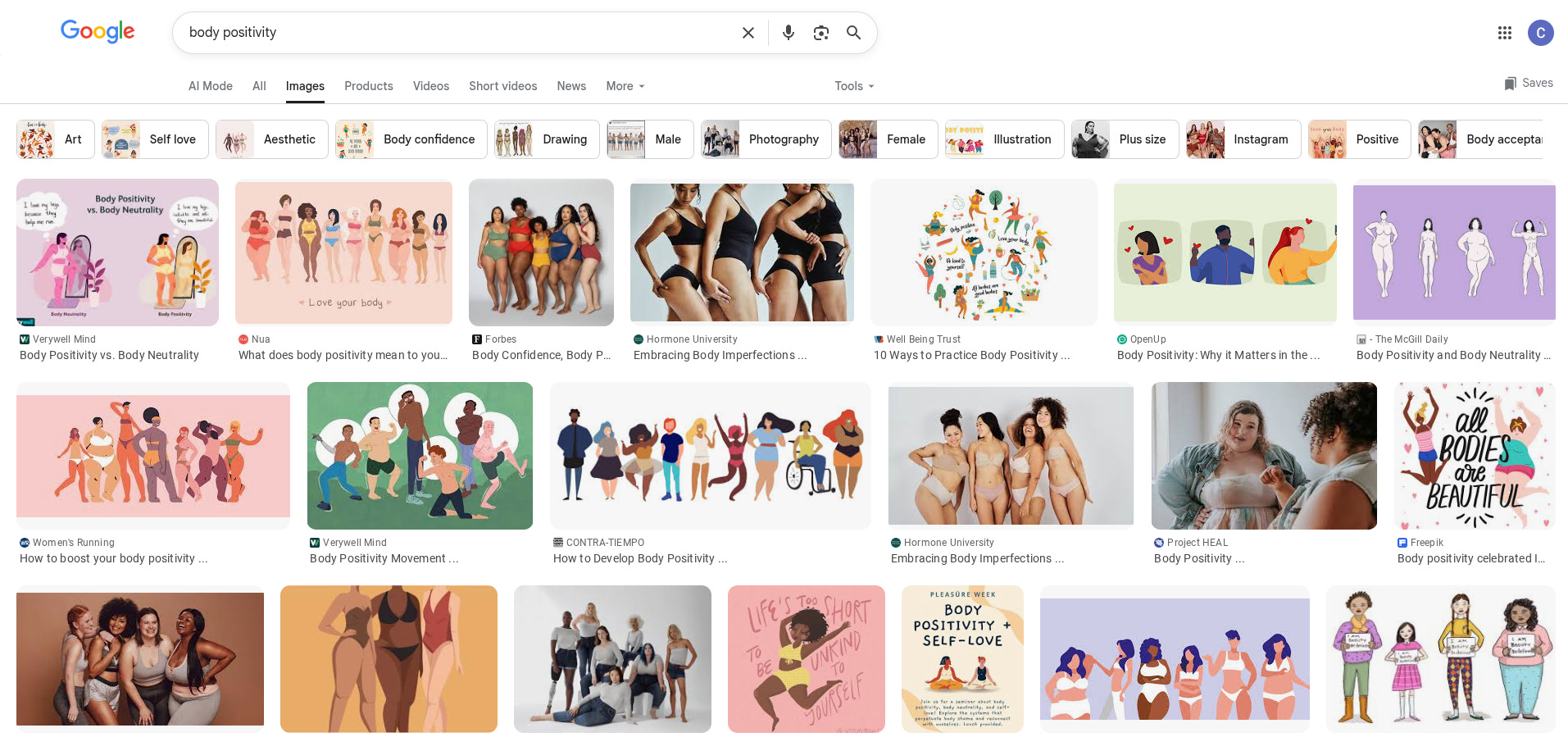
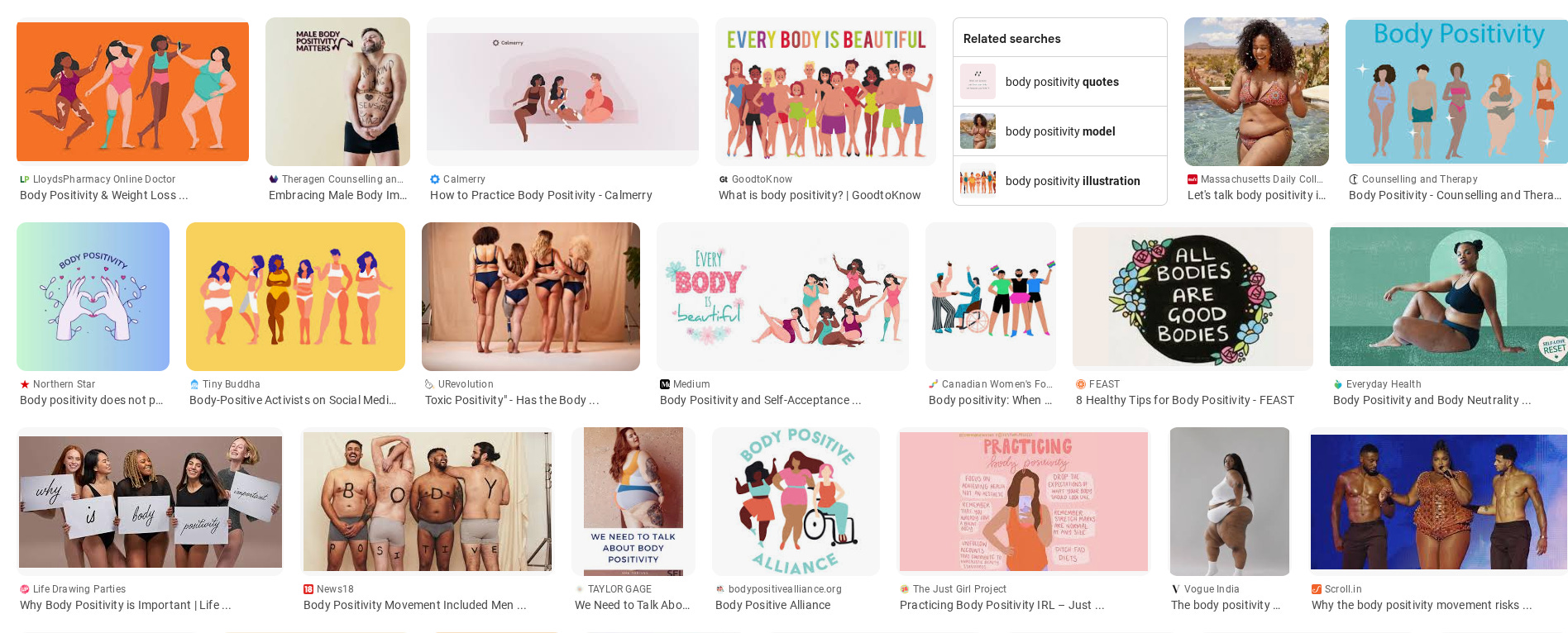
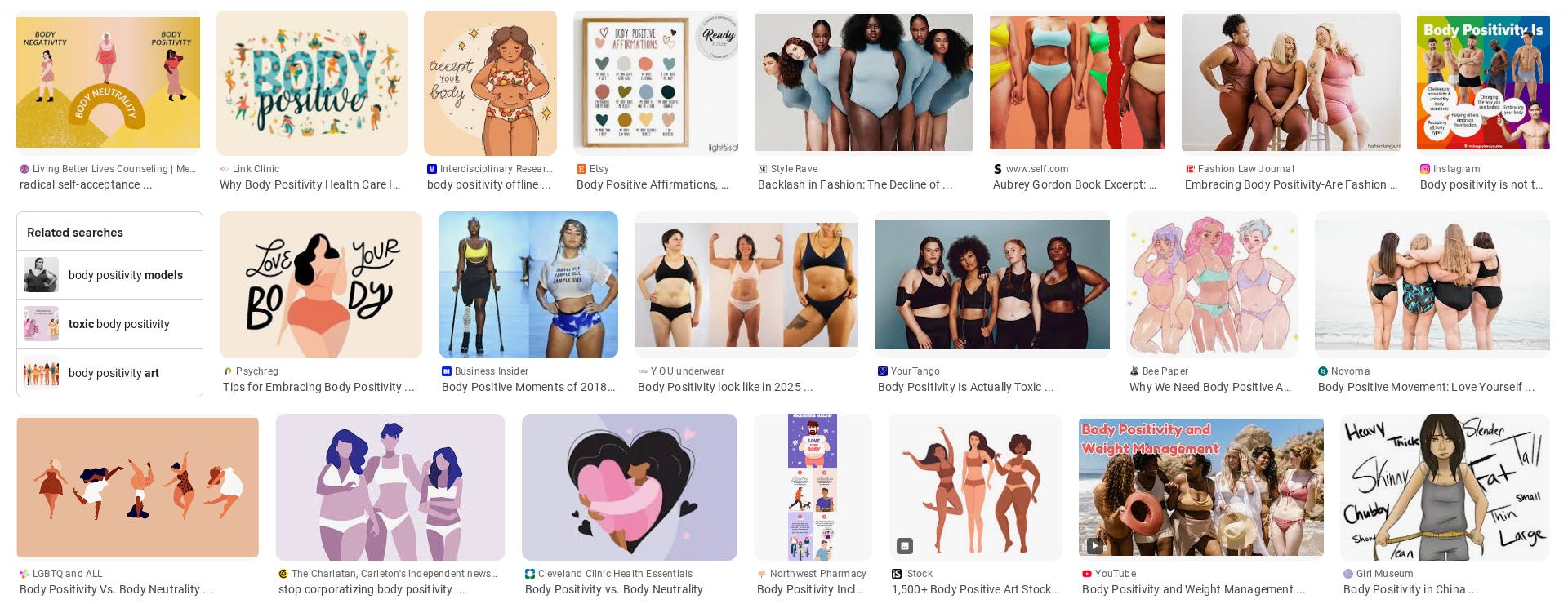
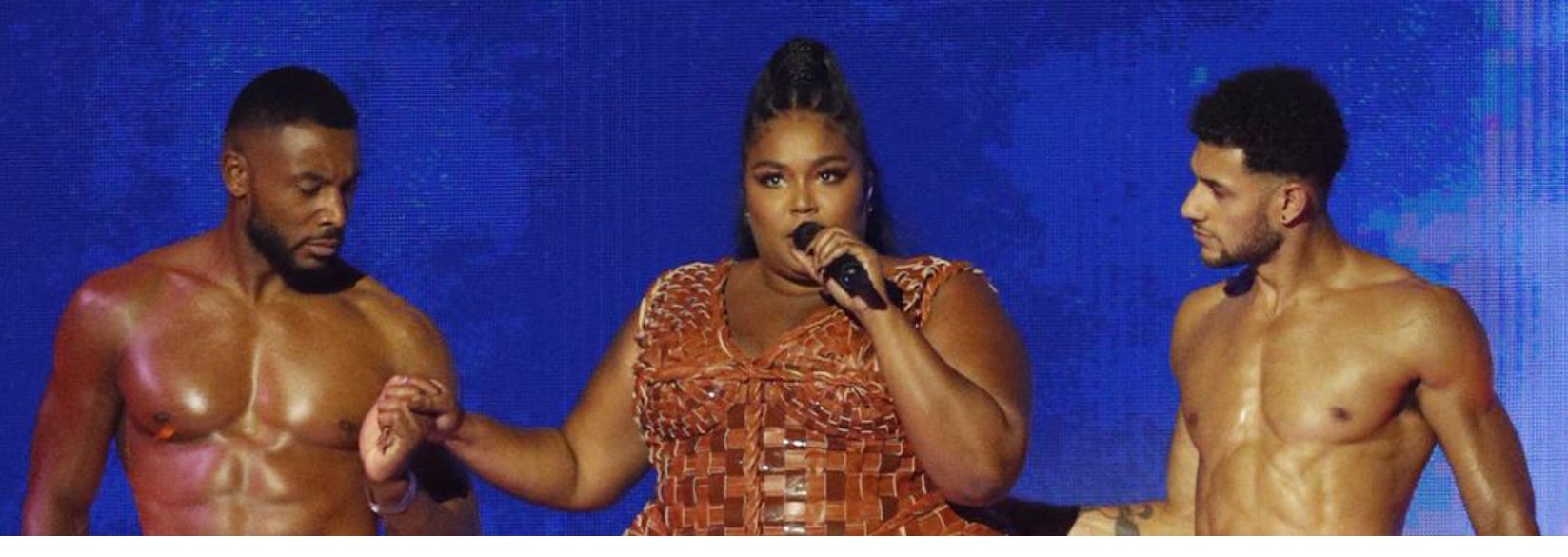
So the definitions are universal, but the output only features and speaks to women.
Two things have happened to cause this dissonance. The first is that in the period of what I suppose I have to call Wokeness (2011-2020) it became impossible to categorise Body Positivity and related topics as women’s issues because it was considered trans-exclusionary. Since the whole point of these movements was maximal inclusivity and to display care for the downtrodden and marginalised, trans-inclusivity was an essential change. The second is simply that women have become a more powerful and agentic interest group in society and as consumers which means that, as with men in the past, there are many situations where the perspective that is adopted as correct and respectable is the one that appeals to their moral priors - not those held by men. Both of these impulses must co-exist, which means that for Body Positivity to continue to appeal to its audience it must be understood as universal, even though it’s really just for women.
I don’t think it’s a stretch to say that this has political consequences. A lot of the pushback against the progressive element of popular culture from the populist right has focused on traditional standards of beauty, both in people and in the built world. Online Dissent Right figures online like BAP have sought to turn female-centred universalism of Body Positivity on its head by promoting propagandistic and homoerotic imagery of glistening half-naked male athletes alongside right-wing political takes
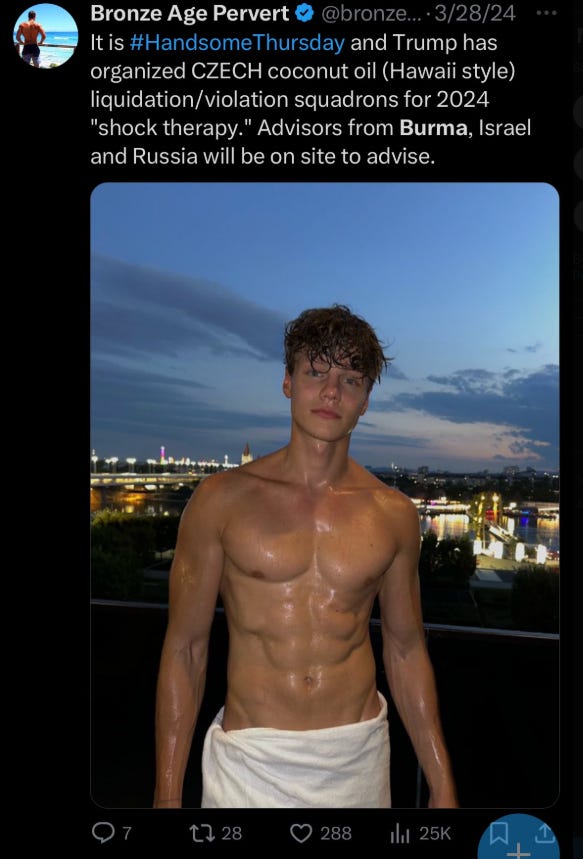
.Looksmaxxers could be understood as a distinctively male reaction to the same focus on physical appearances that created the demand for body positivity on the female side, but also a reaction to the promotion of female-centric Body Positivity as a universal standard. Instead of defending how you look on the basis of inclusivity you become hyper-competitive, hierarchical and obsessed with technical detail of how best to transform one’s body.
At a more philosophical level some have taken the objection to the sentiments behind Body Positivity to their logical conclusion, which is in part how you get people Tucker Carlson talking about the beauty of the physical world being an important feature in people’s well-being, and the Trump administration’s executive orders on “Making Federal Architecture Beautiful Again” and “Promoting Beautiful Federal Civic Architecture”. These ideas mingle all kinds of impulses about nationality, ethnicity, religion and the body all together in one mush of reactionary concepts.
You can of course overplay or overemphasise how racidalising any of this is, just as you can question the chain of causation. I don’t think a normally Liberal person will see an ad with a plus-size model in it and immediately drop everything to attend an anti-immigration rally. But I do think that being presented with an idea as universally applicable and good when it is morally alien to you - that does have an effect, even if that is only a sense of inner withdrawal away from the source of your discomfort. Many such cases!
Women have historically lived in men’s worlds and had to put up with their standards being pumped at them as a universal being male ones. Those include that women who are not physically perfect are to be dismissed as though not fully human - so I’m sure many of them would feel that men’s dissonance about Body Positivity is tough shit. That’s fair enough. I’d add to that that there’s an ambient cruelty associated with the old (male) attitude towards health that isn’t nice; I think men forget how nice it is to live in a slightly more progressive world which is to say (and I mean this in a positive way) a more female-influenced one where you have the option to indulge the benign hypocrisy of being a little bit accepting difference and imperfection even if you don’t always feel it.
Ideas like Fat Acceptance and Body Positivity used to puzzle and annoy me until I realised that it wasn’t intended to apply to me or people like me - it was women talking to each other about themselves and their own problems, dressed in the language of universalism. Great, go nuts. But the irritation was real and not everyone makes this realisation. Understanding poor health as a personal failing to fight and a problem to be worked on, and that stealth-celebrating as acceptable is cruel to oneself - that is the male version of body positivity. The tension between those two perspectives is certainly not the most serious issue we face but there is something here that encapsulates a particular cultural barrier we keep running into. Men and women can have very different moral outlooks; we seem to be lapsing more often into seeing the female oriented one as obviously correct and superior. We keep poking men with that sharpened point and acting surprised when they don’t like it. There is something that has caused men’s moral perspectives to become indigestible to Liberalism, and we should try to figure out what it is, and what to do about it, soon.
Some more articles from me:
Men as a Conquered People

Inspired by The Rest is History, in the last month I’ve been re-reading the book “The Comanches: The History of A People” by T. R. Fehrenbach. I would rate this as one of the top 5 history books I’ve read in my life, a lapidary masterpiece that portrays the plains indians as vital, terrifying, and I can’t think of a better way to say this, incredibly fucking cool. One of the least cool times to be a Comanche was the 1870s, when the flame of their glory and the world that fueled it were fading (really, being extinguished) leaving the people behind in the dark. The description of this period in the book is resonant in more ways than one. Does the following remind you of anything?
The Progressive Quest to Win Back Men Is Going Very Badly

In the beloved movie musical My Fair Lady, we watch as Professor Higgins attempts to turn cockney flower-seller Eliza Doolittle into a Duchess. The process doesn’t run smoothly, mostly because Eliza insists on having a mind of her own. In one of the most famous
Reality Bites

In the Social Media age we talk about epistemic bubbles all the time; closed groups of people agreeing with each other and isolated from unpleasant facts. What’s less commonly spoken about is that bubbles are historically good, and normal; civilisation could not have arisen if people didn’t spend the majority of their lives surrounded by others who saw the world as they did. No, the unique sensation our age is of being trapped in someone else’s bubble, someone else’s dream, and knowing that it’s a dream without being able to do anything about it.
'Fat Acceptance' is one of those things that began in America but I think has run out of steam already over there. It had corporate support in the early 2020s, but plus size models were not selling their products so they went back to Sydney Sweeney types.
But over here Woke causes can be sustained just by NGO support.