
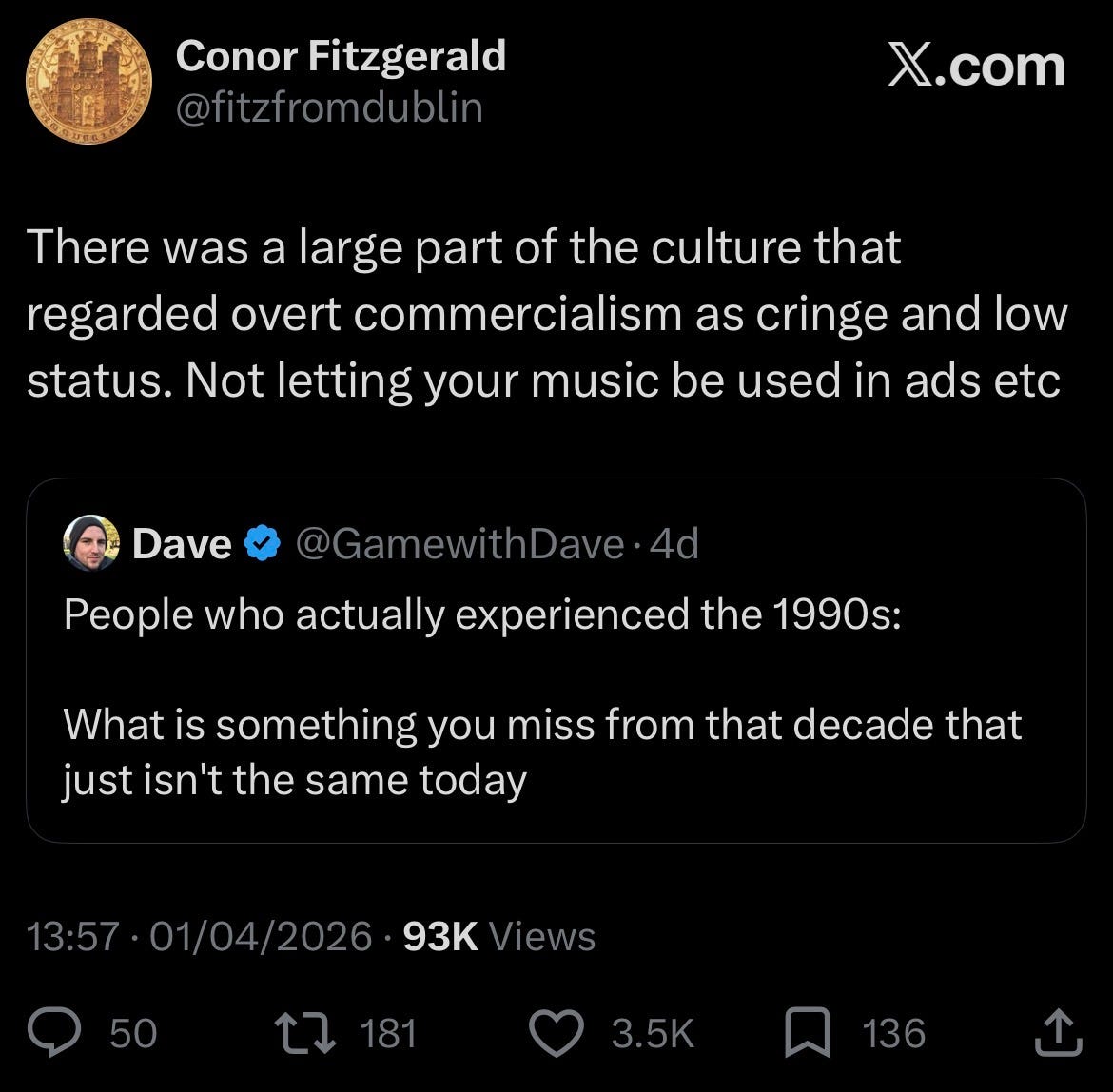
A few days ago someone on Twitter asked what people who were alive during the '90s missed from that era, my reply below seemed to resonate with a lot of people. This is one of the key attitudinal changes in popular culture in the last 30 years, and understanding what happened here is key to understanding many other changes that happened during that time.
For me, the exemplar of the old attitude was comedian Bill Hicks, who had a famous routine about how doing commercials disqualified you as an artist. This bit would have been very familiar to anyone who grew up in that era as a canonical statement of the received opinion on this matter. His rant starts off about Jay Leno, who had been a beloved comedian amongst other practitioners before he was understood to have made a move into increasingly insipid light entertainment, which they saw as a betrayal. That’s who he’s talking about here from the 2:07 mark (I’ve put the important parts in bold):
Because he’s a company man to the bitter fucking end… and it all started, folks, when he did a Dorito’s commerical… and here’s the deal, I’m drawing a line in the sand like Colonel Fannin did at the Alamo, you’re with me or you’re not. If you do a commerical you’re off the artistic roll call forever - case fucking closed. Man, doing Doritos is so sad, Jay doing Doritos… just Satan fucking him in the ass on national TV man - (whiny, lispy voice) “Hi, I’m Jay Leno! Remember when I used to be funny? I’m here for Doritos!” and Satan is just (feral sex sounds). “Here Satan, try the Nacho flavour brand!” (feral sex and eating sounds). (Demonic voice) “mmm, cool and refreshing!” (Jay Leno voice again) “tonight on the show we’ve got Joey Lawrence and Patrick Duffy!” Man if that were the guest list he’d use a fucking Uzi on himself… (mimics gun sounds)… he’d just be chewing fucking lead… (more feral sounds)… you do a commerical you’re off the artistic call forever, you’ve now got a price on your head, you’re a corporate fucking whore, just another whore at the capitalist fucking gang bang, case fucking closed, and that goes for everyone - except Willie Nelson.
(Hicks was from Texas, hence the Nelson joke.)
He did a version of this bit on the David Letterman talk show in 1993 - it was cut along with the rest of his set, leading him to fall out with Letterman (who he idolised and was sort of defending in this bit - the lore is too tiresome to get into). Hicks was unhappy about it until he died the following year, and Letterman was haunted by the decision. Letterman aired the full segment in 2009.
Hicks’s bit is the best manifesto-like statement of this attitude, but there are lots of other examples from the era, mostly from music, of people refusing to interact with or give their authenticity to the corporate world. Most of the examples revolve around commercials. When companies (Doritos again!) employed soundalike versions of Tom Waits on their ads sued them; he described having his music copied in this way as “like having a cow’s udder sewn to the side of my face, painful and humiliating.” REM declined to allow their music to be used in the Windows launch, and Microsoft went with the Rolling Stones for one of the most famous campaigns in history. In “This Note’s for You”, Neil Young (who presumably got the same offers) sang “ain’t singing for pepsi, ain’t singing for coke, ain’t singing for no one, make me feel like a joke”.
The idea that commercialism was low status and cringe didn’t just extend to ads. Anything that smacked too much of appealing to coarse or traditional mainstream tastes was included. It’s kind of become re-accepted that it’s normal for men like to see hot women and for attractive women to commodify their appearance and sexuality, but it was deeply cringe to acknowledge that in the ‘90s within any slice of popular culture that regarded itself as edgy or cool or what used to be called “Right On” (that term has vanished but was useful - it meant something similar to “woke”but even more strident and tiresome). In the UK, where the phrase was popular, that didn’t change until the lad mag revolution of the britpop era.
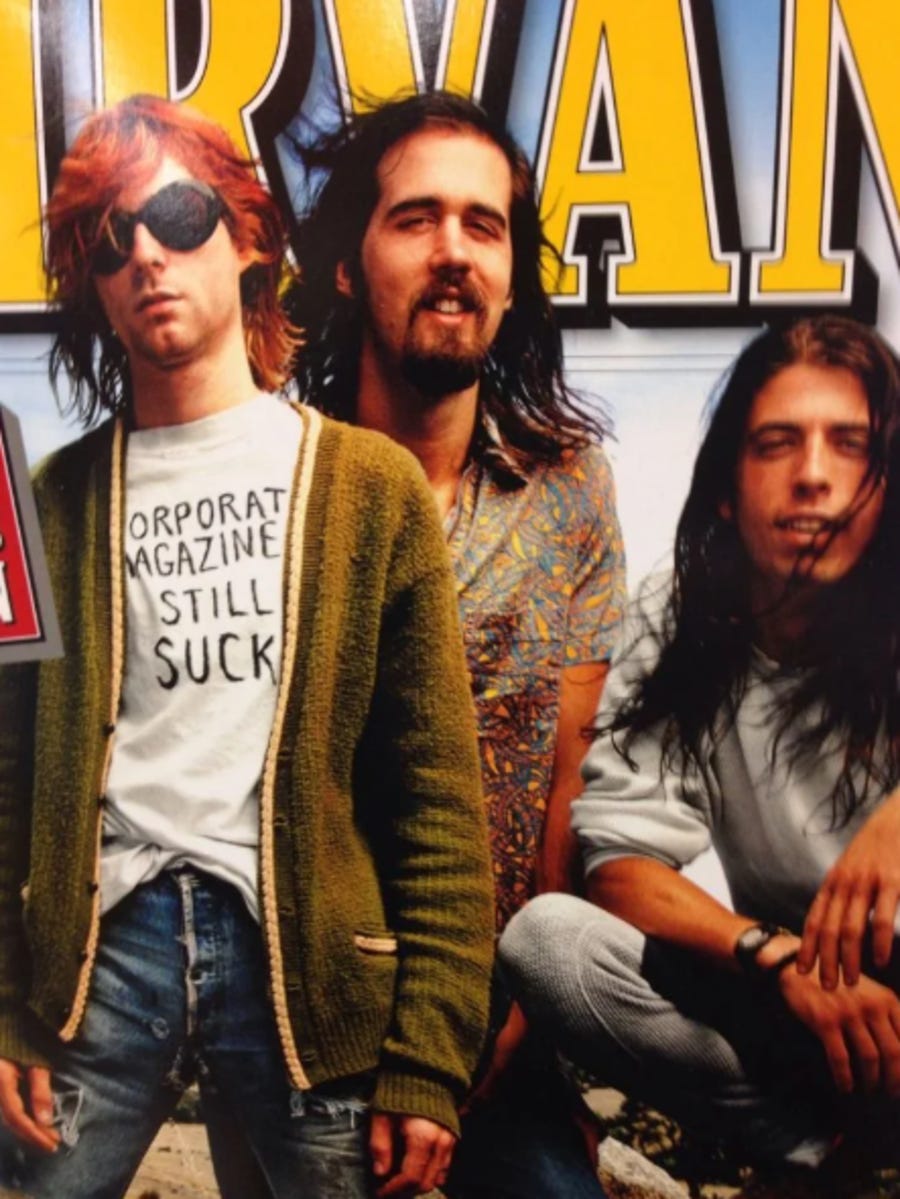
The anti-corporate/ anti-commercial attitude was expressed with a pompous and contemptuous tone that is very familiar from our own era, and as today there were many inconsistencies. When Nirvana appeared on the cover of Rolling Stone in 1992, Kurt Cobain wore a T-shirt that said “corporate magazines still suck” - but they still did the cover. Versions of that homemade t-shirt have occasionally been designer items which also says it all.

A good example of how sincere this attitude often was, was the 1994 battle between Ticketmaster and Pearl Jam, which you can find a summary of here. The band was outraged by Ticketmaster’s monopolistic practices and levelling of sleazy service charges, including for charity gigs. They tried to arrange a world tour outside the Ticketmaster system while also campaigning for an antitrust investigation. You can read about the ups and downs but they were comprehensively defeated, lost many millions of dollars and were forced to start using Ticketmaster-affiliated venues again in 1998. My point is that while there was a lot of pious windbagging on the subject, the anti-corporate stance was not always a performance. Ticketmaster consolidated their stranglehold on the industry by merging with Live Nation in 2010.
I think the best way of explaining why this attitude ever existed is to talk about why it disappeared. Part of that is due to a change in who we think of as both the primary audiences and creators, part of it is technological change, and the final part is that the corporate world found better ways to assimilate a Right-On stance as another kind of commercial product offered by the system.
If you imagine a simple four-quadrant chart, like a political compass, with black-white as one axis and male-female as the other, the pattern of the last 30 years has been a rapid move from one corner (more white, more male) to the opposite (more non-white, more female). This move has in terms of who the typical consumer is presumed to be, but also the archetypal creator. The anti-commercial, anti-corporate attitude was something that appealed disproportionately to white people and to men, and it died as they ceased to be culture’s presumed centre. This goes for both the performative and sincere versions of the attitude.
Between the 60s and the 2000s, the middle-class white people who formed the mainstream were well off enough that they could dream of a life outside it. Mere security or success weren’t the dream because those things were commonplace enough to be uninspiring. Being contemptuous of those things was aspirational in it’s own way - one of the historic ideals and models of artistic life in Europe and America is the aristocratic bohemian, who grew up in wealth and is familiar enough with it to be disdainful of the idea of staining your hands with money, and desperate to avoid the appearance of bourgeois success in a brainless mainstream.
As hip-hop became a more dominant form of popular music it brought with it a different attitude. The participants bragged about their success, about taking over and about making money in a way that wasn’t common in rock music. The attitude made sense, in that if you grew up poor or felt that you had been shut out of normal routes to success then prospering in the mainstream was in and of itself a personal, political and cultural victory. I don’t agree with Billy Corgan’s recent statement that the music industry purposely turned the volume down on rock music in favour of hip-hop for sinister reasons but it is true that the version of the latter that became successful is more comfortable with being commercially-oriented, and more congenial to selling stuff, than some of the strains of white popular culture at the end of the 90s.
The other thing that diminished the popularity of an anti-corporate attitude was the increased power of women in music. The (usually phony) older idea of carving out your own space where you could be wild on your own terms, including being antagonistic towards the Powers That Be is a macho and territorial way of looking at the world that energises men more than it does women. Women are both more conscious of their vulnerability and happier to build an identity around it, which often means banding together in safety with others and the safest place to band together is inside the mainstream. You don’t antagonise against it in principle because it offers the safety of the largest numbers, and the protections of legitimacy.
For better or worse, one of the key differences between women and men at every age is that the latter are bigger consumers, and see consumption as a bigger part of their identity. Women and their patterns of consumption have always been key drivers of popular culture (see the screaming Beatlemaniacs of the 1960s) and that has accelerated since the ‘90s as their spending power has increased and, in music, men and the music they like have receded from the charts. Their ascendancy of a group that likes consuming and consumerism is natually at odds with a performative “fuck the mainstream” attitude.
The third thing is the change in technology. All art/ pop-cultural life (and human life generally) now happens on, and is dependent on, technological platforms that are fully corporate owned and corporate controlled. Since the power of any given platform (no matter what you want to do with it) is determined by the number of people who use it, that makes the idea of a powerful non-mainstream platform a kind of contradiction in terms. The very nature of an online life means that we are adapted to a corporate/ commercialised environment in a way that our predecessors weren’t, and that goes for creators too. We are immersed at all times in an ocean of promotional content and over time it’s natural to go native.
The idea of not selling out only seemed valid as long as you could envision a world where you could create with one foot outside the corporate structure, or in which you could be out of its line of sight from time to time. It might have been possible to do that as a musician in the 90s where your only “in” to the mainstream life was the record label and MTV and the occasional magazine interview. Other than that you jumped in a van and toured around and were allowed to just exist in your own little world, sustaining yourself and in direct and immediate contact with the public. Because the nature of building a career on a platform owned by someone else and integrated into a commercial super-structure means that you are always subject to the oversight and whims of the system, can be punished very easily if you say the wrong thing or express yourself poorly. Online life elicits visible compliance with the system at all times through the spectre of transnational online content laws, moderation and censorship (misinformation) policies.
The ubiquity of social media platforms and the sheer amount of content we all both consume and expect to be able to consume means that in order to distinguish yourself is to commodify multiple aspects of your existence. Every successful modern creator is to some extent a multipurpose influencer - there are very few people who just talk about one thing. You’re not a writer or musician but a content creator, an influencer; and being an “influencer” means being willing to adapt yourself quickly to changing trends, follow where the audience leads while appearing to stay ahead of them, and so is indistinguishable from selling out.
The final factor is that, if you think the anti- “sell out” culture existed up until the end of the ‘90s as being a descendent of the hippy culture of the ‘60s, the problem is that the hippies won. On every level except the economic, their preferences became law and their opinions were acknowledged by the mainstream as the objectively correct ones, with very few exceptions. What does selling out mean when (for example) an american soldier might learn about critical race theory about West Point, when Raytheon has mandatory anti-racism training, or when every corporation changes their logo to the rainbow colours during pride month?
This is sometimes thought of as being a cynical trick pulled by the Powers That Be in order to defang the cultural left, and perhaps that was part of it - but in reality it mostly happened because over time the people who held those Right On values raised their kids to respect them, joined boards and became shareholders and voted for politicians who supported those values. For someone inclined that way, there is no one powerful who disagrees with you enough that an act of selling out to them would be worthy of the name.
This isn’t a bitchfest about how awful it is that we see and hear more from non-white people and women in popular culture - the actual proportion of creators who compromise their ideals for money hasn’t really changed much over the years, and with some brief exceptions popular culture is now what it has always been, an engine of conformity that succeeds by appearing to be an engine of rebellion. To the extent there is a negative difference between how things were in the ‘90s and how they are today, it can almost entirely be explained by changes made unavoidable by changes in technology. Nevertheless I do think something’s missing from that era. It’s good and healthy to allow a sense of having the space to push back against and step away from the dominant power, because it helps at least give audiences the feeling of owned space and of agency they need to be at peace with society and themselves - even if it’s just an illusion. I’m sure women have their own issues with the current format of popular culture, but I think men miss that illusion most of all. All that tension has to go somewhere, and I don’t think it’s crazy to suggest many of the calculatedly repellent spaces men have created for themselves online in the last decade or so are one place that this displaced pressure is venting itself.
Articles on similar subjects:
Lost Horizons

Over the past week I’ve been reading “And the Hippos Were Boiled in Their Tanks”, by Beat writers Jack Kerouac and William S. Burroughs. The book was written in the forties but put on ice for various legal and personal reasons, until 2008 when it was finally released. Book description from the back cover:
Somewhere along the line, selling out became cashing in….
For me the original appeal of writing and making music for a living was that you could ignore the corporate nonsense, but the centrality of social media to both enterprises has turned that on its head. By comparison, a job that asks for your attention 35 hours a week and nothing more is comparatively more rebellious.
Incidentally, this post reminded me of the The Rebel Sell, which I've been meaning to read for a while.