
Thanks to the people who responded on the Q&A.
OLD asked “How do you see the next decade or so playing out in Irish politics, specifically re: treatment of the immigration fracas? Do you see the emergence of a credible anti-immigration/remigration party, or one of the existing parties adopting this as a core pillar? Does Ireland suffer the worst from it in Europe? Does domestic unrest increase, or is it successfully stifled?”
There isn’t any reason to believe there is going to be a reduction in salience of any of the key factors that cause people to focus on immigration (including the thing itself). Problems with housing, public services, asylum and integration are going to at best remain as they are but probably worsen. As I’ve said in numerous previous pieces demographic change is a phenomenon with an exceptionally long tail, so even if our entire system changed orientation tomorrow there are decisions we’ve made on all these fronts that are going to come to fruition over the next ten, twenty five, one hundred years which are only going to cause the tensions in the system to worsen. The nature of Official Ireland is that it is managerial and incrementalist and it doesn’t change unless it feels it absolutely has to. So the most likely outcome is the mainstream parties will do the absolute minimum to keep the public off their backs and hope the whole thing blows over and people forget about it.
The most likely way immigration restrictionism finds its way into legitimate politics is the mainstream parties collectively decide that the international winds have changed, and that a Danish-type model is the new standard approach on this issue for upwardly mobile and respectable countries and the officials that manage them. That could result in the mainstream parties quietly turning in a restrictionist direction like school of fish, all together and without even knowing they’re doing it. Parties moving together toward a new consensus is usually how large social change happens in Ireland, it’s never that a single voice breaks through and takes over against the wishes of the existing establishment.
I don’t see a big anti-immigration party emerging in part because of a lack of candidates on that side who can come across as competent. There are structural obstacles as well but the real Cordon Sanitaire are the older generation who just won’t vote for anyone other than FF and FG; and a wider group (who are certainly not all old) who think of their local candidate as disconnected from the larger parties and therefore are happy to vote for them in spite of their dissatisfaction. Those middle of the road people haven’t been discomfited enough to demand radical change in relation to immigration. That may change when immigrant groups begin acting as discrete interest groups in more visible ways, as they do in other countries but which really hasn’t happened in Ireland - though the foundations have been laid.
I don’t think Ireland suffers from it the worst in Europe at all. Looking at the countries around us, and leaving Denmark aside - who do you envy? We aren’t managing our demographic change situation well, but I also think it often seems worse because it’s happening so quickly from a standing start, culturally speaking we’re covering the same distance in half the time as other western countries, and we’ve failed to learn the lessons of their failures.
A couple of Qs from World Politics:
“What's your opinion of Roy Foster's work? And what's your opinion of Sally Rooney's? Do you think it's possible for a non-Irish person to understand Irish politics? And how do you think Irish snobbery differs (including in terms of the extent of it) from English snobbery?”
I haven’t read much of Rooney’s work. I’m reflexively in favour of any successful Irish writer for nationalistic reasons but I mostly stopped reading literary fiction about 20 years ago because I started to feel impatient with it, and found myself wandering around piles of books in Hodges Figgis thinking who is this stuff for? Not me! (Although you yourself got me reading Graham Greene thanks to your article about his working habits).
I’m mixed on Foster. On one hand he’s obviously a great writer and a real historian. I highly recommend his book Vivid Faces: The Irish Revolutionary Generation 1890 - 1923; as with everything he writes it contains lots of stuff I was previously unaware of including that Yeats had described pre-revolutionary Pearse as “half-mad and wanting to be hanged”.
My ambivalence comes from the fact that Foster is part of a movement in Irish Historical writing called Revisionism. Irish readers will know this but it’s worth detailing it for others - beginning in this 1930s this tendency sought to unpick some what its practitioners regarded as cherished nationalist myths about Ireland, and in particular the stories of people who participated in the revolutionary period. One of the founding figures was Robert Dudley Edwards, whose daughter Ruth is well known today. (Edwards herself wrote an enjoyable book about the signatories to the Irish Proclamation of Independence, “The Seven”, which I guess qualifies as revisionist though I didn’t find much to disagree with.)
So while I like his writing I often don’t enjoy Foster’s point of view or analysis. In fact, when I strarted reading him I wasn’t aware of revisionism as a tendency and I would often pause and think “what the fuck is this guy’s problem?” at what I felt was a snide tone around anything connected to Irish nationhood and an unusually forgiving attitude towards the British legacy in Ireland. But part of being an adult is reading and being able to accept one’s own biases and enjoy stuff you don’t agree with when it has its own qualities, which his work obviously does.
There’s probably something to be written (by someone better read than me) about the position of revisionists in 21st century Ireland. I think there’s a sense they lost - in part because they died off, and in part because the Ireland they positioned themselves in contrast with has disappeared. Revisionist tendencies still hold some appeal amongst a certain type of Irish Times reader/ denizen of Official Ireland… it also impacts external perceptions of Irish history particularly, on the right.
Final bit on Foster - I will say he went a bit down in my estimation after this interview with Tyler Cowen a few years ago. Cowen asks him about a variety of Irish-related topics and when the question of current day immigration comes up you can hear the doors of his mind audibly clang shut and feel the temperature drop a few degrees, which is embarrassing for someone who should be professionally interested in things.
It’s perfectly possible to understand Irish politics, the probelm is mostly that it’s not important enough to be worth paying attention to from an external perspective so people tune in and out; they can suddenly start paying attention and be perplexed and when it doesn’t follow what they consider the proper patterns i.e. the ones they’re used to. I think there’s a complicating factor which is that the smallness of the Irish media market means that people who want to be successful often have to travel abroad and end up going somewhat native, and only writing about politics in terms that flatters foreign audiences and reflects their own local concerns and prejudices. There simply aren’t enough Irish analysts to go round which means that in America in particular there can be an over-reliance on people from other countries to explain what’s going on in Ireland. That doesn’t help since they inevitably either don’t know that much about us, or are willing to speak specifically because they have an axe to grind. All of these are small country problems by the way, none of them are unique to us.
I’m not sure I get what you mean about Irish vs English snobbery, let me know and I’ll come back to you.
From Jimmy Nicholls “Ireland occasionally gets criticised for freeloading off the British military and Nato for national security. Should it ignore the complaints and continue to enjoy the free lunch, or start to engage properly in the islands' or Europe's collective security?”I am not a military or geopolitics person and am out of my element talking about this stuff. I wrote a piece on this subject for UnHerd years ago and kind of regret it, not because the article was bad but I feel in retrospect I had no business writing it. So please read the following in that context.
Neutrality is interesting because it’s one of those issues that I mentioned in my last article where FF and FG have a much more moderate position than you might imagine, and are dragged left by the demands of the general populace and by local politics. Those parties would be happy to increase military spending in the morning if they could, because Europe as a whole has entered a more militarised era. It matters a lot to Official Ireland that we are understood as the most faithful adherents of Europe’s goals and that means being seen to row in behind increased defensive efforts, although they’re worried about where that might lead.
There are a couple of reasons those parties don’t put the military question to the people more directly, the main one being a matter of priorities. The biggest factor in Irish political life is the feeling that the state is running past its capacity to manage its commitments - that’s one reason people focus on the strain caused by inward migration so much. That’s in a country where politicians are unusually close to their constituents and therefore to their mundane concerns. An Irish TD represents about 30K people on average, as opposed to around 90K for a German member of parliament and by some estimates as high as 100K for a French one. It’s going to be a struggle for someone to suggest we make the massive and ongoing commitment any increase in defence would require, when you consider the recent issues around the unavailability of special needs assistants in schools, the inability of the government to provide essential spinal and hip surgery for children, and the non-completion of the national children’s hospital. Whatever my own feelings on the matter, if I was a candidate’s electoral agent I wouldn’t advise them to call for more defence spending for fear of sounding like a swivel-eyed fantasist when there’s more immediate things to worry about. That’s the political reality.
What then would cause Ireland to actually increase its military spending and become more directly involved in European Defence? A direct threat of some kind. It would have to be something more material than fly-bys or boats 200 miles off the coast hovering around menacingly. Alternatively something terrible would have to happen in mainlaid Western Europe that would make the Irish defensive position untenable to a greater degree than now within a European context. Basically what I mean here is if Dublin or Paris get hit by a Russian missile, Irish military spending will increase. I don’t see either of those things happening so I think in reality nothing is going to change in the next while.
Personally I would like a fully militarily independent Ireland, I find it embarrassing and annoying we don’t have something closer to that. I’m not hung up on neutrality but I don’t see why we couldn’t simply be neutral but capable rather than incapable and I think Irish people might be persuaded on that point, as a matter of self-respect. But the reason the current arrangement has proven acceptable to the UK governments in the past is that they understand that Ireland becoming more militarised would inevitably lead to an increase in (currently non-existent) military tension between ourselves and the UK, and to a worsening of the UK’s own security situation as a result. The analogy of a free lunch is not one I’d use but to flesh it out - in military terms the UK currently gets to decide based on its own priorities who eats and when, how much, and the quality of the ingredients that go into the food. All of that would seep away if Ireland begins to develop its defence capabilities, and if the Irish public becomes involved in the conversation around those issues, which it has never been to date. I definitely think it’s a mistake to assume that if Ireland becomes more active militarily, that what you’d end up with is what we currently have but with a larger Irish contribution. But again, as I say above, this isn’t my field.
John Rea asked “Do you believe that the Social Democrats will cannablise the middle class progressive vote (at expense of Greens, Labour, some elements of Dublin Fine Gael) and be in a position to form part of the next Irish government with Sinn Féin?”
When I think of the Soc Dems the thing that always pops into my head is the fact that my mum really likes them, or likes Holly Cairns anyway. My mum is an ex- Progressive Democrats voter, the PDs being a fairly right leaning South Dublin-centric Fianna Fáil splinter group that was in government for much of the 90s and 2000s. I think she likes the Soc Dems because they seem smart and professional and “with it”. That says it all for me, about who the Soc Dems are and who they appeal to in their current form. My mum has a very good read on Irish politics and that speaks very well of the potential success of them as a party.
I think it’s impossible this far out to tell who is going to be successful or not, particularly where you’re talking about relatively marginal parties and coalition governments - the interaction of different possibilities is quite hard to predict. If it wasn’t, then we’d have had an SF government already. Having said that, I’m bullish on the success of the Social Democrats because they’re plotting a balanced path between activism, mainstream leftism, and moderating their style in to appear professional and competent and upwardly mobile to middle of the road voters.
All of those things make them a good partner for any major party in coalition, SF for sure but also FF and FG if they think their voters would swallow it. I guess in summary my answer to your question is yes, with the caveat that it’s impossible to predict elections and especially coalitions this far out.
Civil Serpent “wondered if you could elaborate on the “action is the opposite of depression” that you’ve posted on twitter a few times? Maybe it’s self explanatory and I’m missing the point by even seeking further info. Is it that excessive introspection is bad (especially for neurotics) and can be remedied by activity (physical, intellectual or whatever)?”
I wish I had a more sophisticated answer to this and I don’t take credit for this being an interesting or unique thought, I’m aware it’s occurred to lots of other people. I just noticed that I’m happiest when I’m doing things and especially when I’m working on the things I’m worried about, to the point that I don’t really think “happiness” per se exists in the sense that it can be reliably created for medium or long periods, but “agency” (hate that word, but there isn’t a better one) does and can, as does courage, strength, personal effectiveness etc, and it’s expressing the latter that makes you feel ok about life rather than searching for the former.
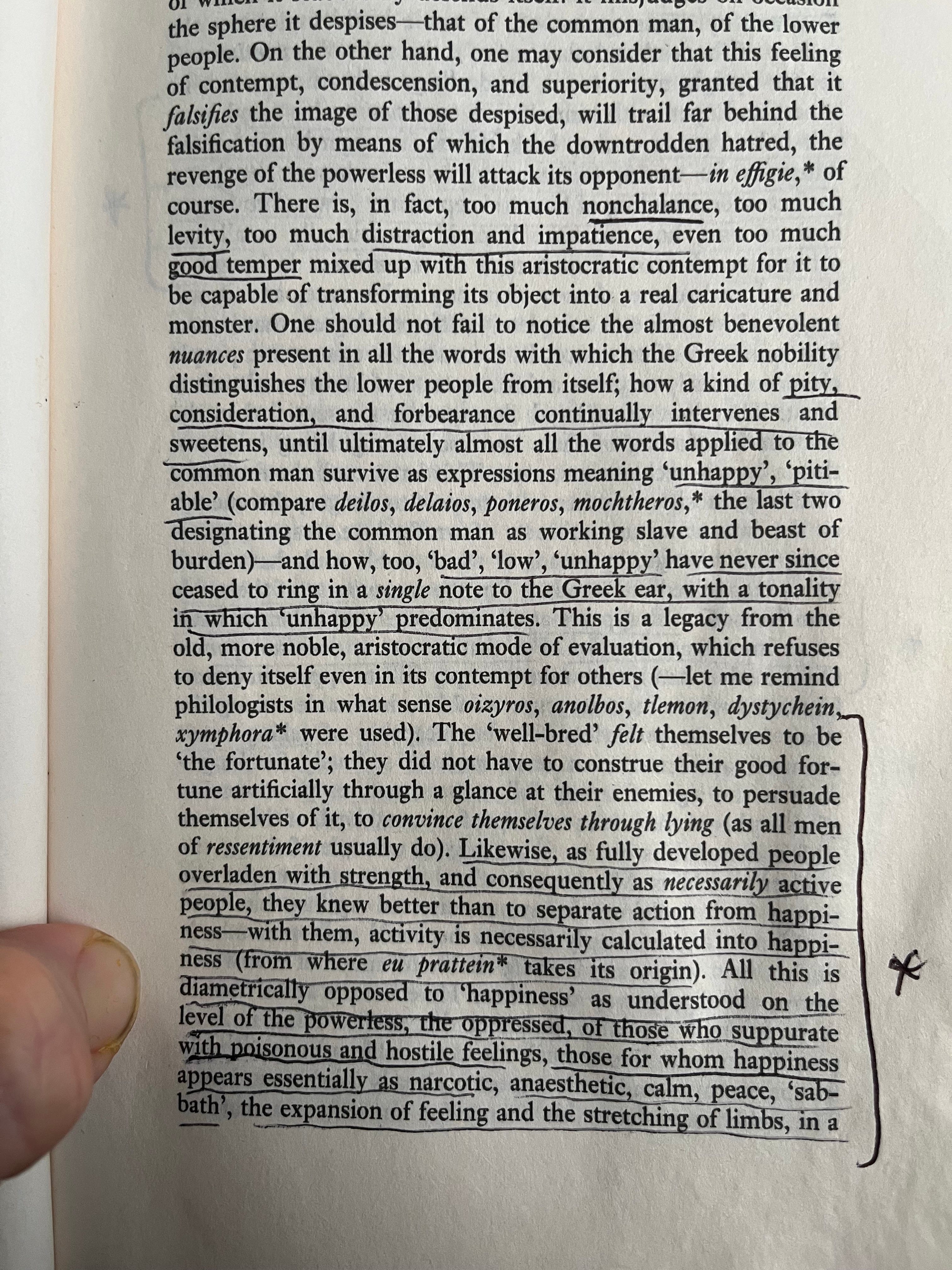
It’s also my experience of depression (In both the clinical and colloquial senses, so not just a medical problem but feeling sadness, melancholy, ruminating too much etc) almost never manifests as “acting out”, crying or emotional instability or even anger but in getting more and more passive such that from the outside, true sadness (for me) almost always looks like laziness or carelessness or lack of interest. So maybe the opposite is true, that a happy and fulfilled person is just a person who does things. All this was confirmed when I read the first essay in Neitzsche’s book The Genealogy of Morals where he is describing an idealised version of ancient nobility - “they knew better than to separate action from happiness…”:
:
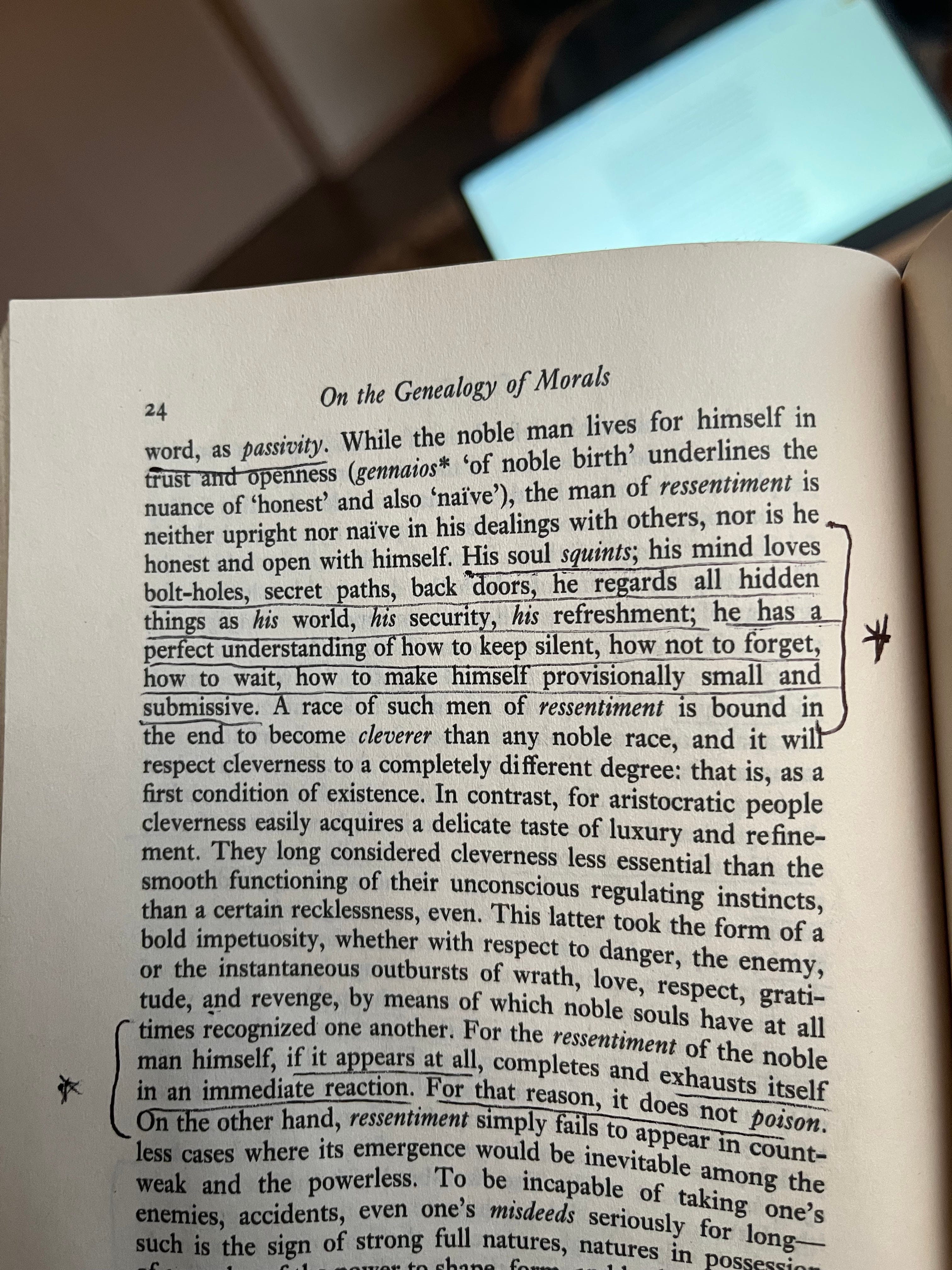
The second section marked with an asterisk is the most viciously accurate and insightful thing about passive and introverted people I’ve ever read. I suspect a lot of this is a sex difference between how men and women experience this stuff.
Conrad Kinch asks a couple “1. Are Irish people anti-Semitic or is Irish anti-zionsim so visceral that it is effectively a distinction without a difference? 2. What is a topic you never write about and why? 3. Who is a fiction author who has published a book in the 20th century you would recommend? 4. Is there any hope for conservatives in Irish life in the 21st century?”
The answer to 2 is 1… there are a couple of other issues including Neutrality, Trans stuff, and some Northern Irish politics that I’ve decided not to write about or have written about less over time because they are a combination of - a) not interesting from a philosophical point of view, b) requiring some expertise I don’t have, and most especially c) because the people who are interested in the topic (not you Conrad) are so animated about it that once you break that seal you won’t be permitted to talk about anything else and will hounded and hounded for answers, explanations, details, what about this or that example, “but don’t you think that…” in an attempt to badger you out of your opinions, until the end of time. From a general standpoint there are certain topics you should only get involved in if you’re prepared to talk about nothing else. Anything related to Israel/ Palestine is the archetypal example of that problem in my experience.
To answer your question quickly I definitely don’t think Irish people are anti-semitic. Certainly when someone like Graham Linehan describes Ireland as an anti-semitic shithole I don’t know what the fuck he’s talking about - my friends and family aren’t like that, are his? I know people who would say “god that’s so awful” when they see a hospital being bombed on TV and would go to the odd protest on that basis, which seems to me to be a perfectly explicable thing to do and almost all pro-Palestinian activism I’ve witnessed in the people around me (as opposed to on TV or on twitter) fits into this category. I don’t believe I’ve ever heard a single member of my family use the word “jews” in my entire life. So based on what I’ve experienced in my actual life I can’t make blanket statements about anti-semitism in Ireland.
I do think that there is a kind of epidemic of loose, self-indulgent moral grandstanding going amongst a certain type of loud and ubiquitous activist psychopaths we have a lot of in Ireland. One curious local wrinkle is that this cohort’s behaviour seems to be amplified rather than dampened by the fact that we have no skin in the game, because for some people the entire conflict then becomes solely open stage to morally peacock around on, in a way I find unbelievably gross and monotonous. I think it’s important that we know that attitude is not limited to Israel/ Palestine - people seem to have forgotten how frothing the reaction against Russia was in Ireland at the start of the Ukraine invasion for example.
On fiction recommendations I’m going to make two because I happen to know the questioner’s taste. For you I would suggest Robertson Davies who is a Canadian author who worked between the 1950s to 1990s. He wrote multiple interlocking trilogies of books, the best one being the Deptford Trilogy. In that one a boy throws a stone at a pregnant woman causing her to go into premature labour and the three books detail the strange, rippling effects of that act. His books are a kind of small town/ university-set Canadian magic realism, although not as flighty as that would suggest… he was an academic and writer of ghost stories a bit like MR James, so while there is a supernatural layer to all his books it’s very light and allusive. An added factor which makes them interesting, that he wouldn’t have known at the time, is that they portray a heavily anglo version of Canada that existed until at least the early nineties and that now seems to have all but disappeared, which gives the books an additional elegiac, melancholy quality.
Davies’ wikipedia page is here - he’s an interesting figure in his own right. Here’s a link to the first book in the Deptford trilogy, Fifth Business.
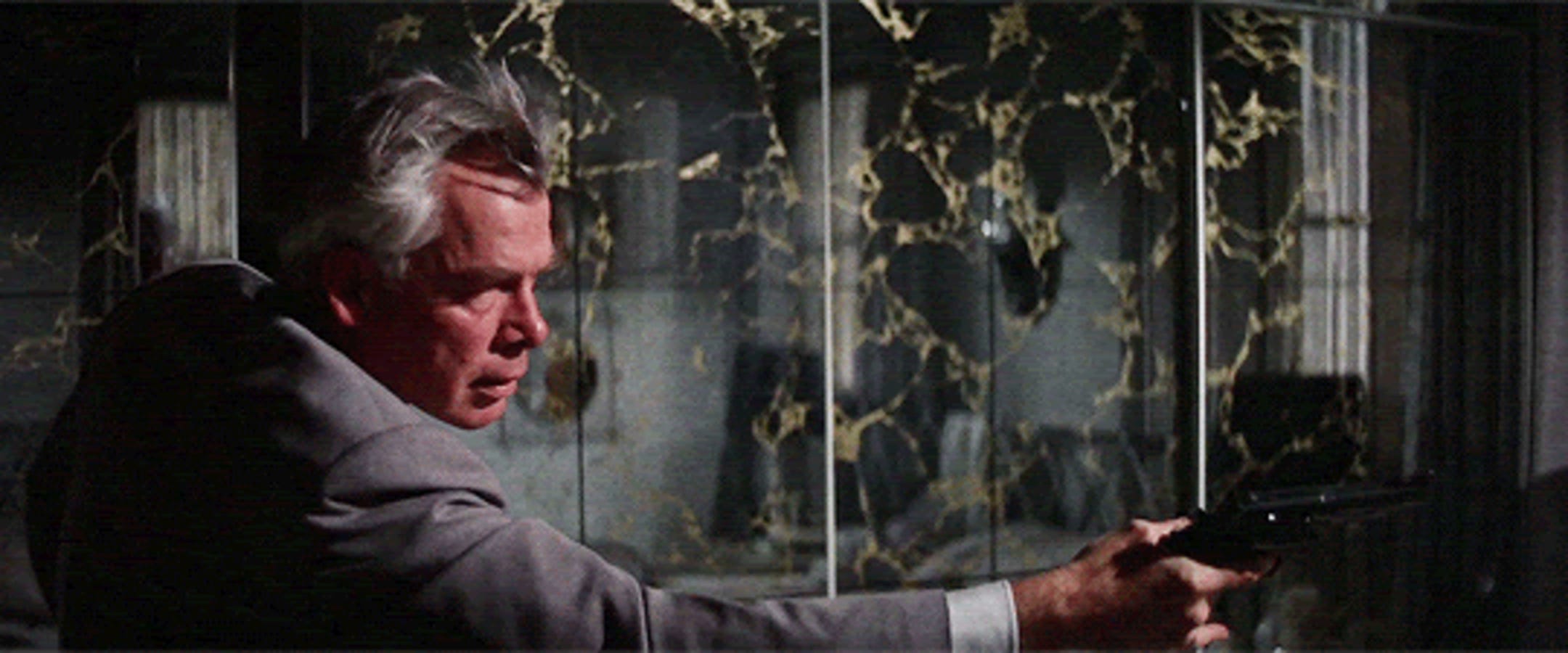
For anyone else my standard answer to this question is the novels Donald E Westlake wrote under the pen name Richard Stark during the 1960s, beginning with The Hunter (adapted in film as the 1967 classic Point Blank) and ending with Butcher’s Moon in 1974. The books are sui generis hard-boiled procedural crime thrillers told from the perspective of a workaholic criminal (basically Robert DeNiro’s character in heat). They’re jet black and ice cold, all very short except for the last one so you could read them in a sitting. The best one is The Jugger, from 1965. Something happens in that book that is so bracingly nasty that when you read it you’ll have to pause for a minute repeating to yourself “fucking hell. I can’t believe he did that,” a couple of times before proceeding. I wish Westlake/ Stark wrote a thousand of them because I’d be reading one right now instead of writing this.
Conservatism does have a future since the desire for stability and continuity is a natural human impulse. The difficulty for anyone of that mindset, is that we’re currently in the midst of a historic pendulum swing back in the other direction so you’re naturally going to have to be on the back foot for a while (which might mean the rest of your life). Sorry.
Thanks for the questions! I thought a Q&A would be a cushy number and it definitley wasn’t. I’m experimenting with formats a bit this year so whether I do it again depends on how these repsonses go down.
Oh boy, Neitzsche’s description of the man of ressentiment hits way too close to home for me. Got some soul searching to do.
Thanks Conor, I appreciate the response.