
I’ve said in the past that one of the things AI is good at and useful for is summarising received opinion with all blindspots and contradictions intact, and then reciting them with total sincerity and lack of awareness so the reader can see them clearly. I got a great demonstration of that recently when, prompted by a Substack by Clare Ashcraft entitled “The Hidden Emotional Labor of Masculinity” I asked AI to describe the positive and negative aspects of how men and women typically manage their emotions - results below.
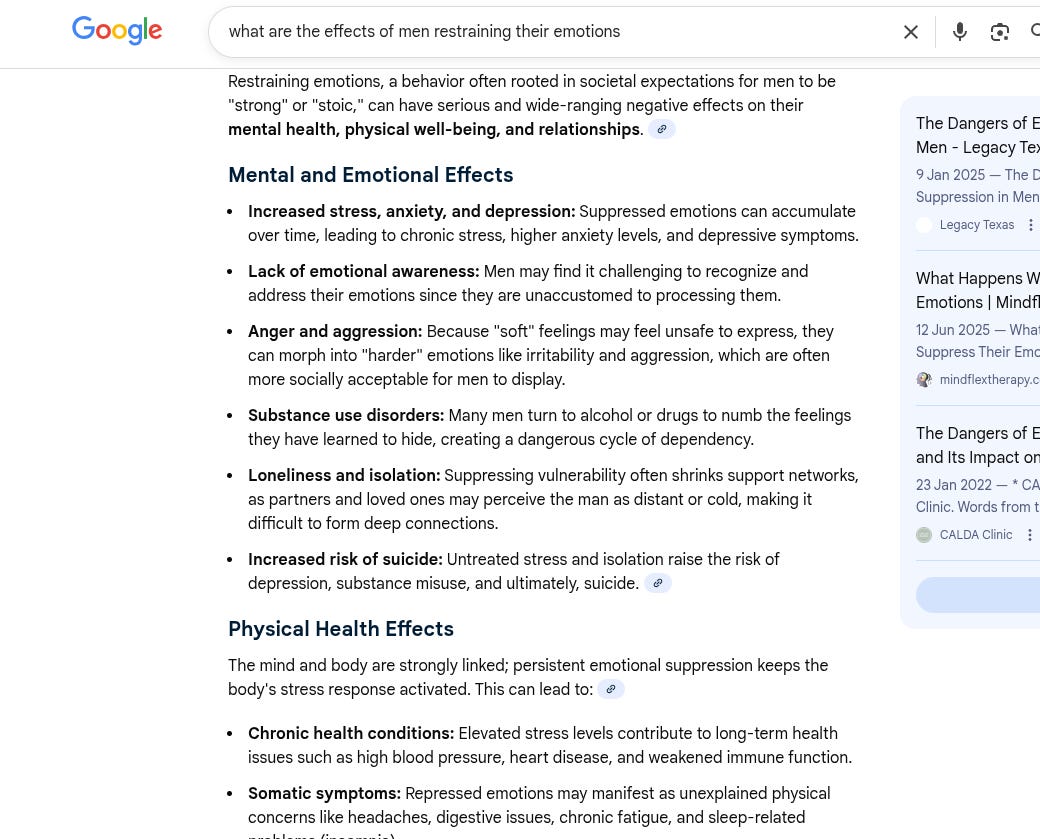
What are the effects of men restraining their emotions
What are the effects of women expressing their emotions
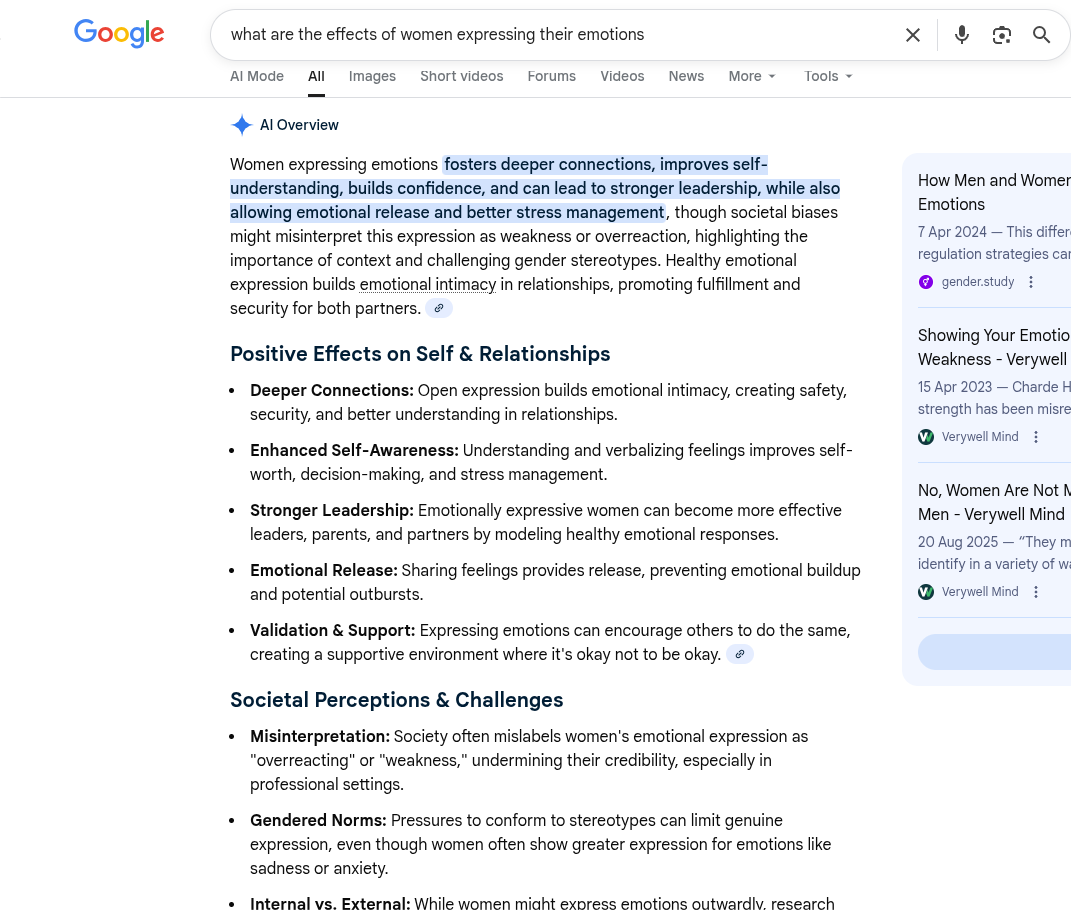
Reading that puts me in mind of the scene in Malcolm X where Denzel Washington reads the dictionary definitions of black and white. Amongst men, emotional restraint is “…a behavior often rooted in societal expectations for men to be “strong” or “stoic,” (that) can have serious and wide-ranging negative effects on their mental health, physical well-being, and relationships…” whereas on the other hand “… women expressing emotions fosters deeper connections, improves self-understanding, builds confidence, and can lead to stronger leadership, while also allowing emotional release and better stress management.”
I think this does reflect an essential bias in how we understand the relative merits of expressing versus controlling emotions, and it has some interesting implications.
The first is that even AI, if pressed, would admit that there is an element to emotional expression that is not socially determined. That makes these statements a biological judgement as well as a practical one. If women’s average tendency is to be more expressive of their emotional state, our society’s perspective is not just that that’s a good approach but that on the emotional level women are simply better than men.
The other is that while the AI summary admits that an emotional style that prioritises empathy and expressiveness at all costs has its drawbacks, it admits to those drawbacks in the usual backhanded fashion. If ever-more intense emotional disclosure is bad, that’s because it’s “too perfect”; empaths are too wonderful, too admirable, and get pigeonholed as the people who can feel everything for everyone. This perception of male/ female emotional styles falls into a pattern we see when analysing political inclinations. Right-wing/ conservative/ restrictionist or just not maximally liberal approaches are bad because they’re wrong and nasty, whereas when maximally liberal/ progressive approaches are bad because they are applied insufficiently, or are too enlightened and kind for their own good, and place too heavy an emotional burden on the people who advance them. These are the kind of results you get when you mark your own homework.
One of the frame-fixing tricks for seeing men’s emotional preferences as maladaptive and morally low rent is that the idea of “Emotional Labour”, which the OED defines as “the mental activity required to manage or perform the routine tasks necessary for maintaining relationships and ensuring smooth running of a household or process, typically regarded as an unappreciated or unacknowledged burden borne disproportionately by women.”
In recent times the definition of Emotional Labour has metastasized into the related concepts of hetero-pessimism (“widespread cultural attitude of despair, irony, or disappointment regarding heterosexual relationships, particularly among women”) and Mankeeping, which dial up the moral contempt and opprobrium implicit in the original idea. The latter was defined in the New York Times, and:
… describes the work women do to meet the social and emotional needs of the men in their lives, from supporting their partners through daily challenges and inner turmoil, to encouraging them to meet up with their friends.
“What I have been seeing in my research is how women have been asked or expected to take on more work to be a central — if not the central — piece of a man’s social support system,” Dr. Ferrara said, taking care to note that the dynamic isn’t experienced by all couples.
… Many of the institutions and spaces where men used to organically make friends have eroded, he said, like houses of worship, civic groups and even the simple workplace.
“Men used to be able to put themselves in these institutional settings and it kind of happened around them,” he added. “That’s just not happening so much anymore. Men do have to do more, be more assertive. I’m finding that even in my own life.”
These ideas are reflective of a moral framework that sees expressiveness as the only type of emotional management that is helpful and worth doing, and a tendency to restrain emotions as contemptible, stupid and morally inscrutable. My mind naturally leaps to all the times that I have benefitted from men managing their emotions.
About 25 years ago, I had started working a full time job but was still living at home. One morning I noticed that people were looking strangely at me at the kitchen table as I spoke. Was it something I said? It turned out that one side of my face had collapsed and was immobile. I felt fine; my mother was very upset and worried and was having trouble not showing it. After a lot of conversation we decided going to the doctor immediately was the best thing (I can’t remember what day or time this was but I recall it was more inconvenient than usual). What I really remember was my father saying “you want to go to the doc? Ok let’s go to the doc”, and then casually strolling out to the car with me to go to A&E. My dad never calls the doctor “the doc” and was affecting a calm, still air as a counterpoint to my mother’s expressiveness and because he understood what was needed at that point was to turn the temperature down and not up. At the doctor it turned out I had Bell’s Palsy (temporary cases of which are not uncommon after a cold, and I was recovering from one). I got some steroids (I think?) and was back to normal a couple of days later.
The point is that my dad was scared, and I’m sure any loving parent would be when they see their offspring behaving strangely and suffering from what probably looked like a stroke. He made an active choice not to display it, to in fact suppress it and display the opposite of fear for the benefit of the impacted person and everyone else around. That’s not a nice feeling - to be scared and to not only not show that you are scared, but show that you are feeling not-scared. This was probably the millionth occasion in my life where a responsible adult man gathered up the scraps of other people’s fear and held them inside himself to the benefit of others, and to his own possible detriment. It’s important to note that part of this role is that you can’t later say “I was actually really scared”- you have to brush it off if someone brings it up, and can’t claim credit for it. What is that if not emotional labour?
While in advertising and in the short form video content that pollutes the internet we enjoy categorising men as shallow, stupid and simple, our culture does implicitly understand there is something worthwhile to a more typically male approach. I think it’s notable that the male figures we see in film and TV as the most admirable and worthy of imitation, and who are the hottest, (including those made for a primarily female audience) are the taciturn and powerful ones, rather than the guys who burst out crying every ten minutes. Research, such as the Czech paper described in this report, shows that men’s relative emotional stability is one of the things that women envy the most about them. Findings like these insults our sense that in the realm of emotions women are biologically superior to men, so you will note in the report that the finding has to be positioned as a symptom of male privilege rather than a simple positive difference in men’s favour. I wonder how much of the “men will do x instead of go to therapy”- style antagonism toward men on social media is just an expression of an unconscious, frustrated envy.
But that side steps the question of whether Emotional Labour and connected ideas that privilege emotionality as superior are even valid most of the time. The lie at the heart of these concepts is that most people’s emotional choices are based on their innate preferences and not because of what it will do for the people around them. Leaving concrete issues like child care aside, a great deal of the Emotional Labour people endure is self-created for their own benefit and is only justified as being other-oriented after the fact. That’s as true of emotional restraint as it is of expressiveness. When we describe a positive version of men’s emotional style we often categorise it as Stoicism. But in most cases it is really just a natural outlook of people who do not enjoy experiencing strong emotions coupled with an un-philosophical desire to feel and be in control of oneself and one’s actions.
The male/female difference is the easiest way to understand these issues and factor in their increased salience, but one can overstate it. There are a couple of explanations for how we got to the point where expression is not just privileged over restraint but where restraint is seen as a bad thing. Technology is the big one; in a heavily mediated world, social status is naturally based on your willingness to perform your inner life, and use that to position yourself worthy of sympathy and attention. Failure to do so puts you at a social disadvantage.
It’s also politically suspect. Emotional restraint and a desire for privacy aren’t the same thing but they are overlapping. Demanding emotional performance inevitably entails a demand that you expose parts of yourself you would rather keep private. That creates an underlying tension with the idea of freedom of speech, since it entails a social expectation you say things you might not believe and you suppress the things you would like to say which might otherwise get you in trouble. A world that rewards extravagant claims of Emotional Labour, empathy and so on will always be one that is comfortable policing speech that falls in the gray zone between public and private; come out here and expose yourself, expose your feelings so that I can punish you for them, and use my own to browbeat you into the correct position.
To the extent that there is a sex difference element to how we understand the value of emotional restraint, it’s easy to take a false short-term view and forget that technology isn’t the only thing that’s changing. The difference between my emotional life and that of my father is probably greater than that between my sister and our mother. Men have happily aligned themselves to what were previously considered feminine social norms around expressing their feelings. But that only shows that if there is a residual male resistance to or discomfort with a societal demand for increased emotional expressiveness, it’s likely there’s something innate at play that won’t go away. I don’t accept the frame of “Emotional Labour”, but it would probably be better to include male preferences as valid within that, than to continue to embrace a different frame that sees men as innately inadequate, and women as saintly emotional virtuosos.
Articles on similar subjects:
The Manosphere as a Monument to Progressive Cultural Power

A confession: I don’t like Louis Theroux’s work. That’s not because it’s always bad (although his new Netflix documentary “Inside the Manopshere” is tired stuff, working over ground that’s been farmed to the point of infertility by other commentators and by Louis himself) but because his stock in trade is embarrassment - the awkward pause, the lingering…
The “Mediocre Man” as Online Hate Figure

As the empowerment of women has progressed, the sexes are directly competing for the same cultural space in a way they never did in the past. In some parts of respectable and popular culture - pop music, progressive politics, fiction - women have made stunning in-roads, with men seemingly reduced to out-group status. The change has happened so suddenly that our cognitive biases about men and women lag far behind. Women in the 1st world are powerful and agentic yet we still venerate ideas that originate from, and were legitimised by, their status as a marginal and powerless group. These include innate female moral superiority, toleration of a far greater in-group preference amongst women, and the sense that men and their preferences must always be a determining factor in an individual woman’s success. Hand in hand with this is our continued belief in the disposability of men, which has evolved but not disappeared, despite the decline in men’s cultural power and their changed roles in everyday life. Online, all of these factors collide to produce the ubiquitous hate figure of the Mediocre Man. I want to write about why this figure became such a common reference point, and the lack of inquisitiveness of men’s inner lives that powers the meme.
Why Is Nick Fuentes Popular With Young Men?

In the past few months Nick Fuentes has appeared on a number of the largest right-leaning podcasts and online shows in America; since August alone he’s been interviewed by Patrick Bet David, Dave Smith and Sam Hyde, each of which garnered multiple million views/ listens. What Fuentes calls his
The real emotional labour is me having to listen to you talk about Debbie's problems while I try to load up the PS5.