
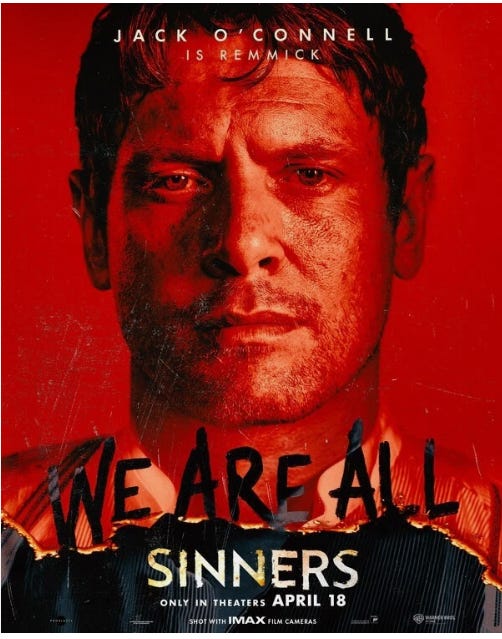
What with it being December, People are composing their “best of” lists of movies for the year, and on many of them Sinners will be close to the top. The action-horror movie about vampires in the early 1930s deep south caused a big splash on release; for maybe the first time since Oppenheimer, here was a big hit that wasn’t a sequel, a remake, or a comic book movie. It also helped it had a majority black cast, leaned heavily on the black american experience, and touched on fashionable themes about white supremacy, colonialism, and race. Its success seemed at last to indicate there’s still a popular appetite for entertaining movies full of ideas, in particular progressive liberal ones cherished by media commentators.
Part of its success also hinged on the unexpected way it touched on Irishness and Irish culture, thus surfing a rising tide of Irish cultural cool, as represented by Paul Mescal, Kneecap, the activities of Diageo’s (almost certainly London-based) marketing department, and so on. There’s a plot summary here; but basically the main villain is revealed in the course of the movie to be Irish, turned undead around the arrival of Christianity in his home country. His driving impulse is to recreate the world lost to him through time and oppression. This character, Remmick, is an outsider in the world of the Jim Crow south and is portrayed as unprejudiced in comparison to other white characters. He states (with at least a little sincerity) that part of his goal in making vampires is equality. Throughout the movie he converts the characters to vampirism and in doing so makes them part of a vacant, post-racial hive-mind. This creates an unexpected tension that allows the film to touch on the similarities of Irish and Black American culture, which forms one of the main themes of the movie.
The impact of music in different communities and the purpose of musicians in preserving an authentic and spiritually nourishing culture that links a people directly with their ancestry is the beating heart of the film. In particular it advances the perspective that white people have a parasitic relationship with black culture, formed in order to address their own deracination, materialism, lack of authenticity, and the spiritual thinness of what passes for their own culture. This is expressed through a pair of matching scenes at the centre of the film. In one, young bluesman Sammie begins singing in a juke joint and in doing so conjures visions of black musicians throughout time, from shamanic african dancers to hip hop DJs. This is contrasted with a scene where the lead vampire inspires the rest of his cult in a gigantic, frenzied dance-rendition of the 19th Century Irish traditional song “The Rocky Road to Dublin”, about an Irishman forced by economic circumstance to leave his home and travel to England, and the difficulties he encounters on the way.
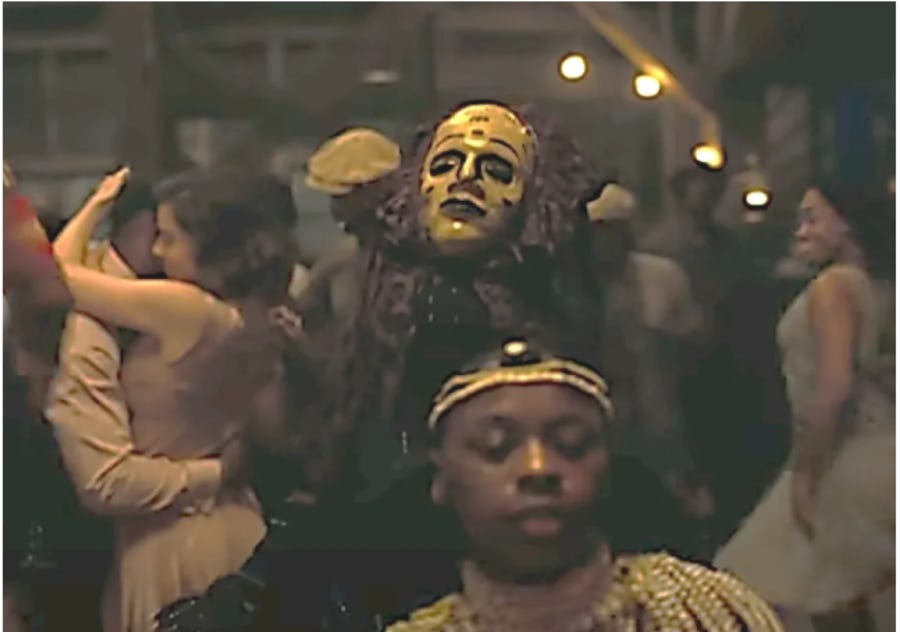
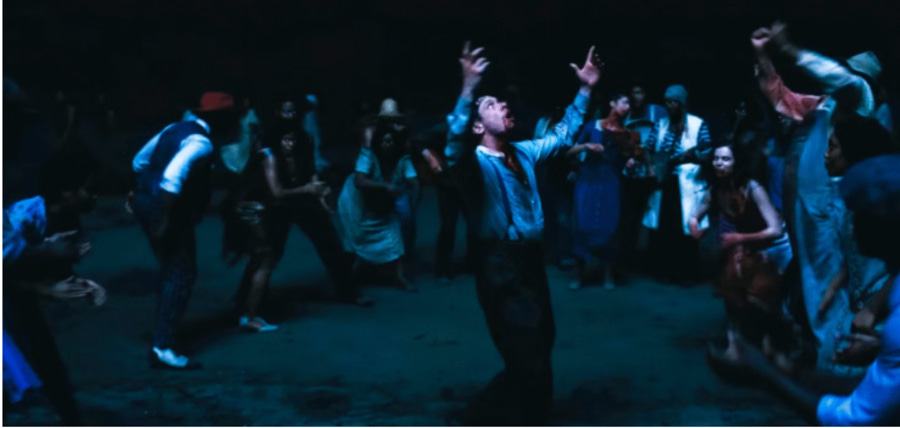
Sinners was made by someone with a genuine affection for Irish culture and music. Ryan Coogler, who wrote and directed, has spoken eloquently about it. Unfortunately for an Irish person, the central point of the movie is not to explore, understand or sympathise with the Irish experience but to use it as a mirror to create a flattering image of the black experience, and to attack what it sees as the infecting poison of whiteness - of which Irish people (being western europeans) are unavoidably carriers. As such, however sincerely well-meaning its identification with Irish culture is, it is also representative of the tokenisation of the Irish experience in the discourse generally; the way that events in Ireland and Irish history, as just another piece of rhetorical ammunition to be fired as a shot in someone else’s war.
In the context of the movie, Irishness is asked to do a few contradictory things at once. It stands in for both the oppressed white, and the white person as oppressor. Remmick needs to be representative of someone with a specific experience of cultural dispossession, but also a general symbol of white/ western european people who may not have had such an experience.
The film-makers would see no contradiction here, and would I’m sure say that a key theme of the movie is the way that the slave can become the slave-master over time, and perpetrate against others the crimes that were done to him. This is Remmick’s tale, and his journey has left him with a parasitic need for authenticity and connection that can only be fulfilled by stealing from a “realer” culture, killing it, and wearing it as a skin suit. “I want your stories, and I want your songs, and you gon’ have mine,” Remmick tells guitarist Sammie: that is his real goal. But who does he speak for here, in symbolic terms - himself? Irish people? White americans? because those are all totally different groups with conflicting experiences.
This is the point in the movie where analogy breaks down; Remmick is asked to stand in for the concept of rapacious whiteness, of people whose cultural and spiritual emptiness (from the movie’s point of view) requires them to harvest the cultural souls of black folk. But the fact is that Irish people have maintained a connection to their culture and their distinctiveness, under an almost unimaginable multi-century campaign against it that was both formal and informal. The problem here is not the story of Irish dispossession and its effects but the implied negative comparison with the black experience. The perspective of the movie is that of respectable culture generally, which is that black Americans and their culture are almost by definition deeper, and more real and more authentic than any white equivalent. In the Irish case at least this is obviously and outrageously narcissistic and false, and it’s worth asking why anyone would believe it.
We say that “politics is downstream culture”; it’s also true that “global politics and culture are downstream of American politics and culture”. The hot core of American culture is established and maintained by high status progressive liberals. The centre of their life, philosophically, is a fixation on the black American experience in the 20th century, and a determination to see all things as fitting the pattern of that experience - and to make things fit that pattern where they don’t do so naturally. Because of the ubiquity and influence of American popular culture and politics, this then filters down to culture globally, and in time people in other countries hear it enough that they start to believe it too. The historic experience between all ethnic groups becomes a function of the American progressive psychodrama of white guilt over black cultural dispossession, their sense of moral inferiority in the face of black people, their envy of them as more authentic and perfect victims in a culture that regards victimhood is a moral resource. Everyone else’s experience must be subordinate to this one. It doesn’t matter what the negative impact on other cultures is of forcing them to fit the procrustean bed of American progressive neuroses on the topic of black/white race-relations.
Sinners was made by a black progressive rather than a white one, but the framework remains the same. I don’t think we can be certain that Coogler’s affection for Irish culture and nuanced views on it filtered down to the audience who saw it. This TikTok video, in which a viewer describes her perspective on the meaning of the movies themes, didn’t get a massive amount of views but was the best summary I could find of how most non-Irish people interpret the film - both literally and in terms of the tone of the observations:
… these white vampires didn’t just want what Sammie had out of pure evil… they wanted what Sammie had which was the power to conjure ancestors through music and sound and his voice they wanted the same thing to connect to their ancestors and no matter how hard they try to sing and do a little riverdance, do a little jig…There are a lot of things that black people have that is just innately ancestrally ours right. Whether that is food, music, the way that we dress… all these things are very unique and special and specific to black people… there are other groups of non-black people who so desperately try to replicate all those things that we have for ourselves right. We all know what people try to snatch from our culture right and no matter how many times they try to do it, no matter how many times they try to rebrand it, they still don’t have it the way that we have it… No matter how hard they try they still couldn’t have what we had… the magic that we hold within our bodies, our bones, within our lineages is something that other people simply do not have and cannot touch…
(Emphasis is mine.) The movie does not make these uncomplimentary points about Irish people directly. But the main villain is Irish; the loss of his traditional culture drives his desire to catch Sammie and harvest his music making ability. This serves the larger point, that both viewers and the makers of the movies have noted, that this is analogous to the relationship between white and non-white people. That necessarily includes Irish people and their history, which then become supporting characters in making this philosophical point about the inherent superiority of black cultural experience versus that of the white. The TikToker’s implicit contempt for Irish culture - she would never describe black people as “doing a little jig, a little riverdance” - is not found in the movie but is a logical conclusion of its themes. The movie does believe that there is something “within the bones of and lineages” of black people that as a white (Irish) people you “do not have and cannot touch”. It does believe that the power to “conjure anscetors” through music is “unique and special to black people”.
The film speaks to the position of Irish people in the americanised hierarchy of cultural authenticity. Irishness can succeed to some degree in this hierarchy because some parts of our national struggle and quest to maintain uniqueness can be placed in the sacred black/ white framework. But lots of our story can’t be positioned in that way, and happened outside that framework, and are therefore nonsensical and sinister to the people who love that way of looking at the world. The movie reflects this - it can take a benign stance about Irish people and history but only as it instrumentalises that Irish experience, and only as long as we implicitly regard the Irish experience as inferior in authenticity to the black one. I think it’s interesting that Sinners makes an instrument of Irish culture and history in a manner that would be deeply frowned upon if it happened in the other direction, but without any awareness that it’s doing it, or guilt for having done so.
An obvious objection to all of the above is that Coogler is simply trying to tell a story about black america; can’t Irish people just make their own movies and tv shows and so on, where they are the heroes, and that centre their experiences? Why not just do that, instead of complaining about others using your history which is inevitable and forgivable in a globalised culture?
This is where we get into small country problems that I wouldn’t expect an American (even one used to seeing himself as marginalised and denigrated) to understand. In terms of movies at least, Irish people can’t tell their own story because we aren’t a big enough country to make a lot of them; the ones we do make will rarely be big enough to be seen outside Ireland, and when they are they will still be asked to fit inside a more powerful, “louder” american culture. Sinners cost about $90 million to make, and was considered something of a plucky outsider when it succeeded. Imagine a movie of equivalent budget, made by Irish people and which dealt with equivalent Irish themes from an Irish perspective! Sadly you can only imagine it, as such a film has never existed and probably never will. In film and TV as in so many other things, Irish people have to tell their stories and achieve success through their part in the work of others, like tenant farmers on the global cultural landlord’s estate. The problem is certainly not unique to Ireland.
The compromise you have to live with, in order to see your story told at all, is the distortion of it to serve the political priorities (and complexes) of those other places. That life as the little guy - you are pictured in the background rather than the foreground, and have to squint to recognise yourself, and maybe have to sometimes convince yourself that this smudge of a representation will suffice as a full portrait. You have to live with the fact that such portraits do not show you as you see yourself, including that they show you as a bit player in someone else’s story rather than the star of your own. This would be difficult enough if it wasn’t also the case that this process also shapes our perception of ourselves, our sense of our own story and our place in history. The mirror of popular culture shows you who you are but also tells you what you should look like, and you begin to shape yourself to fit what the mirror suggests is your proper reflection.
This is why films that focus on Irish history and Irish people from a native Irish point of view can become legendary and celebrated in Ireland even as they are forgotten elsewhere - because it’s so rare, and these seem like victories against the tide of history. Black 47 and The Field are good examples; so too, for all its manifold faults, is The Wind the Shakes the Barley. They are popular because it is so rare to see something that presumes a level of personal identification with and knowledge of Ireland and its history in all it’s uniqueness, all it’s awkwardness - all the ways that it cannot be primarily used as analogy for the struggles and political obsessions of other people (that’s what The Wind That Shakes The Barley did).
Mise Éire, a 1959 documentary on the revolutionary period in Ireland is a great example of how Irish identity can become problem when it fits uncomfortably with a globalised progressive culture. This is an Irish-language documentary compiled using exclusively archival newsreel footage from the late 19th century to the 1916 Easter Rising and its aftermath, with a famous orchestral score by Irish composer Seán Ó Riada. It hit the headlines recently when right wing groups began organising festivals around screenings throughout the country; these in turn were protested and shut down (Kneecap contributed to some showings being called off, the irony of which was noted by many). The adoption of the documentary by the right is part of what caused Irish progressives to react to the film like a Victorian matron confronted with a flasher, but it’s not the only reason. It speaks to specific events in our history, but without framing them first as part of universalist, egalitarian struggle. In the progressive frame there will always be something about that which is not just wrong but sort of obscene and unseemly. So much more reassuring to watch the take on Irish history in Sinners, where we are allowed to play a part in the respectable “true” history of our time - the American progressive liberal story - albeit only as half-villains; at least we get to be on the big stage. (The full Mise Éire documentary is on Youtube and is linked below.)
I suppose I should probably say that I did actually like Sinners; it’s a good, fun movie that at least has some thematic meat on its bones. If you sense that the bulk of my complaints here can be boiled down to - ok - but where’s our Sinners? - you’d be right, and the fact that such movies don’t exist is not the benign and thoughtful Coogler’s fault. As an Irish person it’s nice to see some element of your story played back at you, when you are not used to seeing it, and when it’s difficult to tell those stories in that medium yourself - I am grateful he did that. Certainly it’s wonderful to see some non-Irish people appreciating the greatness of traditional Irish music. But the fixation of progressive liberals on the black story, and the determination to make that a moral template through which all people in all countries understand themselves has particular relevance for a small western european country like Ireland. In the American scheme, we’re white, so we ultimately can’t be the good guys. Our story has some rough edges that don’t fit the template, and they will always need to be broken off and smoothed down so that story can be sold back to us as a product.
The lesson of Sinners is that there is always going to be someone from a more powerful place with a louder megaphone than you, who wants to puts your story to use; since your story needs to be heard, and your resources to do that yourself are limited, you’ll need to manage that problem. That requires aggressively gatekeeping ownership of our history and taking care not to amplify the views of people who don’t know anything about us, are seeking to make an instrument of our heritage. It is especially important to recognise that in many cases where people agree or sympathise with you it is only that your interests are temporarily aligned. It is sometimes profitable to lift Irish people out of the oppressor column and hold us over the oppressed one for point of comparison but in the end we will have to be put in their place. So we need to be wary of these arrangements because the tide can go out on that situation very suddenly, and leave you stranded.
An analogy does not have to be accurate at all points and in every way, and analogies collapse at some point if forced to become too literal. There’s no reason Coogler, or his domestic audience of mostly mixed-race Americans should care that the movie positions Irishness in a way that is not flattering to Irish people - after all, the whole point is to tell a story about them, not us. But of course it matters a great deal to an Irish person that our story is told in a way that reflects our own particular circumstances, and concerns that may not have resonance or relevance elsewhere; how we feel about ourselves, and that we are the centre of our own universe and the heroes of our own story, not ambiguous supporting characters in someone else’s.
I watched this film, although I have zombie/vampire fatigue. I was slightly encouraged that it was a rare, big budget 'original' story rather than a sequel/remake/comic book adaptation. But it was basically a reboot of From Dusk Till Dawn.
I suppose the 'power of music' was a different theme, but it wasn't much of a factor in the heroes vs vampires battle, which was like so many we've seen before.
16 Oscar nominations for this seems absurd, but I can imagine how bad the other films are.
At a minimum people from a core group that can read at least above an 8th grade level. Have at least high school level math skills. Be able to draft a coherent essay. And exhibit critical thinking skills sufficient to score above a 70% level at various objective tests….i.e. SAT exams. You can decide who that criteria includes and more importantly excludes. Such data exists. Whether we’re allowed to speak about the results or not.