
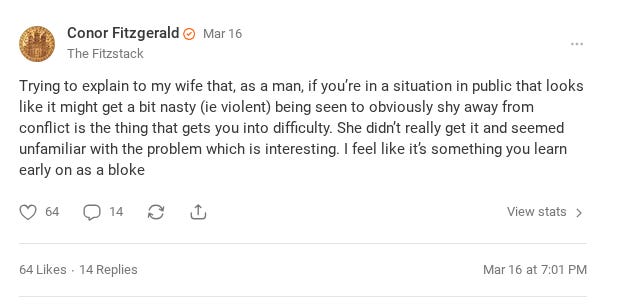
I posted the note above a couple of weeks ago: what happened was, my wife and I had walked to a local shopping centre for some reason - can’t remember. This was at about 8 at night, the schools were out at the time so there were rowdy kids everywhere, attracted by the McDonalds and the cinema and the unsupervised open spaces on which to perform.
As we got close, there was one group of boys blocking the steps up to the only entrance. 10-15 boys, ranging in age from 12 to maybe 16, tracksuits, shouting, vaping etc. They were being what an English person would call “lairy”, standing in a knot in front of the steps, pushing, pulling and dragging each other, shouting at each other over the heads of people coming up the steps, putting one another in headlocks etc.
This was the only access point at this edge of the shopping centre, and without being direct about it they were stopping people from getting up the steps, by suddenly pushing one another into the path of pedestrians, stumbling backwards into them half on purpose, running around in a way that caused people to have to suddenly pause or shift course to avoid a collision, or get into an argument by physically shove one of these kids out of the way. So it wasn’t threatening behaviour but it also wasn’t non-threatening strictly speaking, because they were behaving in such a way that is guaranteed to provoke a conflict or an altercation, and (in my opinion) you could see as you got closer - too late to do anything about it - they were looking to do that. They knew exactly what they were doing, everyone did, because we’ve all despaired of that behaviour but also because we’ve all behaved like that as kids or teenagers.
I was walking slightly ahead of my wife and I was unconsciously thinking, as normal - I’m going up these steps and they’ll just have to move out of the way. I started walking up the steps just as two of them started swinging off each other directly into my path. I gently (maybe not so gently) elbowed them out of the way as they backed into me, and I probably also said “here” or “watch it lads” or “careful there” as I passed.
As we got to the top of the steps and away from the crowd she said to me in a slightly scandalised way “did you shove that kid out of the way?” I explained to her from my perspective that I was coming through as normal and wasn’t going to walk around or get out of the way of someone who saw me approach and was intentionally creating a nuisance in part for the enjoyment of doing that but also in some small part to provoke a confrontation.
This was an innocuous and forgettable incident and I would have left it aside totally had it been recorded as a note on Substack above. The fact that it did got me thinking of all the times in my life where I have been in a situation where someone has created the possibility of conflict, by invading personal space or being otherwise publicly obnoxious in a way that is designed to create conflict or provoke it. I’ve had this conversation with my wife a couple of times and it always interests me that we seem to be speaking a totally different moral language and contemplating a totally different decision tree when it comes to these incidents. (Her view is completely rational and reasonable.)
It’s happened on a couple of instances with homeless people in Dublin who suddenly turn aggressive, she will often note that I extricate myself from these situations at a leisurely pace rather than basically running or speed-walking away, which is what she does. My perspective is that I have been caught in those situations in the past and learned that, while you want to get yourself out of it, I also know that as a man too readily indiciating my willingness to placate an aggressor can have the effect of inflaming something predatory in them and confirming that you’re the target they had been looking for. This isn’t every time, and you have to develop a radar for it.
For clarity I’m not saying her behaviour or perception of these situations is wrong, it’s completely correct for her own circumstances. She’s a thoughful and sensitive person and never tells me my point of view is wrong, but when we first spoke about this it always came as a surprise to her. So my observation is only that the difference between how men and women understand stranger violence, or the threat of it, and the calculus they go through in reacting to it, is important, interesting and under-explored.
When I posted that note most people seemed to agree but there was some dissent, mainly on the theme of the necessity of avoiding conflict, the importance of taking the heat out of a situation, and de-escalation. One person noted that Rob Henderson has covered the irrational and egotistical tendency of men to escalate conflict in his description of the “Male Monkey Dance of Aggression” here. I agree with all that, and of course think it’s incumbent on people within reason to try and avoid conflict. I too have seen plenty of situations where two or more men butt heads, each of them unwilling to give up any space or concede any ground, and if one of them had only done so then a pointless ride in an ambulance/ cop car could have been avoided for one or all participants.
The difference in my mind (and perhaps I didn’t articulate this as well as I might) is what to do when a situation has already begun and you are caught in it, and/ or one party is engaging in an act of predatory victim-seeking for its own sake. This is a common (I would guess the most common) cause of male on male stranger violence. In these circumstances the type of person the aggressor is looking for is very specific. It has to be someone who could fight back and be a threat under other circumstances - so for example a woman or a child is no use; it has to be another man. But it also has to be a man who indicates through their demeanour that they are willing to be a victim of violence, who hopes that their well-signalled harmlessness provides them with a route out of conflict, and that they won’t be engaged in the unfamiliar and in it’s own way dangerous act of physically defending themselves or even just standing their ground/ not panicking.
I think being someone who was bullied or picked on at school, or is a naturally reserved or unintimidating person really helps understand the dynamic of these situations. It conditions you to understand that there are people out there who have a strong hierarchical/ predatory instinct towards weakness that manifests as public aggression and that you are the kind of person they are looking for. Of course, it also prompts you to avoid situations where violence might arise - you look down the street and see a knot of lads harassing pedestrians outside the corner shop, they haven’t noticed you yet, so you decide to turn down a side street and add 30 seconds to your journey home rather than get into it. Every woman has done that but so has every man, and it’s a rational thing to do. But every man has also been in a situation where they’ve thought to themselves - I’ve caught the eye of a predatory person who is looking for someone to show that they are willing to be a victim, and it’s too late to exit the situation easily - what do I do?
The truth is that even the neediest, lamest and most milk and water man has an outlook centred around strength, and they recognise that all other men have an outlook that functions in the same way. That’s true in both a positive and negative way. The positive side is it creates a desire for self-reliance, stoicism, usefulness, the drive to excel or to develop expertise and be admired for the strength of your skills. The negative side of it can be an instinctive and intense hatred of weakness (gentleness, meekness, shyness, ineffectuality, reticence, etc) and determination to prove yourself to others by punishing those qualities in other men. All of this creates in men an innate sense understanding of aggression, how people use it to purposely intrude into the lives of others, and what they get out of it.
This is part of something that I have noticed very frequently which is the disconnect between how badly women are worried about interpersonal violence from strangers vs how aware they are in practice of the possibility of it around them. I think it’s a universal male experience (straight men anyway) to shepherd a girlfriend or wife to the other side of a street (“actually, let’s go this way”) because you’ve spotted something or someone up ahead that presents a threat of violence, and there is still time to get out of the situation before you’re in it; and then to wonder to yourself afterwards - for a person who feels so vulnerable, how could it be that she didn’t notice that? Women are more open about being afraid of violence (for the entirely rational reason they are physically smaller) but it’s actually men who think about it constantly in practical terms and have an almost innate sixth sense, established from an early age, for when it is about to come at them.
Something that is true and important but never acknowledged is that men, particularly in their teens and twenties when they are most likely to be assaulted, are aware of and worry about the threat of violence and aggression from other men constantly; it dips in later years but never totally goes away. It’s a mental load that they carry with them at all times and that colours their worldview. You can extrapolate all kinds of political and social implications from this that help explain why men are the way they are and have the outlook they do, and why it differs from womens. Building an identity around visible vulnerability is dangerous and bad; even though you’re a good guy, a lot of people like you are malign and predatory; secure “owned” personal and psychological space is not just good and but essential. It also reinforces that people will take lee-way and sympathy given to them as a prompt to engage in the thrill of dominating or dispossessing others, and it’s therefore important to formulate your behaviour with an understanding of how it will be exploited by predatory people, and to always be on the lookout for that. I think of the well-documented “leave him alone” phenomenon and how infuriating that is.
Men have this dilemma, which is that feeling strong (whatever it means) is very important for their self-esteem but also for their personal safety which means they rationally decide not to undermine that by being too open about feelings of weakness or vulnerability. Women often use their own sense of vulnerability as a point of bonding and common interest and are more open about it. This forms part of an informational imbalance - despite what we tell each other, the result is that men have a much greater appreciation of how scared women are of public violence, and how it informs their view of the world, than women do of men. The truth is particularly between the ages of say 16-27 mens awareness of violence when they are on the street is through the roof and infects their every decision and later on how they see the world. It influences their every move, and it intrudes upon peace of mind at all times. I think it’s strange that I’ve never seen it acknowledged how much mental energy and mental space awareness of violence takes up in men’s heads during those years and how formative that experience is. If that informational imbalance is on anyone, it’s on men for not being more open but in any case has political consequences.
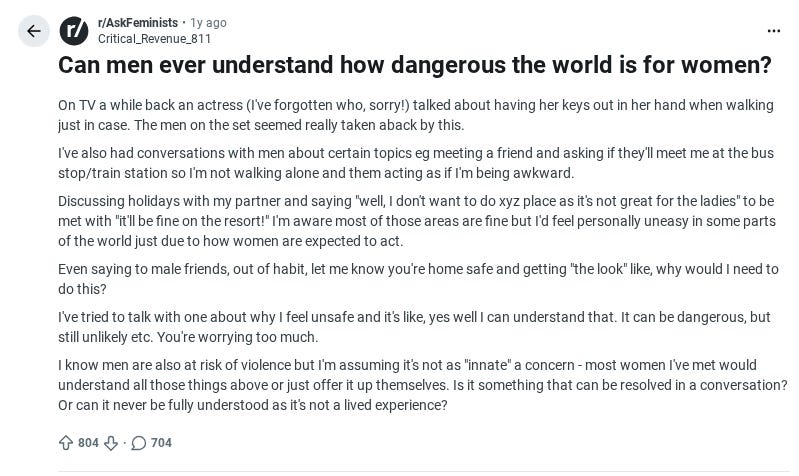
It makes complete sense that women have a different mode of threat perception from men because they are working with different circumstances and don’t have the same personal insight into men’s bullshit status games, and ego, malign intent, and sometimes negative relationship with the idea of strength. And of course as I said above men don’t tell women about the fear they have of violence from strangers (to be clear - male strangers) so why would any woman know about that. I do think that a greater understanding of the difference in how men and women think about these things would help, in particular because it allows for a greater understanding of our different moral decision-making, which after all stems from their differing capacities and blind spots, and is the driver of so much political strife.
Articles from me on similar topics
The Different Challenges of Male and Female Online Radicalisation
In April the UK’s New Statesman published an article entitled Angry Young Women, which uses new polling to
Men, Withdrawing From Work and Life

Darby Saxbe, a psychologist and Substacker, has been publishing a series on feminism and men (“Has Feminism Been Bad for Men?”), the most recent of which is here. They’re all worth reading. In this latest article she covers feminism’s impact on men in “culture, specifically education, male mental health, and misandry” and touches on this idea that men have withdrawn from certain parts of working and public life, and why that is.
The “Mediocre Man” as Online Hate Figure

As the empowerment of women has progressed, the sexes are directly competing for the same cultural space in a way they never did in the past. In some parts of respectable and popular culture - pop music, progressive politics, fiction - women have made stunning in-roads, with men seemingly reduced to out-group status. The change has happened so suddenly that our cognitive biases about men and women lag far behind. Women in the 1st world are powerful and agentic yet we still venerate ideas that originate from, and were legitimised by, their status as a marginal and powerless group. These include innate female moral superiority, toleration of a far greater in-group preference amongst women, and the sense that men and their preferences must always be a determining factor in an individual woman’s success. Hand in hand with this is our continued belief in the disposability of men, which has evolved but not disappeared, despite the decline in men’s cultural power and their changed roles in everyday life. Online, all of these factors collide to produce the ubiquitous hate figure of the Mediocre Man. I want to write about why this figure became such a common reference point, and the lack of inquisitiveness of men’s inner lives that powers the meme.
Before reading this I'd assumed my twitchiness around men who might beat me up was just due to me being a pussy. No doubt this is still part of it, but good to know that every man suffers the same
Totally recognise the shuffling the girlfriend across the street. Almost always leads to an argument as she used to never see the danger herself