
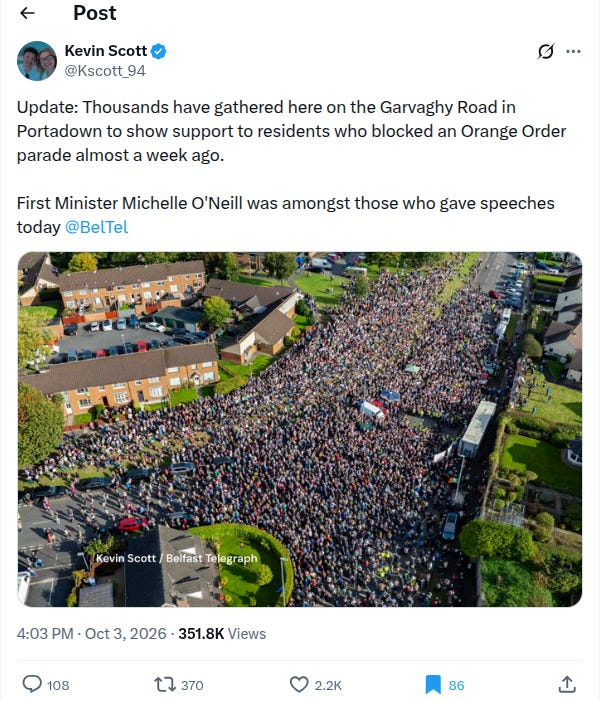
My first thought when I saw that a new stand-off was happening on Garvaghy Road was to be transported to my friend’s front room in 1995, watching on TV as Drumcree first became an internationally recognised flashpoint during the late troubles; a core memory. It’s a weird event to get all “eating a madeleine” about, but that’s what happened - I was suddenly assaulted by a rush of memories ranging from George Mitchell’s bewilderment at the phrase “the dogs in the street” to the fact that, since there was a long period where it was literally illegal to broadcast Gerry Adams’s voice on the TV, footage of him was voiced over by an actor, like a henchman in a spaghetti western. In other words: Christ, I’m old. Like everything that happens in every inter-ethnic conflict, the Garvaghy Road situation is both absurd and deadly serious, but I’d guess I’m not alone - perhaps nostalgia is an underrated factor in why this is all unfolding now.
After a few hours commentators began to solidify their positions and so my second reaction became - wow - the online populist right in Ireland as potential political force really is dead isn’t it? Having never lived. As someone who thinks the Irish political system needs to be shaken to attention and can see no other direction from which a tremor might originate, this was supremely depressing; to be this far along and still making elementary political mistakes at maximum volume. The general reaction from these quarters was that the proposed march and reaction to it was a psyop, designed to distract from the real issue of mass migration; that it was sent with the intention of dividing Unionist and Nationalists who would otherwise unite in their joint interests in fighting multiculturalism; and above all that the number one objective was to attack Sinn Féin for being willing to protest a proposed Orange Order march, while failing to get behind various anti-immigration protests in Ireland. You can see examples of what I’m talking about here, here, and also below. There are lots of other examples.
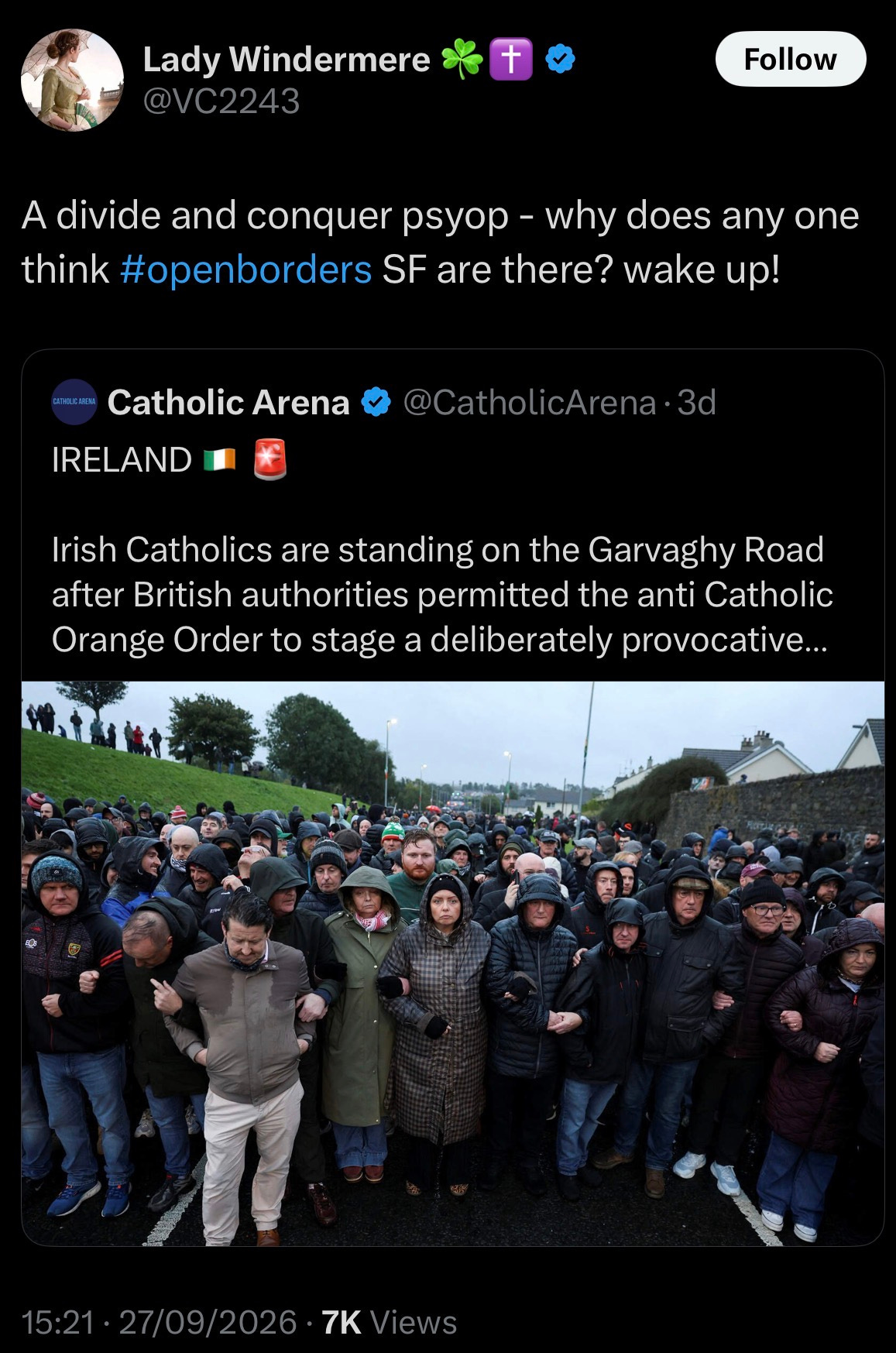
These are from accounts of varying sizes, and some of the people making and reposting similar statements are small - it’s all contextual as the Irish social media market isn’t big. It doesn’t matter - the truth, as we’re constantly rediscovering, is that a movement does have to answer for the worst excesses of its loudest members. The tweets I’ve linked to are representative of a particular line of thought prevalent amongst many anti-immigration protesters in Ireland, as instances of protestors appearing alongside unionist flags and iconography during protests has shown that. A combination of hatred for Sinn Fein, alongside a desire to position utterances to appeal to the tastes and concerns of audiences outside Ireland is trampling all the understanding of the basic requirements of electability in Ireland, and it appears to be not just an incorrigible problem but in medical terms a terminal one. History means that Ireland as a state and a people implicitly define themselves in opposition to unionism; a philsophical coming together with unionism is a contradiction in terms for most Irish people, it can never happen, and will never have popular support at any level. Please understand: I’m just telling you something objectively true as regards the feelings of normal Irish people, I’m not trying to persuade anyone who might doubt that this position is nice, good or reasonable. You can consider what this means for a potential united Ireland on your own time. For our purposes here, the upshot is that SF in this case are, in the minds of Irish voters, basically on the side of the angels.
Orange marches, and how the Catholic community in the north feel about them, are not high salience issues for southern voters, who are as happy not thinking about the north as the average English voter is. But that doesn’t mean these things are meaningless when activated, and that they don’t need to be treated with care. As I described with Palestine a few weeks ago, if this issue is forced into their field of vision, the average voter will always come down on one particular side and it’s not the pro-Unionist one. This is perhaps the most basic electoral fact in Irish life and certainly anyone seeking to don the mantle of nationalism has to understand it if they want to get off the starting line. Anyone who can’t or won’t get to grips with this reveals that they are subject to an incentive structure that prioritises either their own hobby horses or the views of American and British audiences at the expense of normal Irish people, so there is no future here.
The last few week’s developments on the Garvaghy Road have been a huge boon for SF. I’m not a close observer of the northern executive but it seems that their position as a party of power is moribund, since they have neither the resources nor the dynamism to accomplish anything. These events have blessedly returned them to their comfort zone of strident rhetoric and activist action. In the south, the party has been adrift in the last few years, its polling with key demographics slipping due to an inability to hold together the contradictory demands of their base on immigration. The Orange Order have kindly provided them with the opportunity to appear as selfless defenders of the most basic red lines in Irish politics, unafraid to get their hands dirty and reflect the deepest concerns of their core voters, and forget about that other nonsense. It allowed SF to reconnect to a civil rights legacy in the north that is not fully theirs, but that people in Ireland hold in high regard. This success has been amplified and guaranteed by the reaction of the online right, who had been nibbling away at SF’s self-image and self-confidence. All in all none of this solves a long term problem for them but it does damage the emergent right in Ireland, and that amounts to the same thing. If SF’s enemies are going to be stupid enough to tacitly align themselves with Unionism, the party certainly won’t stand in their way while they make that catastrophic error.
None of this is to give SF any credit, or to suggest they’ve changed. The presence of Kneecap, a Rosa Parks banner and the preponderance of Palestinian flags at the protest site show they haven’t. But so what? None of that means that attacking them now is a wise move. Mainstream parties at least understand this, and have adopted the correct approach of either lightly being pro-nationalist in relation to the issue or not talking about it where they feel they have nothing to gain.
I don’t particularly like SF and I’m not suggesting it’s essential to row in behind them; one can simply ignore the situation. I understand why people want to focus on other issues, why people think there is a certain amount of hypocrisy when Sinn Féin seeks to defend the rights of Irish people as a group in some cases but consider it forbidden to do so in others, and I get the urge to highlight that. I even understand why people have a certain amount of legalistic sympathy with the Orange Order position. For that, see John McGuirk’s column here - but the difference is he’s a commentator and is not trying to get people elected or start a political movement, and so doesn’t have to worry about whether the public enjoy hearing this. For anyone who does need to worry about those things, the choices are either to not talk about it, or to swallow your disgust and weigh in on the same side as SF. If it hurts you to do the latter, then do the former. This is the normal restraint and message discipline anyone who wants to get elected, or wants the public to listen to them, needs to display - and of course the less leeway you have with any segment of the legitimate media, the more you need to display that discipline. If doing so niggles at you, you can take solace from the fact that there will be other opportunities in the near future for you to highlight the phoniness of the SF position. This post by Patrick Quinlan is a good example of a thoughtful and restrained approach that sails through that narrow channel.
A lingering question here is what is going to become of the populist energy fuelling immigration protests in Ireland if the movement itself can’t mature politically. The answer, unfortunately for everyone, is nothing. As I’ve said more than once - when political energy manifests in an inchoate form, we can easily trick ourselves into thinking it must naturally become coherent or gain power; but in fact that might never happen, if that energy cannot corral itself into an electable form. Doing so takes conscious effort, and most of all restraint. If that doesn’t happen the energy doesn’t go anywhere - it just sort of rots, out in the open. That means that protests will continue, and both that and the online discourse will cause the government trouble and embarrassment of various kinds, but that’s it. People will continue geeing each other up in the padded cells of their timelines, but the more energy is expressed without ever gaining power, the more putrescent and unappealing that energy will seem.
The saddest thing for an electoral system that needs more ideological variety, is that a lot of the participants will be happy with this situation as they are ultimately getting what they want from these interactions. Like the Deadheads of old, their joy is the experience of being in the camp and following the caravan, not the journey coming to its conclusion. Politics and political change is about a long slow build up, often carried out in the dark, building coalitions, developing policy positions, understanding the local concerns you have no sense of so that you can understand enough to speak to them. Quite a lot of people whose political lives are lived online their true love is the punch-up and the feeling of being at war. Positive political change would if anything be a problem, especially if it’s done quietly - because where is the thrill in that? Powerful feelings can if anything be deepened by intensifying and multiplying the fringeness of your causes, and pushing yourself away from the average voter.
The nature of outsider movements is that they draw in people who are not only willing to be disagreeable, but like it. The risk is that they gather all the disagreeable people in one place, and that the thing they work on is their righteous fury at being marginal, rather than overcoming that marginality. Every corner of the internet bonds over laughing at normies in its own way. But normies are the electorate, and politics is fundamentally a popularity contest. As in all such contests, the winner will be the person who can present their views as closest to those of the average person - so you have to keep in view what the average person thinks. You don’t have to say you believe something you don’t, or give credit where it’s not due, but you do have to understand what’s unpopular and avoid seeming to grab it with both hands. It’s also essential to avoid seeming to be motivated purely by negative sentiment to an all powerful enemy. People are drawn to strength; constantly bitching about your opponent as they try to act in the world makes you seem passive and small-time; and by contrast it highlights the agency of your opponent, allowing them to seem like they believe in something larger than themselves, whether they do or not. Why give them that win? The “good” news is it probably doesn’t matter; you can only drive past so many exits before you accept you’re never getting to your destination, and we’re likely past that point already. Great.
Other articles on similar topics:
We Learned Nothing

During July an Indian man was reported as having been assaulted in Tallaght, a large outer suburb of Dublin; the details of the attack (see screencap below from RTE news) meant it made national headlines. In turn that unleashed a torrent of similar stories,
Sacred and Profane

During the week the Casey Report, which is an inquiry by the UK Government into “Group-Based Child Sexual Exploitation and Abuse” - aka Grooming Gangs - was released. Whenever this topic bubbles back to the top of the headlines, I’m reminded of the long saga of clerical child abuse scandals in Ireland, which as an Irish person was one of the central cultutal events of my lifetime.
The Golden Age

The Irish Referendum which allowed for the legalisation of same-sex marriage is 10 years old this year. The passage of time has a way of flattening and defanging political events to turn them into neat parables; the vote is fondly remembered by Irish people as a milestone in our modernisation, and a joyous win for social justice, so the anniversary articles have taken that cosy angle.