Men and Progressive Culture on "The Pitt"
When is it ok to be the old kind of tough guy?
In Season 2, Episode 8 of Hospital drama The Pitt, the Emergency Room doctors stitch up a party girl who has bitten a chunk off her own tongue while drunk. Even as they sew she dips in and out of consciousness, but she is aware enough to confirm she’s an everyday drinker. As we watched at home, my wife and I speculated how this would play out in an Irish hospital… with an exhortation to cop yourself on and stop being an idiot, some grudging admiration for being such a character, maybe a lament from the doctor that they haven’t had time for a pint recently themselves. We were certain it wouldn’t end with the girl being referred to rehab, which is what happens in the show - an hilariously American reaction. These little cultural quirks and tics of The Pitt are one of the things that keep you watching; but attitudes to alcohol are not the biggest or strangest of it’s blindspots, not by a long shot.
The Pitt is very popular. It uses the virtues of peak TV to tell its story in a different way from ER, its closest equivalent, a ‘90s megahit with which it shares key cast member Noah Wyle. Over a 15 episode season each hour in the Emergency Room (A&E to you and me) unfolds as a single episode set in real time. TV ratings aren’t as easy to parse as they were in the past, but the season 2 finale got 9.7 million viewers in one weekend and averaged 15.4 million viewers per episode. That puts it in an elite category of the 5-10 most watched online shows.
Sometimes putting a show like this - which is ultimately a soap opera - under the microscope can be a little much; not every show can stand up to it. The Pitt demands closer examination, however. It has consciously adopted a “ripped from the headlines” strategy where the storylines from the news and current affairs, various other social crises, form the backbone of each episode and season. In The Pitt’s case the headline it’s ripped from is that of a Salon Article, or maybe a Pod Save America episode. It’s explicit purpose is to advocate for progressive stances on political and cultural issues.
Trump’s 2nd electoral victory was unexpected and total, and seemed to speak to some final turn in popular culture. The term Vibe Shift was coined to explain this wider sense that overt Progressivism had lost whatever popular legitimacy it ever had, and become sort of uncool. The sense that there had been a shift wasn’t wrong; there were plenty of concrete examples of it including tribune of the boomers Steven Colbert having his show taken away, various Pixar movies being cancelled or rewritten totally to leave out progressive story elements, athletes doing Trump dances to celebrate touchdowns. But these have to be seen in context as World War One style victories - the right (or really just the not-dedicatedly-progressive side) marched it’s troops into the guns, and after a months of bloody battle gained piece of ground of no strategic importance equivalent to a couple of square feet. Popular culture has almost entirely bounced back to its previous position, and nothing embodies the centrality or resilience of progressive political messaging than The Pitt.
In particular, the show is a great example in particular of what I described in the past as progressivism’s Narrative Privilege - the assumption (and reality) that the most dedicated activists for that side can expect to put their debateable views directly to the public via popular culture as fact, in a way that would be shocking and disruptive if anyone else did it - but to still think of themselves as besieged outsiders fighting the system. Characters in The Pitt all but look into the lens of the camera and tell you what to think about various issues, often delivering dialogue that differs from the text of a Democratic fund-raising email only in a very marginal way.
Here are some random examples, and bear in mind there are three or four of these in every one hour episode. Season two features a Tree of Life shooting survivor being attended to by a hijab-wearing Filipino nurse, and reassuring her that “after the shooting, it was the Muslims that came together for us in support and walked with us. You raised money. You paid for all the funerals”.
The central identified bad guy of the first season is a hulking white man demanding to be seen ahead of other people in the waiting room, who makes passive aggressive racialised comments against the staff, and eventually assaults a female member of staff. He is all but wearing a MAGA hat.
A trans patient is treated and one of the doctors chooses to pre-emptively change their records to use their preferred pronouns, tells them so and is gratefully thanked - that is essentially the whole plotline involving this character. It serves as a way of communicating that one particular doctor has a human touch with patients, an important part of their development, but as with many of these stories the political and social messaging is to the fore only lightly disguised as fiction, resulting in moments that are strange and dramatically inert; the show just tells you what the right thing to think is and then moves on. In a key storyline in season two, one of the staff members is snatched up by ICE mid-shift.
One place where the complexities of this stuff come together is in the show’s attitude towards men. In season one is a woman arrives into the ER with her sullen, disinterested teen son; the symptoms of the illness she’s complaining of don’t quite add up. Once she’s taken aside she reveals she’s faking her sickness to get near a doctor; she has found “a list of girls at his school that David (her son) wants to hurt”. She persuades the doctors to talk to him but the son flees. The story putters away in the background for a few episodes. Later, a mass shooting is committed at a music festival and the staff begin to fear David is responsible. He wanders back into the hospital as the response to the shooting is in progress, and is locked up by police. It turns out he didn’t do it, but in the interim there’s lots of back and forth about school shooters, internet misogyny, boys and girls and men and women.

At one point main character Dr. Robby speaks about the influence on boys from online and negative political sources. This is one of the best examples of how didactic the show can get. David’s mother asks him how it could be that someone like David could get in this state and he says that maybe it’s because:
… we are failing young men… because we don’t teach them how to express their emotions. We just tell them to man up and the we let them get their lessons in manhood from toxic podcasts. And these young men feel isolated from themselves and society, and they find confort and community in all the wrong places. David needs help. We don’t want to fail him too.
Toxic Podcasts! I don’t think the show itself even understands that these are partisan and arguable political points.
Later, the female doctor (Dr. McKay) who has been most insistent in accusing David of being the shooter sits him down and tries to explain why they have put him on an involuntary psychiatric hold. What she says is that he doesn’t understand what it’s like to go through life being afraid - she means as a woman being afraid of a man. Female fear of violence is both real and reasonable but this again struck me as interesting; as I wrote last time, men, particularly young men, are by far the most at risk group for interpersonal violence from strangers and the awareness of that is a constant thrum of their teenage years. It is a central driver that makes them who they are. David is portrayed in the show as a nerdy and withdrawn kid, and a real life version of him would almost certainly have experienced much more direct physical bullying from strangers than the average girl of that age. Nevertheless the doctor asks him to consider:
Do you know what it’s like to be afraid? I mean, really truly frightened?…imagine if you felt like that every day from half the people you meet because that’s every woman’s life…
(Incidentally… the only research I could find on the subject indicates that male medical staff are more likely to experience physical assault than female staff are. But anyway.)
The question here is not whether the show (as a proxy for progressive thought) can represent women’s fears accurately - we know it can, and it does it well. The question is whether it can mind-read men or model their inner lives. It palpably can’t.
So the show displays the habitual Progressive tic of sincere but unreflective and shallowly-embedded emotional empathy as the sole lens through which to see the world. Any controversial issue aimed at women is treated by the show with extraordinary reverence and solemnity, but it is not inquisitive or thoughtful about anything that touches on men, viewing them implicitly as an unknowable out-group who are failing to live up to an objectively correct standard of self-knowledge.
One of the other key ways the show accidentally highlights progressive culture’s own internal struggles with what to do with men are the male characters on the show; aforementioned main character and chief resident Dr. Robby, his night-shift equivalent Dr. Abbot, student and later first year resident Dr. Whitaker, and senior resident Dr. Langdon. As the show has gathered momentum, all of them have acquired fans but I think it’s undeniable from reading message-boards and internet comments that Abbot is the chief object of admiration, and I think the language of the show supports that view. What does it take to be a hunk on a show that feels alienated from men and skeptical about masculinity?
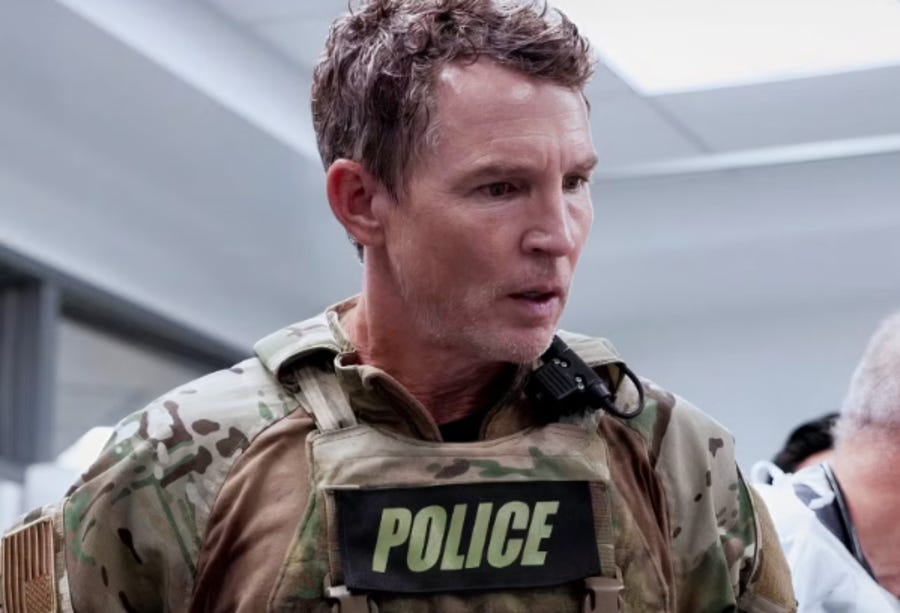
Well, he’s an ex-soldier, and the ex- is pretty tentative. In Season 2 he arrives in the ER having been injured assisting a SWAT team in responding to a warehouse robbery. He wears his kevlar and fatigues and protective shades and gives manly reassurance to a comrade who’s been shot in the throat. Later (in a scene straight out of a romantasy novel or bodice ripper) a younger female doctor comes across him attempting to self-repair a ricochet shot that hit grazed back. He’s sitting on his own in one of the patient bays with his top off, pecs bulging and his brow furrowed as he prepares a bandage. She talks to him about her dilemma of secretly wanting to give free medicine to a patient that has fled the ER to escape hospital bills (the patient is in the country illegally and can’t get coverage - please cross those topics off your bingo card). Abbot casually offers to pay for it as he works.
He references his military background all the time, reminiscing about Kabul with another doctor, lingering over patients who are vets, using tactics in the ER learned on the battlefield. In one scene, during the response to the mass shooting, the ER is running low on blood for transfusions so the doctors donate. One of the other doctors looks down at Abbot’s leg while they attend to the patient and notices that he’s giving blood while working, with tubing poking out of his scrubs and a bag filling up at his ankle. Abbot shrugs it off - all in a day’s work for this gruff american superman.
For the progressive stance of the show - which is its central purpose, not an incidental detail - this guy is an active participant in violence and the military industrial complex and is therefore ideologically the opposite of what the show admires. Yet the language of the show tells us that he is the good guy. With the exception of the first scene of the first episode he copes better with pressure than the other doctors; he’s never the butt of the joke, he doesn’t engage in behaviour we are asked to disagree with, and he usually has the solution to any problem that arises. The show, in other words, asks us to like and admire him without qualification.
How does it treat the other main male characters? Langdon is boyishly handsome and a married girl-dad, smart and funny with a floppy haircut like Edward Furlong in Terminator 2. But he’s revealed as a weaselly drug addict and so by definition unreliable and not entirely admirable. Whittaker is gentle, thoughtful and kind and in fact better embodies the stated Progressive ideal of what a man should be than anyone else on the show, Abbot included. He even works for the hospital street team, providing medical care to homeless people in his free time. But in season one his vulnerability sees him defined as in part as comic relief - there’s a running joke that at every ER interaction he contrives to get himself covered in patient bodily fluids, and is forever finding himself in the path of sudden explosions of blood, piss, shit, puss. It’s both interesting and revealing that the show takes this person who embodies so many of the qualities that its belief system says it admires, and tortures, needles and humiliates him albeit in an amusing way.
Doctor Robby is the main character played by Noah Wyle. He gets a lot more screen time than any other character and is harder to fit into an archetype and the depth this gives him means he is harder to describe as an archetype. Of all the people he resembles on the show it’s Abbot - in his gruffness, his ultimate softness and support for his team, and his hard-bitten experience.
The similarity is by design, and is the point; structurally the purpose of Abbot is to provide a counterpoint with Robby. Robby is damaged by giving too much of himself to his job; he bottles up his trauma, struggles under its load and it can come out at inconvenient times. Abbot has tried to grapple with his own demons and an important part of his character (for the show and for our purposes here) is that he is in therapy. He tells Robby that he works the night shift because:
“My therapist thinks I find comfort in darkness.”
"Want to know why I've never killed myself, after what I saw, lived through, losing my leg, losing my wife? Because it comes for all of us. We can't let ourselves succumb to it..."
"(To Robby) Are you fucked up?… 100%. But nobody works here as long as you and me and doesn’t get screwed up. You gotta find somebody to help you dance through the darkness."
Much of the above sounds semi-parodic (“dance through the darkness” etc), and if it doesn’t come across that way on screen it’s mainly down to the quality of the performance and the production. But an Anchorman-style movie about a macho blowhard military doctor who has found zen peace through therapy, starring Will Ferrell as the doctor, would be very funny.
In any case: the therapy stuff is the key. From a man, we want someone who has been through it all and leaned on all those virtues we otherwise consider false, gendered expectations under the belief system of progressivism. That includes physical bravery and violence. But we also want them to make us comfortable with those values by putting them in the rear-view mirror and laying a veil of sensitive therapy talk over them. That way we get to enjoy those essential values, which from a progressive point of view are fruit of the poisonous tree of masculinity. A familiarity with violence is indicative of a person who has seen it all and can deal with anything that arises, will have your back in a fire-fight and will have the answers when the shit hits the fan. But in the wrong hands that is radioactive material; so the therapy-talk, and the sense that it is all in the past, are like the rubber gloves that allow you to touch this dirty and dangerous thing you crave.
Abbot is of course a character in a TV show who has not actually had any of these experiences with therapy or real life violence. Someone wrote some lines on a page to serve a structural purpose with our main character (to provide a counterpoint to Robby, as someone with a similarly traumatic past who has come to terms with it rather than let it overwhelm him). This is not a criticism of therapy per se, and I don’t diminish the reality of PTSD, or even maleness come to think of it. The point is the curious inconsistency of a show that is so obviously and overtly ideologically driven, and an attempt to understand what the root of this is.
On that, one helpful place to start is with Eric Kaufmann’s idea of Asymmetrical Multiculturalism which is (this is a google summary):
a double standard in Western societies regarding ethnic and national identity, It argues that while ethnic minorities are encouraged to celebrate, maintain, and protect their distinct heritages, the ethnic majority (typically white populations in Western nations) is expected to abandon their ethnic identity and adopt a "cosmopolitan" or raceless identity…
… or in fact to adopt an attitude of shame or active condemnation towards that identity. One could posit that Abbot is the expression of a similar attitude you might call Asymmetrical Egalitarianism; the same thing expressed towards sex differences rather than race/ ethnicity. For the sake of optimal progress we ask people to abandon what we say are their socially constructed and oppressive gendered identities and behaviours. But we continue to find many of the traits we associate with them desirable and preferable, so we ask people to continue to display those, while also decrying and rhetorically distancing themselves from them. For men specifically we ask them to cloak their view of those traits in language and a mode of interpretation that is more appealing to a Progressive (which often means not-male-friendly) way of thinking. How the fruit of the poisonous tree is produced is on you, so long as you continue to do it and we don’t have to live through that process.
One of the cliches we hear about sex-driven political differences is that society doesn’t know what to do with men. I think what The Pitt helps reveal is that’s not actually true at all, certainly from the Progressive side. It’s attitude is best summed up by Simpsons quote where Mrs. Skinner says to an exasperated supermarket bag-boy “I want everything in the one bag but I don’t want the bag to be heavy.” What Progressive culture wants is for men to be exactly as they have always been while that is convenient and helpful; but to be different when that’s convenient and to in fact disown having ever been, or ever having wanted to be, the other way.
Where those two things conflict or are impossible, that’s for men to figure out. And in any case we want the package presented to us in the rhetorical terms we (and not they) find most comfortable. All of this ignores that how people behave is a product of their biology and what they have experienced, and the interaction of those two things, and those ingredients can’t be removed after the cake is baked.
This is not a whinge about how hard it is to be a man because the reality is it’s no harder or easier than it ever was; through biological reality, life puts particular demands or strains on you that you have to keep up with. What’s interesting is how the dilemma of Asymmetrical Egalitarianism is recreated as art and entertainment, and the political problem it represents for progressivism itself. Men notice the requirements of AE and don’t really like them, and despite the occasional real life Abbot-style anomaly they feel repelled by the language and rhetoric with which it asks them to frame their lives. The Progressive sense of narrative entitlement makes this issue worse because you get to present your preferred picture of the world to yourself as though it is a reflection, in which all these absurd and contradictory things can prop each other up. Since a true, deeper vibe shift hasn’t happened and won’t happen, it doesn’t seem that the cavalry of a balancing vision is coming. The Pitt is a good show in spite of all that; let’s not forget that the privileged people still make the best stuff. That’s a dilemma for everyone else to wrestle with.
Recent articles from me on similar subjects


Great read here. I must say, few things have turned me away from the Left more than the politicization of entertainment, particularly the shows my wife and I used to watch. The token identity characters is bad enough, especially when they are anachronistic, but the blunt political messaging that is basically propaganda makes me irate. Nothing like watching the hero white British homicide detective instruct the bigoted witness blaming the Somali Muslim for starting a fire that “Our country was built by immigrants.”
I don't think the girl who bit her tongue would get that much consideration in a real ED, especially one as beleaguered as that.
I'm pretty progressive and I don't think most progressives realize how pervasive progressive messaging is in culture. It's like the old saying about how the fish doesn't know it's in water. It really stands out in The Pitt where the characters turn to the camera and spout progressive talking points because the show is very well made otherwise.
I kind of hate how media deals with "incels" and the show is definitely guilty of that, although it's hard not to feel contempt for someone who writes down how they want to kill women