
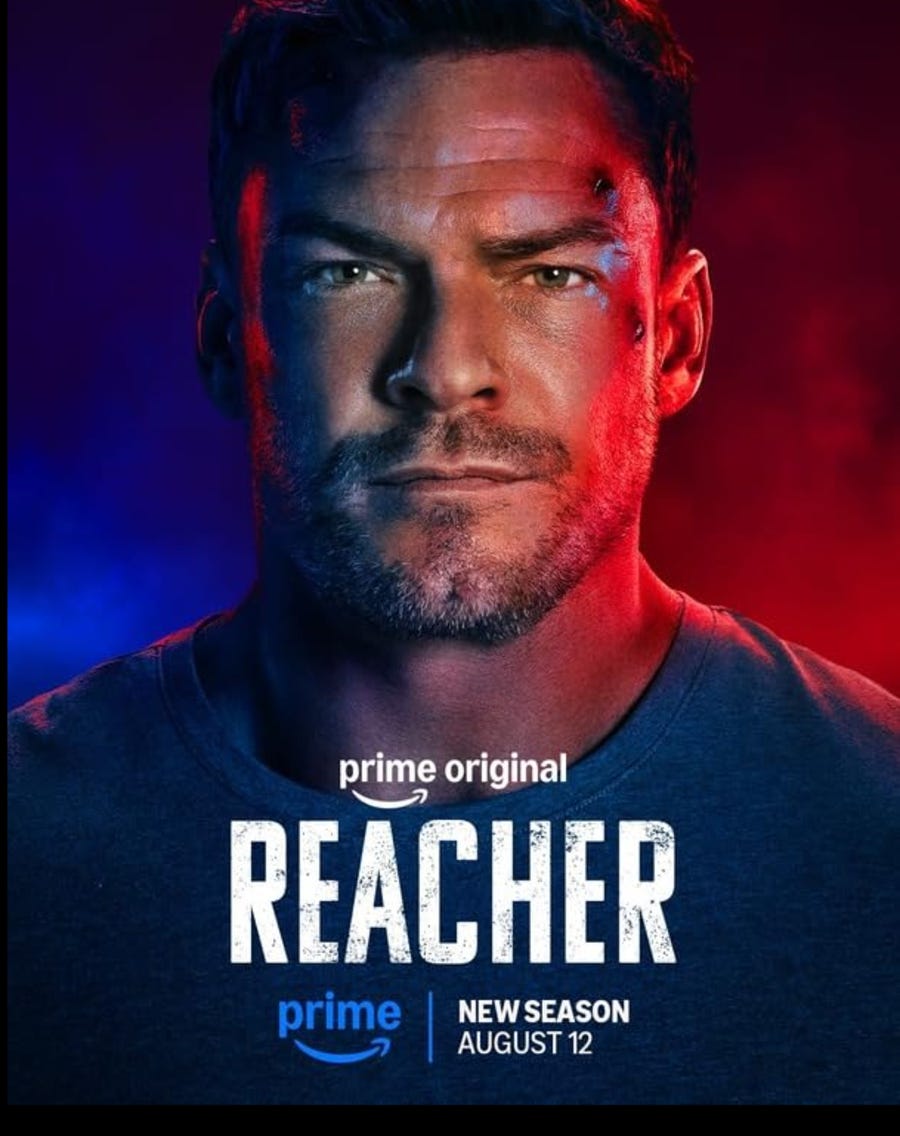
The Simpsons has a great scene in one episode where a Navy recruiter is explaining to Bart and Lisa that the service’s recruitment strategy works on three levels - subliminal, liminal, super-liminal. Subliminal is hidden messaging, liminal is direct advertising; to demonstrate “super-liminal” he leans out of a window and shouts “hey you! join the navy!” at Lenny and Carl, who are idling on the street. I always think of the idea of superliminality when it comes to Reacher, the phenomenally successful Amazon Prime series (based on a similarly successful series of novels) about a wandering army tough guy, which returned to streaming for a fourth series this month.
How popular is Reacher, exactly? Most of the stats we have are from Season 3, which was viewed by 54.6 million global viewers in its first 19 days, making Amazon’s most viewed original show. It was the first Amazon series to reach the #1 spot on Nielsen’s overall streaming charts. It consistently places in the top 10 streaming shows globally. It is notable for it’s international popularity, about half of the viewership originating outside the USA, particularly in the U.K., Germany, and Brazil. The show’s popularity in non-english-speaking territories put one in mind of the similar success of Charlie Chaplin and Mr. Bean - perhaps the only thing more universal than the hilarity of a man falling down is a man with big muscles punching the bad guy.
In any case, for anyone looking to analyse the wider meaning of this runaway hit, the lack of subtext is a kind of blessing. The show touches on so many of the most important political and social themes of our time, and the ones that are of most interest to this Substack, namely representations of men and “masculinity” in modern media and the idea of a cultural vibeshift versus the reality of it. Rather than hiding it under layers of meaning, the show’s creators kindly put this stuff right on the surface - often unbeknownst to themselves - so it would be rude not to take a look at what they’re saying.
It’s interesting to consider the show as a product of the Peak TV era because it’s a replica of a type of programme that was common at 6-8 O’clock on weekend evenings around the world between the 1960’s and 1990’s - light entertainment like Kung Fu or The Incredible Hulk. There is no reason that this couldn’t have been on any mainstream terrestrial channel at any time in the last 50 years, other than the length and number of the episodes, the expense of the production, the swearing and the violence. But none of those features are new - they are exaggerations of existing qualities that were already in these shows. As in so many other cases all these adult, prestige hallmarks do is draw attention to how throwaway the product is, rather than obscure that fact. With the exception of The Sopranos, The Wire and a couple of other shows, TV has quickly reverted to its sloppy mean except with a new range of cliches. There are still some shows out there doing interesting things or at least using the unique virtues of the medium. The Pitt and its single day seasons are a good example. It’s notable, and we’ll come back to the fact that, where those programmes have a political valence it’s the complete opposite direction to Reacher’s.
The kindest take on Reacher’s cultural import is that it represents a resurgence of an older kind of male-oriented pulp which existed in the past but which has all but disappeared 2026, something that was very action based but light on emotion. In the crime genre we can see this in the move (over multiple decades) away from hardboiled detective fiction (heavy emphasis on plot, atmosphere, ideas, language, procedural detail and technical information, and on brevity) and towards much more emotional stories, stronger on sympathy and empathy.
This lurch back in an older, nastier direction explains a lot about certain story quirks you see repeatedly in Reacher. It leans into a stylistic trope I call “everyone’s a sucker but me” - I think it originated with people like John Wayne, who always kind of a dick in his movies, which used his obnoxious to those around him as a short-cut way of indicating his toughness and independence. Reacher dunks on supporting characters in subtle and unfair ways, correcting them with his universal knowledge, making them the stooge to bounce his witty comebacks off. The best example of this was Russo on in season two as played by Dominic Lombardozzi. Russo is a cop but a hapless one, not as handsome or strong or dynamic as Reacher, and with the wrong end of the stick about the central case. The language of the show is clear that he is not the bad guy or a bad guy - he’s brave, honest, and a protector of the innocent. Yet Reacher is constantly mean to and dismissive of him, right up until the point that Russo is killed (a death Reacher is pretty directly responsible for) at which point Reacher somewhat hilariously tells everyone he kills “this is for Russo”.
This is a macro example of the key thematic thread of the show, which is a naked and slightly pathetic yearning on the part of the viewer to be identified with the guy who is not just strong but The Strongest, unbeatably strong, who knows everything and is right in every situation, to the point that the feelings and opinions of others become instruments for that central character’s achievements with no other function.
Reacher is pitched as being symbolic of The Vibeshift and that it is a right wing show, and that’s part of what makes it notable. Whether that’s true or not I think it certainly is an attraction for viewers - I do think part of the appeal to viewers of Reacher is that they believe it is implicitly anti-woke, that it represents a return to a time when men were men, a revival of the old-fashioned action hero and so on. But only someone who is half paying attention could think it meets that bill. Reacher has many of the exact features that its audience complain about in other media - an intentionally multicultural cast, “strong female characters”, and implicitly liberal politics used to communicate who is the good guy and who is bad. What does this tell us about the ideological demands, and indeed ideological consistency of the anti-woke viewer? That they are too inattentive to notice that the solution their preferred anti-woke programming is selling them is liberalism, but delivered by a white guy with big muscles who loves The Troops.
What all of this speaks to is the impermanence of the vibeshift as a cultural victory, and the hopelessness of something like Reacher as part of a cultural pushback. If we take it as true that Reacher is the Right Wing show of the late Peak TV era, what are the left-wing rivals in a qualitative and creative sense? If I pick TV shows I myself have watched recently it would be things like Furious and The Pitt. Both are also overt in appealing to a particular political sensibility and audience. The Pitt, as I wrote previously, is heavy-handed in it’s messaging, often laughably so, and Furious isn’t much better. But on the level of acting performance, scripting, visual quality (it’s sobering to compare the aesthetic richness of Furious to the “floodlit office cubicle” lighting approach of Reacher) and thematic complexity, there is simply no question that the calculatedly left-wing shows are the better ones in every sense. The only thing Reacher has going for it is the reduced emotional load; that’s not nothing, but the lib stuff has everything else. The point here about the political valence and value of the show. A true, deep vibeshift was never going to happen because the prospective right-wing audience don’t care about making something good that is also ideologically consistent, and wouldn’t even know such a thing if it was right in front of them. If you want good right wing/ conservative or non-liberal messaging or themes, you’re going to have to find it in the left-wing stuff.
Stepping back a little - what is strange and notable about Reacher, is not its political value but it’s Frictionless-ness. It’s strange to spend twelve hours in the shoes of a character who never truly loses a fight, who always knows everything, or when he doesn’t he instantly knows where to find an answer, who is never flustered or confused. In fairness to the new season they seem to have figured out that this is a problem and at least on this occasion he gets clocked in a couple of fight scenes, which hadn’t happened previously. But, that aside, why is it that people want and like something so free of ideas and dramatically inert? The first explanation is that it’s pure wish-fulfillment for people without a strong artistic impulse, who aren’t paying close attention and are consuming the show as edited fight-scene highlights on Youtube and TikTok. But I don’t think it’s just that.
Personally, I get it. For a show like Furious, its overwhelming purpose is to allow you to experience strong sympathetic emotions arising from interpersonal conflict, grief, betrayal, unfairness, victimisation, disenfranchisement, belittlement, pity, the experience of cruelty being inflicted on you, dismissal and so on. To be honest that’s also why I hate it so much - I would much rather, a hundred times more, watch someone be shot in the face close up than watch someone be publicly embarrassed. Like a lot of people who hate that stuff, it feels directly manipulative to me in a sleazy way that action isn’t; obviously action is manipulative in that it’s directing your attention and causing you to think and see particular things, but someone doing that with your sense of excitement is so much less gross than being coldly yanked around by your tear glands. As a counterpoint, for the large group of people who don’t enjoy that approach, you have Reacher, so the lack of artifice is the point. But the lack of sophistication can get exhausting, like listening to something with the volume turned way up all the time.
A good place to close is with the books, since it gives us a reference point to gauge if some level of complexity has been lost in the transition to TV. I don’t think so; like the TV show the Reacher books are all plot, all event. This is a back-handed compliment, but the kind of (to use Nabokov’s phrase) “ox-stunning fisticuffs” that both the TV show and the books are full of always works better visually rather than in writing - there’s no written version of a gunshot or a kick that could beat the filmed equivalent of those things. Qualitatively the books and the TV show suffer from a particular problem - which is not that they’re never good enough, but that they’re never quite bad enough. I’ve read the first 100 pages of five different Reacher books, always beginning with the intention of diving into a guilty pleasure and having to abandon it after an hour or two because it’s such a boring slog. The book character has all these strange character tics that are intended to make him sound wise and in control but actually sound like is a very out-of-touch but full of himself dad giving his bored adult children tips about how to live. In multiple books, he teaches side-characters that they can iron their clothes by putting them under their mattress as they sleep. In a number of others, his love interest is amazed and impressed that Reacher doesn’t wear a watch but always knows the exact time. To my knowledge Reacher never complains that if these kids just gave up the Avocado toasts they would be able to afford a house, but I’m sure the author has considered it. So in general, book-Reacher’s knowledge and capability often feels less like that of James Bond or Batman, and more like a middle-aged golf club bore leaning over the back fence and telling you about Sadolin wood-stain while eating an egg sandwich. The TV show is the same. Any flaws I point out in the show are baked into the books, including and especially the melancholy nakedness of it as a piece of wish-fulfillment for a certain type of older man. But then, they need their dreams too.
Other articles from me on similar topics
"Media Literacy" is a Lie

I was speaking to someone recently about Tom Holland’s book Dominion and they noted there were two versions of the arguments made in that book, which is that Christianity was not only an essential influence on the formation of Western culture but that it’s influence has not waned, and that it continues to act on us in hidden ways.
Odysseus’s Modern Manhood

Christopher Nolan’s movies are about fathers and sons. In Batman Begins, Christian Bale is driven to live up to the example of his father and tortured by the idea he has failed to do so; he’s kept on track by surrogate father Alfred who reinforces the moral lesson of his dead dad, and pulled off track by false mentor Liam Neeson. In Inception, Cobb’s central motivation is to get back to his kids - the story clearly comes from the mind of someone whose dad was away on business a lot when he was young, and who is also guilty that he’s spending all his time on location worrying about lens choices and not driving Sebastian to school (I have no idea what Nolan’s kids are called or what age they are). Don’t get me started on Interstellar - the key scene is literally a parent who ascended to the heavens watching from above as his most beloved child grows up without him. Jessica Chastain plays a daughter but it’s an
Men and Progressive Culture on "The Pitt"

In Season 2, Episode 8 of Hospital drama The Pitt, the Emergency Room doctors stitch up a party girl who has bitten a chunk off her own tongue while drunk. Even as they sew she dips in and out of consciousness, but she is aware enough to confirm she’s an everyday drinker. As we watched at home, my wife and I speculated how this would play out in an Irish hospital… with an exhortation to cop yourself on and stop being an idiot, some grudging admiration for being such a character, maybe a lament from the doctor that they haven’t had time for a pint recently themselves. We were certain it wouldn’t end with the girl being referred to rehab, which is what happens in the show - an hilariously American reaction. These little cultural quirks and tics of The Pitt are one of the things that keep you watching; but attitudes to alcohol are not the biggest or strangest of it’s blindspots, not by a long shot.
Funny notes on the books!
Personally I loved Season 1 but never saw any point in watching subsequent ones -- the small town premise and reacher's sidekicks (that blond girl and the black guy with the .32) were just so perfect, if they throw all that out why bother.
Great analysis, the progs finally realizing they cannot attract MEN with their mamby pamby cultural offerings and trying to put a "man" into their universe while maintaining the prog worldview.
Have you seen that the USA Dems are now trying to run all these rugged bearded dudes for political office LOL...rugged dudes whose only value is to to protect the wimmin folk and other victim classes.