
A confession: I don’t like Louis Theroux’s work. That’s not because it’s always bad (although his new Netflix documentary “Inside the Manopshere” is tired stuff, working over ground that’s been farmed to the point of infertility by other commentators and by Louis himself) but because his stock in trade is embarrassment - the awkward pause, the lingering implication, the humiliating backtrack. Like a lot of people, I would 100% rather watch footage of a real person being shot in the head than see the same person suffer prolonged public embarrassment - even if they are bad people, and even if they aren’t aware they are embarrassing themselves.
In this one he has tapped into a particularly rich vein of oblivious cringe, and I had to watch as though I was a contestant on Hot Ones - small tentative bites, huffing, puffing and grimacing, tears in my eyes, occasionally tapping out to stop from throwing up. I will never do it again and it was not worth it.
The reception to the documentary has been mixed. Some of that criticism has focused on the fact that it’s just a bit boring, while some has focused on Louis’s perceived failure to properly nail the participants given the seriousness of the threat they are understood to represent. On the other side there is also some praise for having done just that. It probably won’t surprise you to find I think all that stuff is totally overblown and that the documentary misses multiple points: why this world exists, how the content it produces is consumed, and the creators’ symbiotic relationship with a wider Progressive culture and a respectable media that advocates for Progressive values.
I guess I should start with the ways in which the documentary is good. It does correctly highlight that these are horrible, stupid people and consumed in large chunks their product is shit for morons. Everything about the creators justifies the prejudicial ideas you had about them going in; that they dress like parodies of 1980s wide-boy estate agents you’d once have met outside a regional nightclub called Tracers or Chasers; waistcoats, pointy shoes, shiny suits that are always a size too small. Even the ones that dress like they’re going to the gym still have a bewildering reverence for the tacky totems of masculine luxury: sports cars the colour of highlighter pens, cigars, boats. The yearning for the latter is particularly strange to me. It seems that being on a boat, being near where the boats are, owning a boat, getting some girls on a boat - there’s a belief life simply could not get better than that. In summary my feeling is yes these people are horrible but the main thing is, God it’s all so embarrassing.
One piece of analysis Theroux does that I think is helpful and insightful (while not being new), is on the absence of fathers in the lives of the content creators featured. I agree - although the documentary never puts it this way - that if anything what these men are suffering from is a chronic lack of traditional patriarchy in their lives. All of their “I’m the boss” stuff - the demand for “one-sided monogamy”, the reductiveness about women’s motivations, the purposeful cruelty towards any perceived indication of weakness - comes across in each case as the tantrum of a disempowered loser and all the more vicious for that. It’s precisely because maleness is so downwardly mobile, marginal and contemptible, that explicit assertions of it have to be so nasty.
This also explains the repetitive mansophere imagery of the steaks, the cigars, the cars, the boats (the boats!). I kept thinking as I watched of the clichéd but accurate description of Manosphere-adjacent influencer Clavicular, and similar looksmaxxers, as a “male to male transexuals” - that is, people who reduce every aspect of maleness to an exaggerated physical performance increasingly removed from its original purpose and intent.
The same is true here. The participants in the documentary made me think of the clowns of Commedia dell’arte, a style of 17th century performance extant today which per wikipedia is “characterized by masked “types” (and) standardised archetypal characters shared across all productions and identified via their names, costumes, and functions in the comedy”, but where the original meaning of each of the types have been long forgotten leaving only the gaudy costumes and exaggerated gestures behind - because no one living has seen the thing that the performance is based on.
If the Manosphere in the documentary represents anything it is not traditional patriarchy reasserting itself in the face of a Progressive takeover; it is testament to the totality of Progressive cultural victory. These people behave like this, and cleave to these symbols, precisely because they have never experienced anything like a male-centric society.
This idea that Manosphere as portrayed in the documentary is not an enemy of Progressive culture but an inevitable feature of it kept recurring to me as I watched. When Louis meets Sneako, he notes that the popularity of the latter is in spite of having been banned by all major platforms. These are presented as contradictory facts - being banned on one hand yet remaining popular on the other - but of course one fact is true because the other is true. The internet is endless, and without resorting to a level of centralised control over adult discourse that would be counter-productive even if it was possible, content will always find expression somewhere. Bans remain inconvenient and personally damaging to the banned, but for creators who can power through, they function as a badges of authenticity, unfakeable identifiers of the most hardcore and rebellious content creators - the exact ones that a healthily transgressive person (most young men fit in this category) would want to seek out.
It takes a true spiritual schoolmarm to miss this point, but Louis does; when he describes the denizens of the Manosphere as dwelling “in the unregulated new media landscape they share their unfiltered views….” the conclusion we are supposed to reach is clear, that regulation and “filtering” would put a stop to all this when they are in fact powering it, necessitating it - at least in part.
One of the most curious overlaps between Theroux’s Progressive worldview and that of the Manopsherists, relates to the position of the female content creators who are shadowy presence throughout the documentary. The key point of connection here is the OnlyFans platform. OF enriches many women who willingly use it; its very existence is in itself a logical extension of Progressive goal of female empowerment and OF creators often express what they do in those terms. If the Manopsheric involvement with OF is sleazy, exploitative and hypocritical (Louis thinks it is) then surely all participants in the business of that platform share in those characteristics. What seems to really bother Louis is that male creators are profiting off OnlyFans while decrying it, but the role of the women who profit from the platform is a kind of moral blank space in his mind.
I get that the documentary is about men and not women but the elision still matters. Louis describes the mansophere as “a strange new world (the creators) embody, using extreme content with global reach to sell products”, but that description applies to all viral content aimed at both sexes, and is certainly true of OF content created by women without male involvement. The men in this documentary might be irritated at being judged, but would find much to agree with his implicit assessment that women’s role in OnlyFans and cooperation with Manosphere creators is neither here nor there, because we inhabit a world that is good or bad only because of men’s success or failure in meeting their responsibilities.
Quite aside from OF, as I have noted previously there is a thick layer of female-oriented content on sites like TikTok and Instagram designed around or featuring the expression of deep contempt towards men. Like Manosphere content, much of this is innocuous in isolation but the cumulative effect is the dehumanisation of men, the othering of them (to use Progressive terminology) within popular culture, and legitimisation of their disenfranchisement. There is a great deal of evidence that to the extent young people are becoming more politically polarised, the movement is primarily happening on the female rather than the male side (see the chart below).
People can of course make and consume whatever content they like - I believe that even if Louis doesn’t. But an implicit part of this documentary and all moral panics about the Manosphere is the question of why men do this, what the incentives are, and what effect it has on their male audience. To gloss over the fact that everyone has a role is to miss something very important and I wonder if the point is also to purposely misunderstand the problem in order to find the right kind of villain.
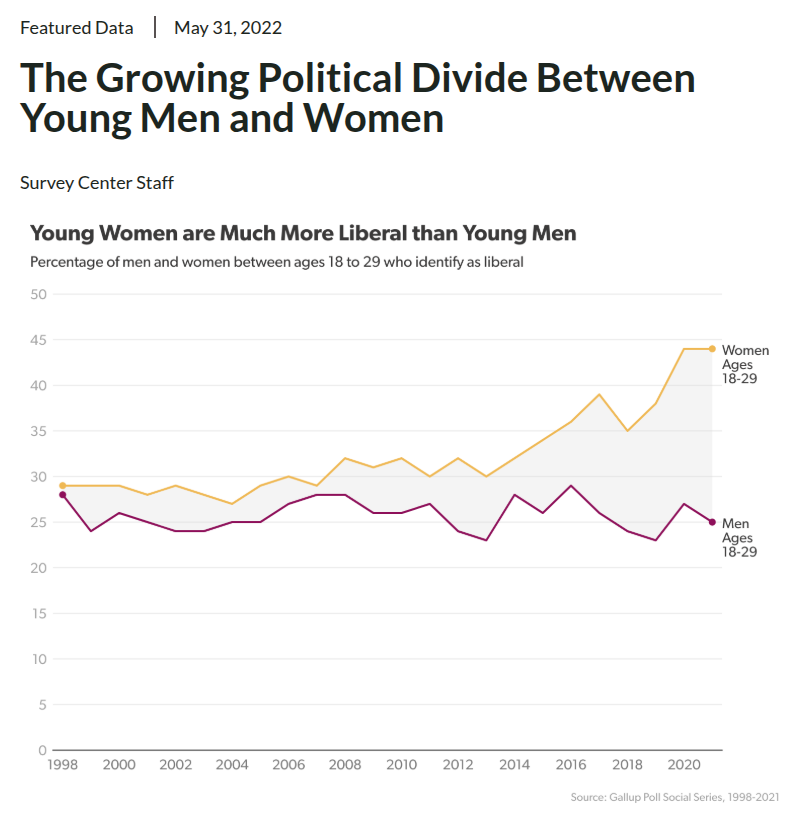
One of the central differences is that the female content aimed at othering and hating men is an essential part of the mainstream, and is at home in respectable spaces where it often finds defenders and celebrators. The point here is not to excuse the unique awfulness of Manosphere content, or to enable male cries of “they’re doing it too!”. It’s only to note firstly that young men see all this, and the hypocritical stance as to which edgy or hate-filled content is acceptable and which isn’t probably doesn’t hurt the popularity of the Manosphere. It’s also to note that if the internet generates a lot of socially poisonous content with bad political implications that doesn’t just happen amongst men side and it misrepresents something essential about the nature of the problem to pretend it does.
A Progressive outlook can be a burden in coming to grips with this point, because it can stop observers from understanding content tailored to male preferences as legitimate. When he meets the fans of one particular creator, they describe the important lessons he has imparted to them to improve their lives. “As a man you’re born without value,” one of them says. “The lesson is to never give up… you have to build that value… nothing in the world is given to you… you have to work for every penny.”
They go on to elaborate on these views and come to some zany conclusions but I think in essence this is a perspective that 1) obviously true to some degree, 2) appealing to a lot of men and delivered directly to a male audience, and 3) that many men would find it inspiring and helpful. It’s easy for Louis to say (as he has in subsequent interviews) that even if such advice is useful, men could get it from other sources outside the Manosphere. But in a world that constantly boosts therapy culture as the only legitimate path to personal improvement, where else will this message come from?
For me the giveaway here, and probably the key part of the documentary that sums it all up, is Louis’s reaction to this advice - which is to say “but don’t you think women have it hard?” There it is! This comment provides us with the roundabout answer to the question “why can’t we have a Progressive Joe Rogan?”, or similar plaintive cries that we should replace existing male-oritened content with a version of the same thing which advances a Progressive perspective. If you regard men as emotionally malfunctioning women, and as members of an oppressor class, then of course any attempt to talk about their own problems in their own way is by definition a sinister and insidious political development to be opposed. But in taking that opposing stance you are unintentionally insisting that Manosphere or something like must exist.
If the documentary is a catalogue of blindspot, one of the most basic is the assumption that the guys featured are influential, and that their influence manifests in the radicalisation of men away from Progressive ideas and towards conservative and far right ones, and into violence. But the material success of the subjects of the documentary is uncertain, and Louis seems to want to have his cake and eat it on this topic. If this whole thing is a scam, then these people can’t be making that much money; but then that also would logically mean that their appeal is smaller than they pretend, and so too is their influence. They can’t be selling fake success but also be incredibly successful. (As an example, here is HSTikkyTokky admitting his lifestyle is fake.)
But the biggest and most interesting blindspot is the way the Manosphere as featured seems to exist as the logical extension and conclusion of a society with a dominant Progressive culture. Just look at the creators: they are multi-ethnic and often minority religious. They often seem to have been raised by women and expressly schooled in the values of egalitarianism, an appreciation of diversity and pluralism, and opposition to the standard list of unProgressive phobias.
They share many of the same priors as Progressive thought and society in relation to women and their role in the world. The manospherists make money off of, and exist as an adjunct to, a society that centres sexual liberation and the technological methods we have developed to allow people (including women) to monetise that liberation. Despite coming at it from different angles both the Manosphere and Progressive culture essentially agree that only men have moral agency, since agency implies sole responsibility for some part of the world around you, and in turn a blame that can’t be pawned off on other social structures, groups or individuals. Both believe that the world is only as good as men make it and women are along for the ride.
They are the perfection of Progressive cultural rule even if they do not perceive themselves that way. Every single thing they do is either an unavoidable and impotent reaction to Progressive cultural dominance, or something that makes sense within the context of that dominance. Louis’s prescription for this problem, I’m sure, would be the usual one of a further application of Progressive thought. Think about that.
The final thing I will comment on is the audience for this stuff - who they are and the way that they consume it. I think this is the key absence at the heart of the documentary and also the most important thing it gets wrong. If our concern is the impact this content has on men, and the driver of men’s demand for it, then we need to look at this problem from the other end of the telescope.
What were you like when you were 12 to 15 years old? I was a Marvel comics reading, Dungeons and Dragons playing, Star Wars watching dork. Later in my teenage years I continued to be all those things but also read Camus and watched David Lynch movies and tried to be a writer (a different kind of dork). That kind of life, where you are exposed to and seek out and value ideas and sensitivity and creativity is alien to the world featured here. The subjects of the documentary were my philosophical and natural enemies. I hated them and their world and they hated me, and I would have avoided even being in the same spaces as them at all costs.
But no one is any one thing and even timid nerds have the same transgressive, prurient impulses as any other member of their peer group. And the point about internet content is that the level of consumption of any content is self-directed. Had this content been out there in the early to mid 90s I probably would have watched it because it’s titillating and grotesque and vivid, as I did with whatever the equivalent content was at that time. Yet I still would have been the same Sensitive Young Man. You don’t have to live with both feet in that world and I would guess most young men don’t.
Reflecting in this way on how people really live undermines the radicalisation thesis. Louis is an old media figure and is thinking about this stuff from the old media position. The output of a single content creator is not a tv show that you sit down on your couch to watch, with a mug of tea and a packet of digestives to sit through from beginning to end. No one consumes content in that way anymore. The people featured here aren’t channels, they are one fleck of froth on a titanic wave of content, and I would bet that the portion of their audience that only “lives” in the Manosphere is not large. Embedding yourself with them for a couple of days makes for a good story but is not a good way of replicating influence or viewer experience, which is what is really at issue. Only a boomer - or someone seeking to make some exploitative and misleading content of their own - would think that it is.
Other articles on similar subjects:
Men as an Out-Group in Popular Culture

Sabrina Carpenter launched a new album this week; in June it had been prefaced by a single called “Manchild”. As with a lot of her songs the subject matter was the useless repulsiveness of men:
The “Mediocre Man” as Online Hate Figure

As the empowerment of women has progressed, the sexes are directly competing for the same cultural space in a way they never did in the past. In some parts of respectable and popular culture - pop music, progressive politics, fiction - women have made stunning in-roads, with men seemingly reduced to out-group status. The change has happened so suddenly that our cognitive biases about men and women lag far behind. Women in the 1st world are powerful and agentic yet we still venerate ideas that originate from, and were legitimised by, their status as a marginal and powerless group. These include innate female moral superiority, toleration of a far greater in-group preference amongst women, and the sense that men and their preferences must always be a determining factor in an individual woman’s success. Hand in hand with this is our continued belief in the disposability of men, which has evolved but not disappeared, despite the decline in men’s cultural power and their changed roles in everyday life. Online, all of these factors collide to produce the ubiquitous hate figure of the Mediocre Man. I want to write about why this figure became such a common reference point, and the lack of inquisitiveness of men’s inner lives that powers the meme.
What’s Wrong With the “What’s Wrong With Men” Discourse

I’m going to try and answer this intriguing question from Twitter user youngvulgarian, who posted it last week. The ostensible reason for her tweet was this clip of Caitlin Moran that circulated on Twitter a little while ago, speaking about a book she’s written about men, boys, masculinity, men’s mental health etc. Loads of people had a good ol’ dunk on…
I won't bother with the new Theroux documentary for the banal reason I've cancelled Netflix, but it seems to echo his previous work on the alt right. (Theroux has in fact said as much.) That documentary was interesting because it showed how out-dated his techniques have become.
Back in the 90s Theroux offered a rare glimpse into weird subcultures and people. Compared to what my Twitter feed can show me 24/7, the subjects of these old films are tame. Newspapers also frequently run pieces about modern weirdos like Clavicular, Andrew Tate et al. Theroux has lost his monopoly.
At the same time many of Theroux's prospective subjects are much more experienced in broadcasting themselves, and thus much harder for him to crack. Back in the 90s a UFO enthusiast maybe had a zine, but it was a rare privilege for a real journalist to come and film them. These days they would have their own YouTube channel, podcast and whatever else.
The last point is that Theroux has clearly become high on his own supply. Like anyone in show business, he always had ego, but he's now trading off his reputation to a far greater extent. (One alt right subject even wore a Theroux t-shirt during an interview.) The podcast format probably hasn't helped him, because the vacuum of hours of audio inevitably draws hosts to fill it with their own idle musings, and we can all talk about ourselves for days.
I remain a fan, but frankly his shtick doesn't work any more. If he wants to make another great documentary something needs to change.
Initial comments
1.digital age yes, in an era of catchy phrases, many would only skim the manosphere sites.
2. Who are taking most note of 'progressive' talking points. Is it more the pmc class professional management class?
3. The manosphere is somehow an extension of progressive culture. I need to think more about that.
4. Yes I don't like the manosphere caricature types who a bit moronic and needlessly
aggressive too. A sort of decorative superficial view of masculinity But
. This stigma attached to just being a man is a serious problem. It's one dimensional and reeks of sour sniping. It's fucked up what's termed the left but isn't that more liberal 'progressive'.
5 okay many men as well as women oppose domestic violence against women, for instance' but I'm also reactionary
6. Saying you are a feminist man sounds a bit fake to me. Do you have to and that doesn't mean necessarily that you will be fully accepted. You are for some ideologues after all, tainted by being a man