
In his 1989 short story “Love in a Colder Climate” (it’s in the collection War Fever) J.G. Ballard posited a future in which sexual diseases have run rampant and turned young people off casual sex to such a degree that the government has to conscript them into procreation. The process is overseen by a priest-caste on the male side and nuns on the other. In the story, two characters conscripted together fall into a blissfully sexless love - which is illegal, as it means opting out of their national duty. The male character tries various ruses to thwart the government so the two can remain faithful to each other. At the end, he is caught and punished with castration - a fate he (and this is so Ballardian) eagerly embraces as a way of shaking off the whole rotten system. It’s a slight story and not one of his best; but in describing how sexual permissiveness can first destroy but then unevenly recreate the impermissiveness of old, and in particular the idea that sexual liberation becomes such a dreadful burden that people reject it, he was ahead of the curve as usual. So with that in mind: let us turn now to our own sexual dystopia.
The Cornell Seven case happened in America, not in Europe and certainly not in Ireland, so we should be careful about taking too many lessons from it; despite the dominance of that country and it’s culture we’re not yet fully aligned to its norms around consent, media behaviour or campus bureaucracy, although of course we’re getting there. In particular the fraternity/ sorority structures that were a feature of this case seem very weird to European eyes. In spite of the parochial nature of some facets, it’s also reflective of internationalised changes in sexual behaviour, the gendered split in partisan politics and in media. So it’s worth talking about, even for an outsider; doubly so since it seems to carry so many political implications for men as an interest group, yet I’ve seen almost no analysis from that perspective.
As usual the immediate impact of details of this case breaking, after the standard condemnations, is a flurry of articles in the storied “teach boys not to” genre. There’s loads to pick from; here is a local example from Ireland, written by well-known Green politican Hazel Chu in her characteristic breathless and unreflective style.
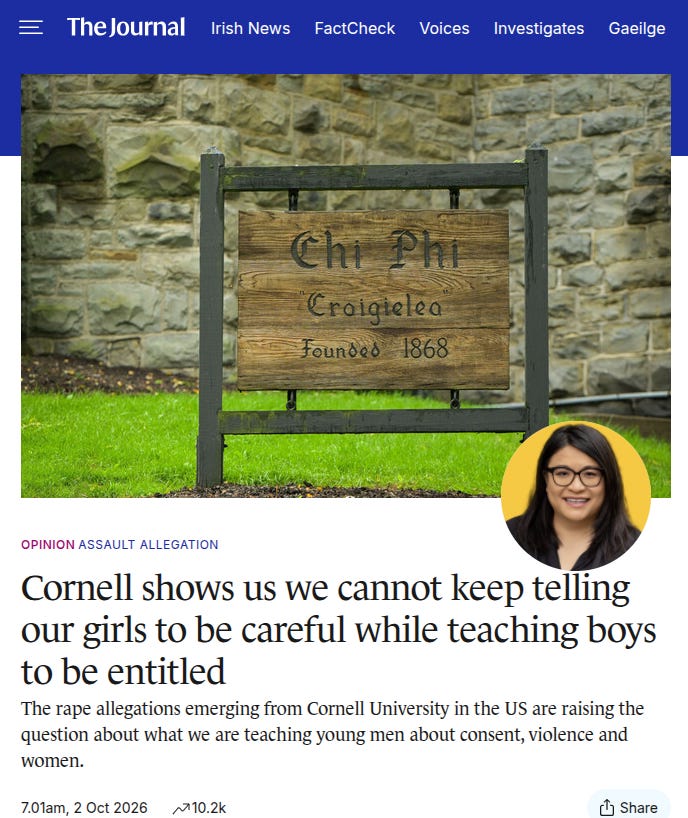
Chu is a good example of the authors of this genre of piece because of her bad record of interventions on this topic. I’ve written about this in the past too, here and here. That first one is eight years old, and though as with anything I’ve written that long ago I disagree with plenty of it and would rephrase given the chance, the essentials are correct. The “Teach Boys Not To” genre never wrestles with the fact that the current generations of men (in the west at least) are the most sexual-consent-sensitive to ever exist and have been raised in that environment and in those values, so it may be that whatever we want from education we’re already getting - or that the quest to patrol their inner lives is itself having a counterproductive effect. The authors of these pieces never admit (or realise) that what they are trying to do is regulate expressions of sexuality, or that behaviour on that front is part of a complex web of behaviour that introduces responsibilities on all parties - and that, in a liberal society, these can’t be reintroduced selectively and on one side only - sorry for quoting myself*, but
… (the sexual restraint of older times) was not a single discrete belief but one of many, beaded on a string – you can’t pick up the individual bead without lifting the whole necklace. If you want the old-time civility then you also take the other old-time beliefs that were adjacent to it, that flow logically from it, and that are it’s emotional foundation…
The second article linked notes that the whole “Teach Boys Not To” genre is built on the probably false belief that regulating small incivilities will have the end result of managing more extreme behaviour, like a kind of moral broken windows theory - endorsed, of course, by people who normally hate such theories. Anyway - I don’t credit myself with any insight, the point here is that these are very obvious complexities that anyone who spent five minutes thinking about the topic would come up with; and yet here we are.
The “Teach Boys Not To” articles are representative in a negative way of the reactions to this case in legitimate media, in that anyone looking for close examination of the moral or legal complications highlighted by it - or how we will come to grips with those - would have been disappointed. To take one more or less at random, this editorial from Time magazine essentially pretends those complexities don’t exist. I think men will notice these things, with everything that implies politically.
What happened in the Cornell case does seem horrifying to me but it’s impossible as a man to read about it and not wonder at the possible implications, situations where our beliefs about consent and sexual liberation seem to rub up against each other in a way that’s impossible to reconcile. Everyone involved in the Cornell case - with it’s chat messages about Free Pussy from the men, initial happy confirmations of being a slut from the woman, and sunny references to gangbangs from both - behaved like a products of a fully pornografied environment (let’s call it FPE). One feature of the case that is reflective of society at large contained in microcosm in the case is instead of acknowledging these two things - the moral centrality of consent, and the normality of the FPE mindset - are in direct contradiction to each other, instead what we get is the depravity of the latter expressed through the language of, and with the legal and moral consequences of, the former - to queasy effect. The wholesome chungus affirmation-talk from all parties about such a sordid situation before the accusations were levelled is low-key one of the most distinctive and repulsive features of this case - it’s definitely the most offensive part from an aesthetic perspective.
The question of how all this affects men’s behaviour or thought processes is probably not one that I’m best placed to answer. Any analysis will note that increased risk-taking (of which there was lot’s going on here) is a key feature of male psychology and especially that of young men; I suspect I’m amongst the top 10% of most risk averse people on the planet, amongst men maybe the top 1%. If I was quietly enjoying a drink at a party and got a chat message saying there was “free pussy upstairs” I have to admit my first thought would be to take out my SIM card out of my phone and bite down on it, throw the phone in the nearest river, and then catch a plane to whatever country with no extradition laws I could get to that same evening. But then of course it’s exactly because I have that attitude that I’m never likely to find myself in that situation. There is a proportion of men who will never think that way. My point is that the sociological consequences of this type of case, and the culture that creates it are twofold - one is the general male withdrawal from culture, politics, romance, life, work and everything else that you see everywhere in the civilised world. The other is that, perversely, you may see more Cornells because of a concentrating and sorting effect, with the most risk averse opting out of everything like a tide rolling back to reveal the ugliest tangled wreckage piled up on the shore. You will end up with (and we have) extreme (and widespread) passivity and disengagement on one end and a nub of extreme recklessness at the other, with normality the no man’s land in the middle, a hollowed centre being the motif of our age.
After all, if our society’s guiding principle is “you should be able to do whatever you like as long as it doesn’t harm anyone else”, then key part of that sentence is not “do whatever you like” but the “… as long as…”; because the person who can determine what exceptions meet that criteria is a person who has a great deal of power. The unintentional consequence of our golden rule is to empower people who are best at expanding the concept of harm, or best placed to make claims that they are suffering harm simply by existing, or (most importantly) anyone claiming to act on their behalf. It disempowers people who are bad at those things, or are less able to claim them. “Consent” is part of that tool-kit. That explains why the idea of the increasing centrality of Consent can feel good, right and important (because it is), but also ominous. It certainly explains why Consent can seem essential when determining if certain parties were harmed in a particular incident yet to offer no relief for others (“why doesn’t it matter that I was high too?”).
The primacy of Consent is an elaboration of the basic principles of our world, so even if you notice some inconsistencies and difficulties with how it’s applied, there’s no real scope to pick those apart. People lack both the language and the mindset: it’s interesting that even people who allege skepticism about some details of the Cornell case habitually still refer to Jane Doe as the victim where they argue the facts have not yet been determined. Even people who reject progressive principles use its language to describe their world, since that is the language of decency and upward mobility; but that language itself contains those principles. A good (different) example of this is the way the sleaziest and most reactionary tabloids will still use the preferred pronouns of people who claim a trans identity. The point is - if you feel yourself part of a group that is philosophically disadvantaged by this development, retreating is a more tangible option than arguing back.
A selection of texts between various parties involved in this incident have been leaked; I have zero doubt that the ones that have been made public have been leaked in order to support one side but even the ones I’ve seen do cause me to feel a lot of sympathy for the woman involved. I’m projecting my own feelings onto her but I see a person doing something awful to themselves in order to fit in or be liked or loved, and then fawning to explain it away afterwards as a positive experience - because to acknowledge the reverse is true is just too pathetic and annihilating. I also think that people who have sought to debunk the facts of the case haven’t given the proper weight to the physical strength difference between one woman and a single man, let alone multiple men; it’s weird to see groups of people who are normally determined to emphasise the essential nature of sex differences be so blind to the consequences of them in influencing people’s actions in this case. Part of the difficulty in this case arises from the fact that we no longer (if we ever did) have the moral language to describe and condemn something that is awful and sordid, but not actually illegal.
The respectable media was fully behind Jane Doe when the story came out; they haven’t changed their minds but I’ve sensed a certain drifting away from her cause and less strident writing about her. You wouldn’t expect there to be a drift in the other direction and there hasn’t been; the most notable people speaking on the case are still dealing with the complications implicit in it by pretending they don’t exist. When you look at recent polling over which parts of which coalitions blame the opposite sex for their problems, the key theme was that Progressive women regard men as the primary cause of their ills. I make no judgement as to whether that’s true or reasonable, only that it has consequences. It’s not really possible to reconcile that view into a framework that appeals to both women and men. Again: men are a distinct interest group whether they acknowledge they are or not, and it’s hard to believe that as a group they won’t notice this and act (which is to say vote, but also evade) accordingly. A phrase that is re-populairsed from time to time when issues like the Cornell one hit the headlines is “there are no perfect victims”, and it’s true: there aren’t. But the necessary counterpart to that claim is that there are no perfect villains either, I’ve yet to see anyone wrestle with the implications of that.
*I’m not sorry at all
Other articles on similar topics
The Different Challenges of Male and Female Online Radicalisation
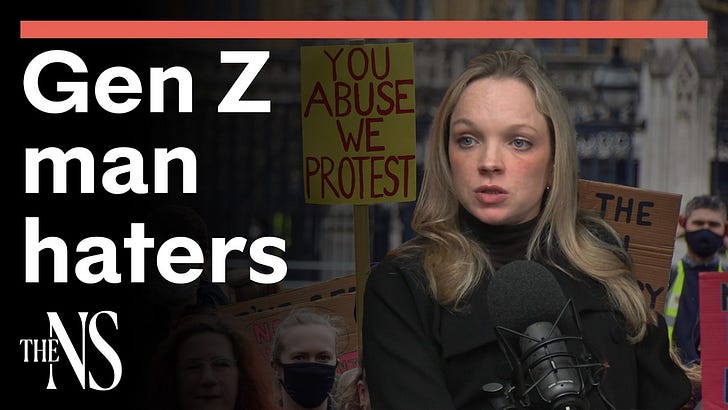
In April the UK’s New Statesman published an article entitled Angry Young Women, which uses new polling to
Men, Withdrawing From Work and Life

Darby Saxbe, a psychologist and Substacker, has been publishing a series on feminism and men (“Has Feminism Been Bad for Men?”), the most recent of which is here. They’re all worth reading. In this latest article she covers feminism’s impact on men in “culture, specifically education, male mental health, and misandry” and touches on this idea that men have withdrawn from certain parts of working and public life, and why that is.
“The Great Feminization” Is Here to Stay, and We Are Going to Have to Learn to Live With Each Other

Following on from a widely-viewed speech she gave at a National Conservative conference, Helen Andrews published an article in Compact on “The Great Feminization” (henceforth TGF). Articles don’t really go viral any more, but this one did; between the two pieces she’s clearly caught on to something. Her overall thesis is that what has been termed wokeness is just the increased cultural power of women, which she positions as a problem - a catastrophe, in fact.