
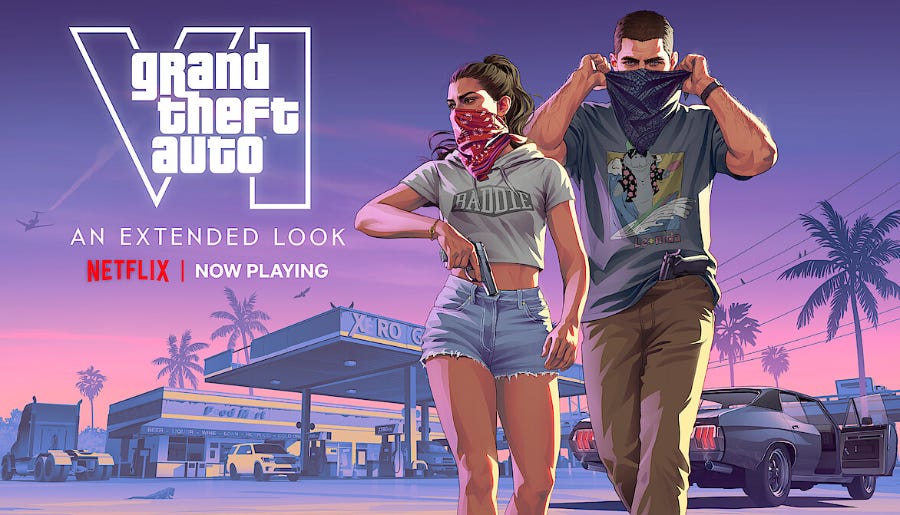
The launch of GTA VI, the titanic groan of our forgotten monoculture, is getting closer, and the marketing is ramping up. During August, some clips from the game were released, including a long trailer on Netflix looking at the game mechanics, action sequences, and relationship between the story protagonists. One notable feature is that, as with Red Dead Redemption 2 and its soap baths and hair pomade application, GTA VI follows the trend in these games of an increasing focus on performing basic life admin activities in-game, for instance the gym visits in the screencap below as an example. (I note in passing that the female character in the screenshot appears to be learning to bench by repping 70kg in weight, which would easily put her in the top 0.5% of strongest women on the planet, at the start of her strength-building journey. Good for her!)

The USP of these games, and to an increasing degree of many AAA games, is an unrestrained open world experience. When the GTA games first became popular, this was the focus of the moral panic; that a player could do whatever they wanted including running people over in stolen cars and murdering prostitutes and the sense of mainstream coverage was the worst things a player could do were the point of the game, allowing players to fully live out their poisonous ids. I don’t accept that was ever an accurate reading of what the were games for, and in any case those two things aren’t contradictory; players were free in a macro sense but steered by the game towards certain activities. In any case it prompts two questions, which is if the appeal of these games is the freedom they offer, how do we explain the increasing tendency to micromanage the player experience, in this case by turning you into a turkey-toothed lifestyle influencer chud of either gender; I also think it’s worth asking that question as it relates to men specifically, since they are the predominant players of these games. The answer highlights something important about what they get from a world they are determined to lose themselves in.
People differ on what constitutes the first truly open world game (you can go back to things like 1985’s Mercenary ) but in the modern sense, it began with 2001’s GTA 3. Let’s take a step back and consider that one for a moment. This was the first game that offered you total freedom to do what you want in an urban environment, restrained only by the limitations of computer systems at the time, and the player themselves. It was violent and coarse as all these games are; that was and is a huge part of what players get out of it, but it’s the part that’s easiest to understand and most over-emphasised. If you wanted to slough off the main quest indefinitely and go exploring in the different neighbourhoods of liberty city you could do so, listening to the radio and doing taxi rides like a digitised Travis Bickle. The sense of total freedom was thrilling, vertiginous, and new; and utilised the unique expressive virtues of the medium. After all one can’t wander off-page or off-screen in a book or a movie. If a particular vista captures you in a film you can’t inhabit the main character and experience it for one hour, or two, or three, instead of the thirty seconds it appeared on screen. You can’t revisit the same place at different times of the day at different times to see how it looks in different lighting.
Someone circulated clips online during last week from a different GTA sequel, San Andreas. I noted that the English language doesn’t have, and needs, a single word for a pleasurable and enveloping sense of melancholy isolation that’s so characteristic of games at their best, and of these games - when they leave the player alone. “Solitude” isn’t the word because it doesn’t reflect that you are participating in a constructed space; you’re not just alone, you’re enclosed. “Liminal” is another word that people love throwing out, a very fashionable one particualrly in light of Backrooms and it’s links to online culture, but it means “a place between places” or the feeling of being in such a place - which is not quite right. In a way it doesn’t matter, the point is that GTA 3 was one of the first to capture and capitalise on providing that feeling of pure personal freedom in a huge but defined space.


Like many games of its type it limits your progress to zones which open up as you reach certain checkpoints. In GTA 3 you begin on one of three interconnected islands; the other two are closed due to a storm. During the first part of the game the player is continuously aware there is a wider and more exotic world out there that has been walled off from them, and that prompts you to progress. In-game, the opening of the bridge is communicated via radio. I wouldn’t expect a modern player to understand because technology has moved on but the experience of this moment - the sense of unprecedented, cavernous possibility and freedom instantly becoming even larger and more enveloping - I can remember when I experienced this moment in-game vividly (night-time, rain falling, radio burbling in the background) and it was one of the most memorable sensory and aesthetic experience of the last 25 years. The key to it’s specialness being a vertiginous sense of possibility and adventure, combined with personal ownership of those things. It could not have been delivered via any other medium.
I absolutely don’t think the yearning for this is exclusively male - there are lots of people who play games who aren’t men. But the dedicated audience for the GTA games is 80-85% male, so it’s indicative of something as it relates to what men versus women enjoy. My point is that commentators look at the violent escapism, the shallow, calculated transgressiveness and the juvenile humour that is hard-coded into the games and stop there. The sense is either that world is so cucked and oppressive that men can only find the freedom they need from nannying HR types in gaming; or alternatively men are so weak and incapable that they have backed down from the challenge of a changing world that they’ve given up and immersed themselves in a lurid fantasy. The thing both these takes have in common is that they see the root impulse to play as a frustrated desire to be an alpha, that is either noble or cringe. I think even if that’s true it’s also something else. If you watch people play these games their behaviour is often dynamic but a lot of it is also meditative; a great deal of the time is spent not really doing much else other than kind of just vibing. What the player is enjoying is not the thrill of conflict and transgression but of privacy, acting in a space that you know is yours and cannot be policed from outside.
I wrote previously about the inherent and sometimes maladaptive male drive towards self-isolation and loneliness, also linked below, and I think it comes into play here in understanding the appeal of these games. The popularity of isolating gaming amongst men tends to be seen as men running away from something in modern society; the alternative, which I think is true, is the structural explanation that games have become very good at providing a certain type of freedom that men have an innate craving for.
That’s what makes it interesting that as these games have evolved so as the microscopic management of the first person experience in a particular direction, and in general to corral and restrict the player by providing them with options in a particular direction, so interesting. The primary reason is the increased technological sophistication. As the technical complexity of these games increases the inner demand to use that technology to tweak and interfere with and massage the player experience becomes unbearable on the part of the creator. There is also an inherent relationship of tension between a creator and the end user, whose goal is expressly to take this thing you have created and make it theirs. I understand the risk from the creator point of view - you’ve made this multi-billion dollar product that your livelihood depends on, it’s very hard to relinquish control of it. Even the idea of doing so inflames your natural sense of ownership.
I think you can extrapolate some wider lessons here, and highlight a natural tension that exists and is resisted in all forms of entertainment but that games are the best at clarifying. Whether you use it for nefarious purposes or not, a feeling of freedom from oversight is a key experience that people need from art. It’s not a coincidence that every action movie now has to either be sent in an era when smartphones don’t exist or to find some way of taking them out of the picture. The paradox is that proliferating and omnipresent media is both the thing that people are trying to escape (the oppressiveness of the panopticon where everyone is tracked, everything is documented, every act is a performance) and the vehicle they use to escape (through endlessly proliferating art, entertainment and discourse that speaks to that discomfort).
The simultaneous desire to escape the world using technology, and to lock oneself in an artificial world, isn’t one that is solely desired by men. As I’ve been writing this, I’ve been trying to think - so then what’s the female equivalent of GTA, in the sense of a recent technological change that facilitates some ambiguous inner-impulse? The closest answer I can come to is the ereader and self-publishing boom in fairy porn. Games and spicy content are twins in more than one way; as technology has become more efficient at delivering these thrills, those thrills in their diluted forms have leaked out of the mainstream art and entertainment and of real life, as recent studies on the decline in sex in movies, and decline in sexual activity in real life attests to. Perhaps to assume that the “real thing” declining at the exact moment that the concentrated online version is intensifying is to make the classic error of assuming the activity that happens in the real world is real, and the digitised version is the fake. Marx in his oft-misunderstood reference to the opium of the people, said of religion that it was “the sigh of the oppressed creature, the heart of a heartless world, and the soul of soulless conditions”; even if religion was phony and preposterous, the impulse it spoke to was heavy and sad and real. Maybe the fleshpots of liberty city, and its lowbrow denizens (the real ones and the digital ones) deserve to be considered with the same weight, given the part they play in our culture.
More articles from me on similar topics:
Grand Theft Auto 6, and Games vs Movies

The trailer for Grand Theft Auto 6, the latest in the groundbreaking game franchise, launched five days ago has 136 million views as of today. GTA 5 came out 10 years ago and has had astonishing longevity - it's still played as much today as it was then; it regularly appears at the top of streaming and sales charts, and the sequel is so hotly anticipated that trailers for the trailer were causing global newspaper headlines weeks ago.
Maybe Men’s Problem Is That They Like Being Lonely

The release during June of a UK report entitled “Loneliness, isolation and social connection among boys and young men” gives us yet another opportunity to think about that topic of eternal media interest, the “Male Loneliness Epidemic”. This report focuses on the idea of stigma, in particular that “becau…
I Love Podcasts but I’ve Kind Of Started to Hate Them Too

A couple of weeks ago, late at night while I was home on my own, all the power in my street went out. Since this was in Ireland during summer, a place where true night never arrives, I wasn’t plunged into total darkness but something close to it. I had stupidly let the battery on my various devices run down (I’m bad for that) and so couldn't watch videos on my phone or laptop; I had to stay up and wait for my wife, who didn’t have her keys. Long story short, the only way I had to occupy myself for the two or so hours of the outage was lying on the couch listening to podcasts. This drew my attention to something I have become increasingly aware of over the last few months but mostly don’t focus on, which is how many podcasts are unlistenable without the accompaniment of a distracting activity.