
The release during June of a UK report entitled “Loneliness, isolation and social connection among boys and young men” gives us yet another opportunity to think about that topic of eternal media interest, the “Male Loneliness Epidemic”. This report focuses on the idea of stigma, in particular that “because boys and young men face severe social stigma around admitting they are lonely, the actual scope of the problem is vastly underestimated in official health data.” I don’t question its conclusions; but the quote above repeats some familiar ideas and assumptions about men’s relationship to ideas of loneliness, isolation, and solitude that crop up every time the issue is discussed and that never sit right with me.
One of the characteristics of “Male Loneliness Epidemic” talk is that men almost never bring up the subject unprompted themselves. There are a couple of reasons for that; one is the general one that men don’t find talking about their problems to be fulfilling - that’s a whole separate discussion. On the specific side, while making friends and maintaining relationships does seem to be harder than it used to be, my personal experience is that men enjoy long extended periods on their own. I can’t help but wonder if men’s problem with loneliness is that they need it, like it and that it suits them a little too much - and like all psychological and spiritually fulfilling things that means it can become a crutch. It’s a perspective one doesn’t often hear - that men have a skill and a taste for isolation, and need it in a way women don’t, to a degree that can cause them difficulty.
The conversation about male loneliness is often driven (and seemingly solely driven) by women and their concerns for men; that perspective colours the conversation in ways that can obscure the men’s feelings about the problem. The obvious place to start is therefore with what research says about men and women’s differing average desire for time apart from others.
I was very surprised when I started looking into the science that the accepted position is that women have deeper need for it than men do. Summary of some representative studies here:
This National Institutes of Health study reported significantly higher affinity for solitude than men, and experienced higher levels of “aloneliness” (the subjective distress of not getting enough time to oneself) compared to men.
The University of Toronto Department of Psychology study of 6,000 single adults found that single women are significantly happier being single, possess higher life satisfaction, and have a much lower desire for a partner than single men, in part due to their greater comfort with living alone.
This meta-study in Psychology Today concluded that in every study where a statistically significant gender difference appeared, women appreciated their time alone more, were less likely to try to avoid it, and were more likely to report a deficit in getting enough time to themselves.
As well as an innate preference for time alone, the research often frames the preference as a structural matter, arising from carrying a heavier load in domestic life (including planning, scheduling and managing households) and exhaustion from being the default support in the lives of children, husbands and boyfriends, even parents. In the research the constant demand that women be emotionally accessible is what drives their need for isolation. The studies also reflect that the desire for time alone is not unfocused or unlimited but for time to self-actualise and engage in fulfillment through hobbies and purposeful self-reflection.
I don’t doubt the research says what it says, that women have a strong drive for personal time that is normal in all humans, nor do I underrate the reality of some structural factors here - I genuinely have no idea how mothers, even ones with very considerate and collaborative partners, cope at all. But a lot of this flies in the face of everything I have seen and experienced in my own life, when it comes to both men and women.
My personal observation has been that women if left to their own devices for an extended period of time quickly get itch to be around other people, whereas I think quite a lot of men can stare off into space on their own and be happy for an almost indefinite period of time and not only enjoy that but find it to be a relief. If you think of a teenager who won’t come out their room, or of a person of whom you’d say they need a couple or hours a day by themselves in order to function - the person I envision is a man, and I don’t think it’s just that I’m a man, and I’m like that. Regardless of whether, say, they need an hour of quiet in the evenings to decompress while they eat their dinner, every woman I know is essentially a sunflower, brightly bending towards the light of human interaction and nourished by it. That’s not true of the men I know.
I think it’s important that the research relates that women desire time alone for something and always buttressed by social interaction. Time apart is always held in place at either end by time with other people; I think for women those book-ends are the thing that gives personal time its shape, and without it, it’s meaningless. I think men like isolation and time alone for it’s own sake. The difference is between someone who drinks a single glass of wine at the end of the day as signal that now it’s time to relax for an hour, and a person who is tempted at all times to smuggle a bottle of scotch in the toilet and guzzle it all because they like the way alcohol makes them feel. Women have less of an affinity for isolation for its own sake, which means they can pick it up and use it in a measured way, but then put it down and go back to life.
Where men do have a desire for time alone, how does the research explain it? You can probably guess. Social research has trouble understanding men as social actors with their own impulses and tends to regard them as psychologically malformed women, or as being misshapen by the undeserved privilege they are handed by patriarchy. Where there is a different perspective or tendency between sexes, the female one is presumed to be the morally and practically correct one, and the difference is always explained as an innate deficiency on the male side combined with the negative effects of a social structure that uniformly favours men. That’s the case here, with the general sense being that men enjoy being in places where they are not required to express emotion (because society has not taught them how to do that); also that they use isolation as a way of hiding vulnerability by not exposing themselves to social interaction, and of way of indulging a lone wolf fantasy of the “Wanderer above the Sea of Fog” type.
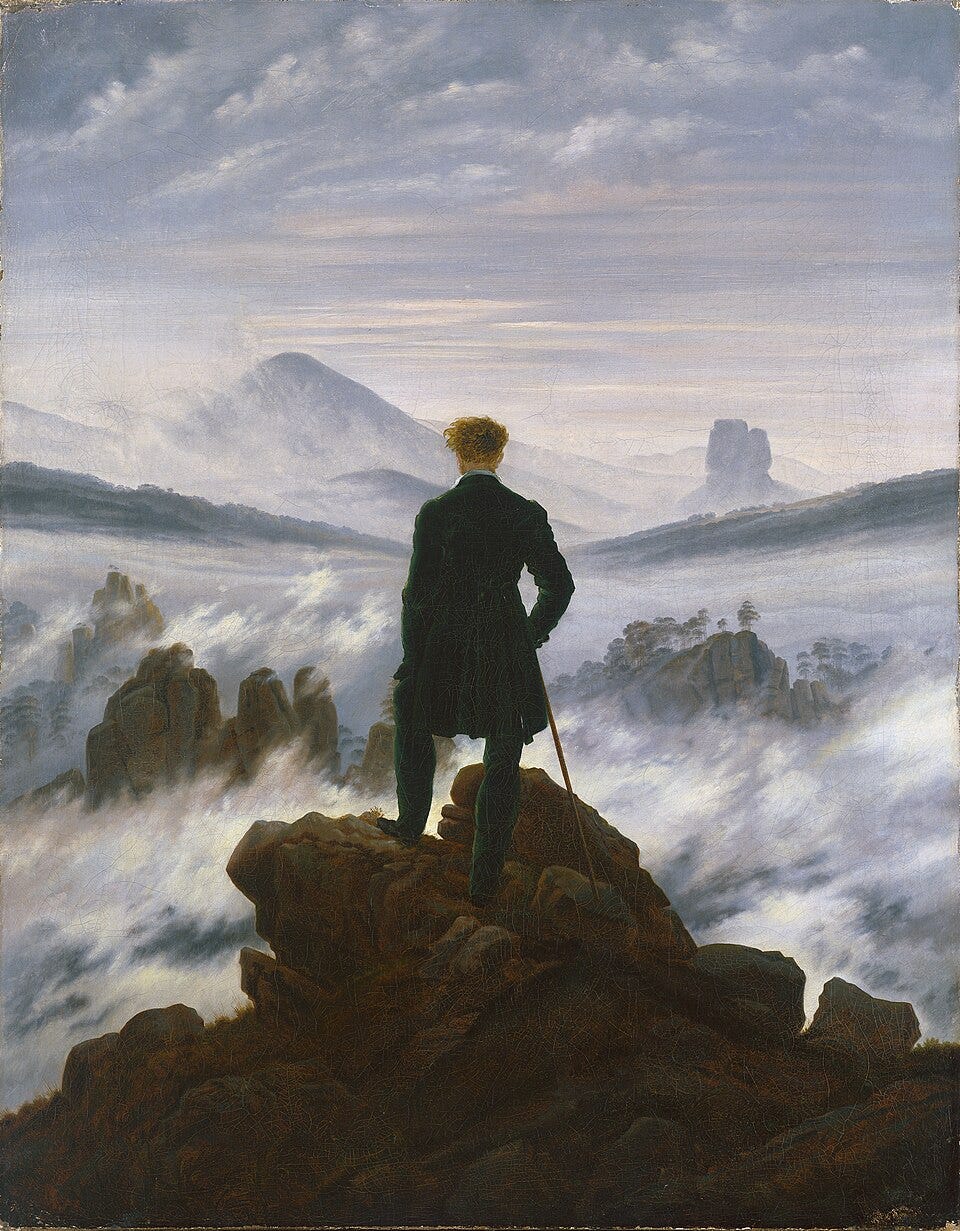
I’ll admit there’s something to this, though I’d frame it in a less pejorative way. I think that men are drawn to isolation because they like the idea of owned space, and isolation is an easy way of creating that; manufacturing a place where everything within reach belongs to you and nothing external is expected of you, and nothing is going to enter into your sphere as a challenge that you are forced to meet and overcome. Men are aware that their value and social status is determined by usefulness, accomplishment and strength, and while most fundamentally feel that structure is correct and wish to prosper within it rather than protest it, it’s hard. Isolation is a way of gaining relief from that and creating a space where strength, security, and adequacy are guaranteed. That reflects that the male need for boundary maintenance and psychological “owned space” is one of the deepest and most fundamental ones that men have.
In relation to the discussion about men and loneliness, my personal difficulty is that I don’t recognise myself in it. My preference for long periods of isolation from other people is one of the definitive characteristics of my personality, I draw a lot of satisfaction from it and I feel the need for it all the time; by the time it ends I always feel that I could take more of it. I thought in my teens and twenties that it was inherently maladaptive and that I was running away from something, but as I’ve gotten older and more comfortable with myself and the world, the desire for almost unlimited amounts of what the research terms “autonomous solitude” hasn’t really subsided as much as I thought it would. I am at a very extreme end of need for this, but I think most men are at least a little like me but I think relatively few women are.
I don’t think my preference for being alone is interesting or deep, or endearing, and I often find it exhausting and irritating. One of the things I need from those closest to me is a willingness to leave me alone all the time, which is infuriatingly contradictory. Again, without having research to hand I think “I need a lot of distance, space and time apart even in a loving relationship” is a sentiment that’s much more common in men than in women.
Even if you don’t accept that there is a male loneliness crisis per se, there’s a wider lesson we can learn about the relative draw that isolation has for each sex, and why men might sometimes get stuck on it like quicksand. Men and women are energised by different things and if a political programme seems to lean too heavily on the sorts of emotional and social connections that women prefer, the risk is not only that it won’t appeal to men but may repel them. One of these key things that men like and need boundary maintenance and owned space. Any socio-political approach that revolves around dissolving emotional boundaries is going to seem inherently weird and off-putting to men. It is going to cause men to retreat to a space where that is not demanded of them, since that’s the easiest thing to do and it is also facilitated by technology and an atomised society. It is going to provoke the exact withdrawal and boundary-drawing that you are trying to prevent.
The data on whether there is actually a Loneliness Crisis even happening with men is uncertain. This study from the American Institute for Boys and Men from last year convincingly argues that if such a crisis does exist, the fault line is class not sex. But it’s one thing to say that fears about a male loneliness epidemic are overblown; and another to say (which I think is true) that the modern world creates some problems and dangers related to isolation that pose a particular type of threat to men, because of some innate qualities and preferences they have.
In particular it’s important to understand the differing impacts of technology. The case against phones may be overstated but clearly there is something about, say, image-based platforms like Instagram, that latches on to powerful tendencies in women’s psychological make-up and steroidally charges them until they metastasize. Perhaps the same is true of men and isolation: that they like it so much, that the ability of technology to provide and facilitate it can turn it into a trap that it’s very easy to get stuck in. It’s not only that technology can provide a kind of enveloping shroud that you can cosy up in, but that it does so while also addressing the specific male need for accomplishment and recognition, by providing a phony facsimile of those things that prevent you from seeking out the real thing (gaming is a particular threat in that regard). In order to combat those things I think you need to understand why they would be superficially fulfilling in the first place, which in turn requires understanding something about men’s psychology.
Articles on similar topics
What Covid Did to Men

A recent article in Vox (yeah, I know) highlighted the growing cultural power of what the author describes as the “anti-woke tech bro”, a mutation of the old style Libertarian and described as follows (emphasis of the final sentence is mine):
Men and Progressive Culture on "The Pitt"

In Season 2, Episode 8 of Hospital drama The Pitt, the Emergency Room doctors stitch up a party girl who has bitten a chunk off her own tongue while drunk. Even as they sew she dips in and out of consciousness, but she is aware enough to confirm she’s an everyday drinker. As we watched at home, my wife and I speculated how this would play out in an Irish hospital… with an exhortation to cop yourself on and stop being an idiot, some grudging admiration for being such a character, maybe a lament from the doctor that they haven’t had time for a pint recently themselves. We were certain it wouldn’t end with the girl being referred to rehab, which is what happens in the show - an hilariously American reaction. These little cultural quirks and tics of The Pitt are one of the things that keep you watching; but attitudes to alcohol are not the biggest or strangest of it’s blindspots, not by a long shot.
The Different Challenges of Male and Female Online Radicalisation

In April the UK’s New Statesman published an article entitled Angry Young Women, which uses new polling to
One summer back in the 2000s I had enough money to quit work for a while. So I suddenly didn't need to go to bed early or get up in the mornings, or do anything that I didn't feel like doing. I was living alone and did my shopping at the 24hr hour Asda, walking the mile there at 2am and using the self service machines to pay. I think at one point I must have gone 2 or 3 weeks without speaking to anyone at all. And it was fine. I even think back to it sometimes as an idyll.
On the other hand I greatly prefer working in the office to working from home. But is that because I like the companionship of fellow workers or that work is an intolerable intrusion on what should be my own time and space?
I can't relate to this loneliness epidemic talk at all, I have a rich social live and can't imagine otherwise. For example there is this guy in Scotland or whatever and he writes stuff on the internet, and I pay 7€ per month and comment on the articles and he sometimes likes my comments and everytime I am like BANTZ!