
Irish politics is, from an outsider’s perspective, a swamp. You can’t quite figure out what role anyone is playing; nothing seems to map on to the usual recognisable landmarks. Irish commentators often watch with mixed delight and contempt as wanderers stray into our national conversations and end up face down in the mud.
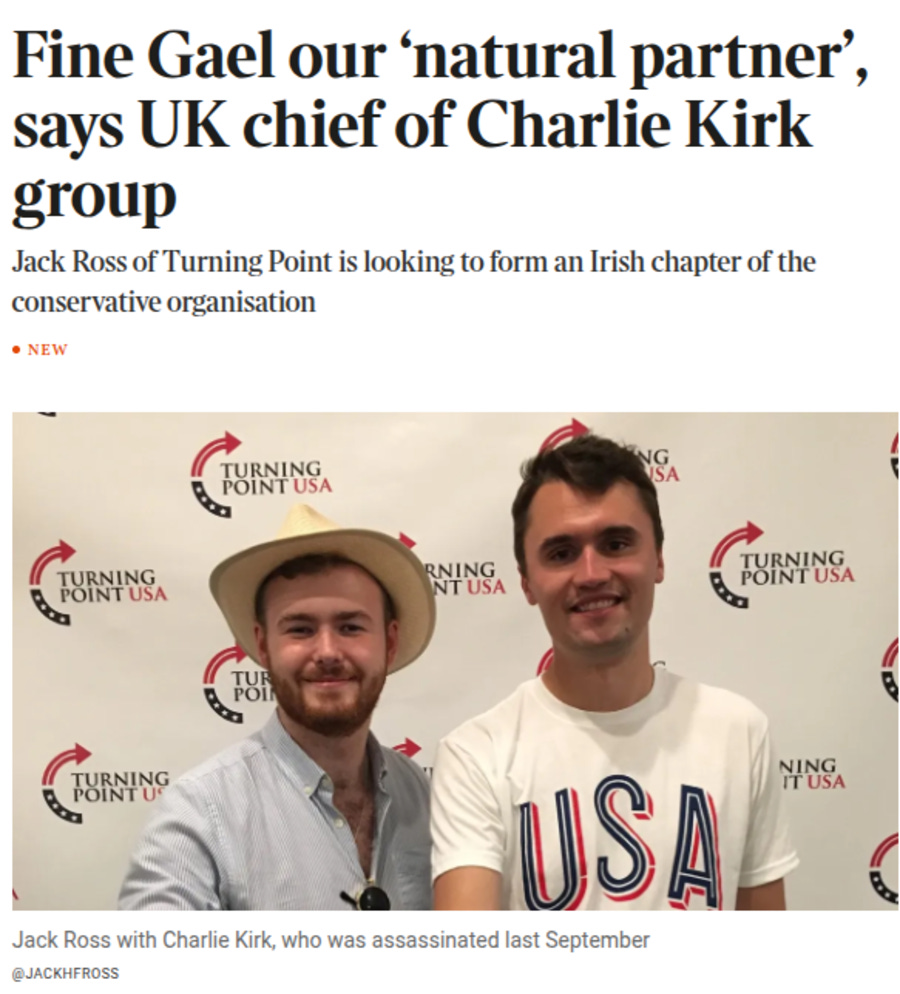
The most recent example occurred during the week, when the head of the UK wing of the late Charlie Kirk’s conservative activist group Turning Point flagged up that they were interested in expanding their operations across the Irish sea. The point that provoked the most hilarity was who they identified as their most likely national partner.
Jack Ross, the chief executive of Turning Point UK, has said Fine Gael is seen as the natural partner for an Irish chapter of the group made prominent by the conservative campaigner Charlie Kirk.
Ross said discussions had taken place about establishing an Irish branch of the organisation and that Fine Gael had been earmarked as a party Turning Point planned to approach.
He said: “My understanding is Fine Gael are like the Conservative Party.”
I’m mainly writing about it because it’s so funny, but also because it helps illustrate the uncertain future of populists movements in Ireland as a pure replica of those happening elsewhere in the anglophone west. It also demonstrates the folly of trying to apply an anglo-american lens to Irish life without any local knowledge. You can think of this article as a continuation of the ones I wrote recently on the rickitiness of The West as a useful political concept (here), and my dim view of Steve Bannon’s boast about bringing MAGA to Ireland (here).
It’s true that of Ireland’s two largest and historically predominant parties, Fine Gael have been regarded as the more socially conservative or right-wing one. They have in recent times been more antipathetic towards Irish Republicanism than Fianna Fáil and I can see why that would appeal to a British person.
There is a symbolic residue of that in these positions in their DNA; they’re always going at it with Sinn Féin, and of the two parties it is Fine Gael’s leadership who are more likely to make gestures towards the importance of law and order, restrictionist sentiments on immigration, prioritising social cohesion over liberalisation and so on. This is never more than rhetorical and it is utterly refuted by their actions.
Fine Gael have been in power for 15 of the last 20 years, meaning that every piece of legislation that occurred during the Ireland’s golden age of liberalisation was either initiated by them, passed while they were in power, and/ or enthusiastically endorsed by them as a non-governmental partner that was happy to work towards a consensus vision of Irish modernity.
This includes stuff that no Turning Point activist could possibly co-sign, like the amendment of the constitution to allow abortion laws to be passed, the legalisation of gay marriage, the introduction of gender self-ID, an immigration amnesty, the expansion of the asylum system and huge increase in the foreign born population of Ireland, to say nothing of connected actions around Ukraine and Covid. Fine Gael more recently drove the proposal to remove references to women and mothers from the Irish constitution, and to introduce the language of gender identity in its place.
You can decide for yourself which of these were good things in theory or in practice, or whether in fact Fine Gael even had much of a choice in them. I think there’s a great argument - that a left wing people would certainly make, and have made - that modernisation was a force bigger than Fianna Fáil or Fine Gael, a wave that was coming no matter what they did, and they pragmatically chose to ride it rather than drown.
But it’s absolutely true that they were behind each of these policies, and have gone to bat for them repeatedly and with great vigour. Some of the parliamentary decision-making may have been opaque but FG are not ashamed at having been at the head of this change. Visible dissent in their parliamentary ranks is half-hearted and intermittent, and they are not walking these decisions back or distancing themselves from them in any serious way. There has been evidence of Turning Point -type sentiment in the youth ranks, but no major party figures supported it, and it has been crushed or disowned whenever it’s raised its head.
A good illustration of prevailing attitudes in the party is this video interview from the last week of a Fine Gael minister in the current government being asked about the fact that the impact on free speech was not considered in introducing misinformation laws. You’ll note that not only does he not back away from that decision but is unembarrassed about it and contemptuous of any complaints.
In summary, Fine Gael are not comparable to ostensibly conservative “empty suit” parties like the Tories who feign internal debate or turmoil over these kinds of decisions, or indicate when out of government that they would do things differently.
It’s probably just as well that the partnership with Fine Gael is a non-runner because the problems are not just on their side. Turning Point themselves are a terrible fit for Irish politics and would be an electoral bowling ball tied to the ankle of anyone they chose to associate themselves with. Parties like Fine Gael and Fianna Fáil are often more moderate than the Irish populace themselves but TPUK’s rhetorical love of “free markets and limited government”, staunch support for Israel, and association with Unionism is a near-perfect list of things a mainstream party cannot be associated with if they wish to continue to be elected in Ireland.
What should an outside group - left, right, whatever - do if they want to help or encourage particular outcomes in Irish politics, if they see something in Ireland that they sympathise with and want to help with? I’d rather they didn’t, of course. If I was pushed I would say the best bet is to lend expertise from afar, but always in the most hands-off and deniable way, and always deferring to the people on the ground who know and like Irish people history and culture. Where there is a disconnect between the Irish position and yours, either accept that you can’t deal with it and leave the scene or swallow it. But always err on the side of silence and invisibility.
I think anyone getting involved has to understand this basic point: why Ireland is different, and why understanding that difference is so hard. Because of a number of factors I’ve outlined exhaustively elsewhere we’re experiencing in 15-30 years what other countries did in 60-100; and even that analysis ignores that we are starting from a different place.
Ireland in 2026 is a mix of stuff that’s already happened in other western countries years ago, other things that are happening elsewhere right now, and still more that have no parallel in the US or UK. Ireland is at a different stage in its journey to the UK and the US, but it’s also true that we are on our own schedule and not on some kind of anglo-american clock, waiting to hit checkpoints that other countries hit in the same order with the same result.
Fine Gael are neither right nor left but an ideologically blank managerial status quo party, with the cultural status quo at this time happening to be progressive. They will change that orientation only when comfortable, middle of the road people are sick of it - and the party will not change with those people, but after them.
The greatest engine of public dissatisfaction in Ireland is immigration but it is shallowly embedded in public life. Demographic change has happened in Ireland but groups have not begun to act overtly as political forces and interest groups to the degree they are in other countries. Nothing remotely like what we saw in the recent Gorton and Denton by-election in the UK is happening in Ireland. It’s that latter part that will provoke a change in a party like Fine Gael.
If it happens at all it may not be for another decade and even if it does, as I’ve said above, the form it will take isn’t certain; maybe time will make a party like FG more amenable to orgs like Turning Point UK - but I wouldn’t bet on it. It’s definitely too soon to start harvesting the mature fruits of that dissatisfaction by using one of the least ideological and most risk averse parties in the country as the collection vessel.
Any articulate and thoughtful Irish person outside the mainstream could have told you this stuff. My only real advice to Turning Point leadership is that the number of people in the UK with a good sense of what’s happening in Ireland politically is not high, and relying on their knowledge for your Irish expansion plans is a mistake. That’s assuming of course that you really do want to understand the local situation and fit yourself into it, and you’re not simply using Ireland as a place to perform for the entertainment of a non-Irish audience.
Some articles from me on similar subjects:
Multiculturalism and the Irish Language

The revolutionary generation of Ireland of the late 19th and early 20th centuries saw themselves as a cultural force as much as a political one, with the preservation and revival of the Irish language at the centre of their struggle. This is most often summarised by Patrick Pearse’s view phrase “
“The Establishment Is Afraid!” Ok - But of What?

As the race to secure nominations for the Irish presidential election heated up, Fine Gael and Fianna Fáil took some unusual steps to stop outsider and anti-system candidates from getting on the ballot. Presidential candidates require support from at least 20 members of the Oireachtas (the Irish parliament) or by at least four county or city councils. The council nominations are specifically intended to allow non-traditional candidates a route to the Presidency. FG leader Simon Harris explicitly
Sacred and Profane

During the week the Casey Report, which is an inquiry by the UK Government into “Group-Based Child Sexual Exploitation and Abuse” - aka Grooming Gangs - was released. Whenever this topic bubbles back to the top of the headlines, I’m reminded of the long saga of clerical child abuse scandals in Ireland, which as an Irish person was one of the central cultutal events of my lifetime.
"Nothing remotely like what we saw in the recent Gorton and Denton by-election in the UK is happening in Ireland. It’s that latter part that will provoke a change in a party like Fine Gael."
The response to Gorton and Denton has been pretty disappointing. An event that prefigures the grim future of democracy in Europe and the learning outcome appears to be 'look how well you can do if you court all those line-voting ethnics - don't get left behind!'. Even for Farage, it seems unthinkable that you wouldn't actively court the Muslim vote. Only Restore has really been clear on the implications of this.
Look at the way Roderic started slavering over the outcome in Gorton/Denton. I think it's more likely that the 'lesson' to be learned by FG re Gorton/Denton is that there's huge opportunity in courting the votes of ethnics, and acting accordingly.
It's quite a bad situation!
Like most Englishmen I couldn't tell you anything useful about Irish politics. But I will say your description of the managerialism of Fine Gael sounded at times pretty close to how the Conservative party acted for much of the noughties. Obviously there was the Brexit rupture, but even amid that the Tories continued to accept many nostrums of high status liberals throughout the West, agreeing (with variable resistance) to gay marriage, no fault divorce, transgender medicine, full-term abortion and most importantly high immigration.
Granted, the gravity of public opinion has finally pulled the Tories to earth, and whatever happens it is hard to see them winning more seats than Reform at the next election. It seems likely that the Greens will give Labour trouble through a similar flanking strategy, and you can see similar patterns in Europe with local flavour. But for a long time both cheeks of the uniparty continued to enjoy the smell of their own farts.
As for Turning Point, if they've had any influence on British politics worth mentioning it has escaped my attention. As far as I can tell it remains an American problem.