
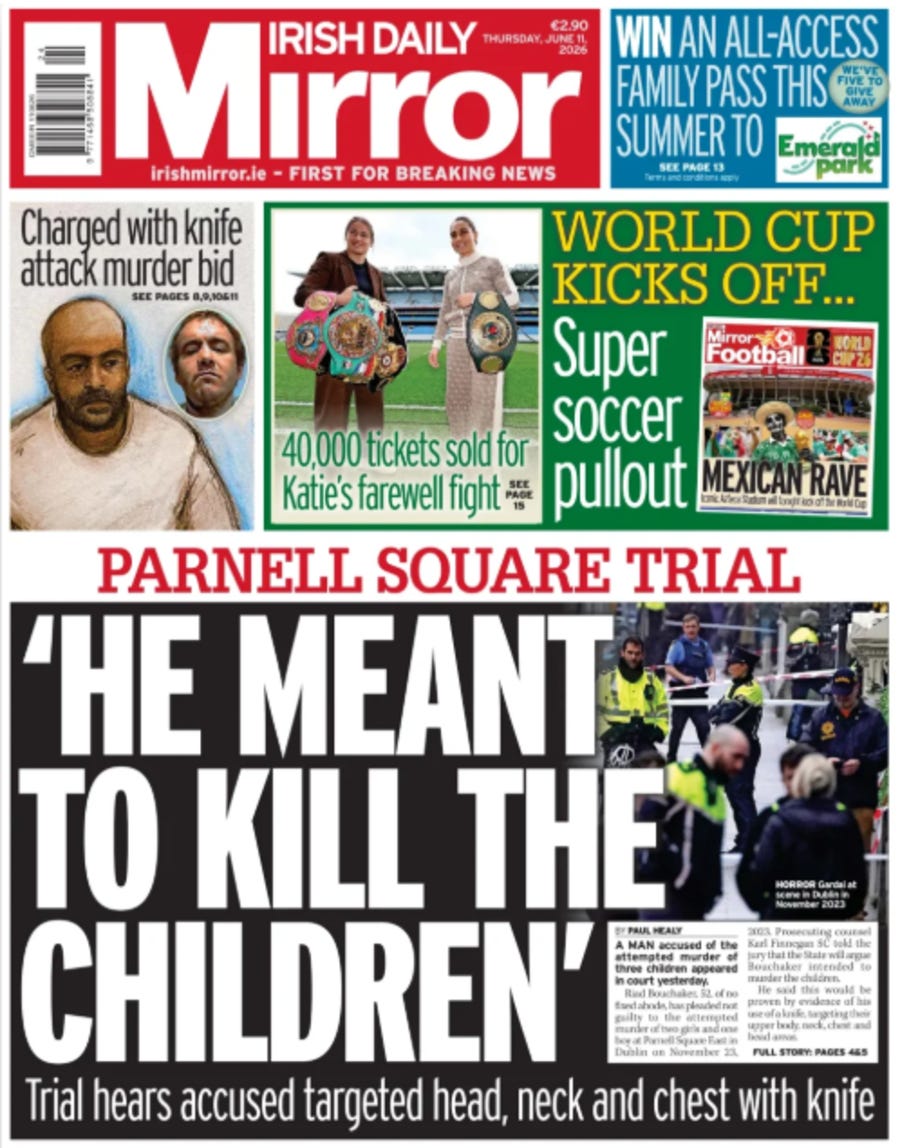
I try to keep the Irish stuff to my monthly updates (last one is here!), but you’re going to have to bear with me this week. I keep finding myself lying awake at night thinking about the horrific injuries suffered by the children attacked by Riad Bouchaker in Dublin’s Parnell Square in 2023, and I need to get it out of my head. Bouchaker’s trial for the knife attack on three children and a childcare worker wrapped up this week. He did not mount a defence and was found guilty of all charges, including attempted murder.
This is how RTE, Ireland’s national broadcaster, covered the worst details of the damage inflicted during the attack. It’s upsetting. We begin with a doctor giving expert testimony (forgive the long quote).
Dr Baker described how surgeons tried to stop the bleeding from the girl’s heart and had to open up her entire chest wall, close the stab wound and massage the heart to get it beating again.
However, she said the little girl developed seizures within 24 hours of the surgery, and scans showed her entire brain had suffered dramatically.
She said there was extensive injury to every part of her brain, with the worst affected area being her “deep grey matter”.
She said when the little girl woke up, she had severe dystonia - which meant her muscles went into spasm and led to extremely painful abnormal movements.
She said the girl needed multiple medications at very high levels. She said the dystonia was also internal, meaning she had huge problems with her gut and had to be admitted to ICU on two further occasions to deal with the pain and distress caused by trying to get nutrition into her.
Dr Baker said the girl has no control over her hands, arms and legs as her brain is sending the wrong message to her muscles. She said this was distressing for her and for her family. She has to be fed through a tube as she can’t swallow safely.
She was in Temple Street for nine months and has also spent time in the National Rehabilitation Hospital. Her family has moved to new accommodation to allow her to be near a team to manage her disability, and Dr Baker said she needs multiple mobility aids, a hoist and a wheelchair. The doctor said she would need a huge amount of equipment going forward.
Dr Baker told prosecuting counsel, Karl Finnegan, the little girl has a life-long, life-limiting disability. She will need a wheelchair for the rest of her life, she will also need splints to stretch her muscles and was at huge risk of painful contractures of her muscles and of scoliosis.
She said she is nonverbal and can’t communicate her wants and needs. The doctor said she was going to have a learning disability and would need 24-hour care and would have no independence for the rest of her life.
She said the little girl could blink for yes and no, and they were working on eye technology to help her communication. But she said this was very slow, and they were not sure how successful it would be.
She said the little girl, who is now seven, reacted and understood different things, and she described how her eyes would light up and smile if she was referring to something “fun” in the room. But she said she did not understand more complex questions.
Bouchaker was born in Algeria and came to Ireland about 25 years ago as an asylum seeker. At some point he was naturalised, presumably on the basis of residency (the details are not public). He’s sometimes referred to as an Irish citizen and while it is true that he has a passport, it is not true in any larger sense, as his relationship with the country that gave him shelter has been purely predatory, extractive, and resentful. The picture that emerges from this summary (also RTE) of his life is of a pathetic figure and, as it relates to the time of the incident itself, a repellent one - every part of the story enforces this.
The stabbing was precipitated when he was asked to provide additional information in order to benefit from more social welfare payments (which he interpreted as a refusal); he was noted prior to the attack psyching himself up muttering “shit Irish, shit fucking Irish.” It was noted at the trial (though he denied this) that he sought out a school with the youngest children he could find, and that on the day he waited for larger children to pass before attacking. He had numerous outbursts during the trial, laughing at inappropriate moments and specifically leaning into his resentment of the country and people that had harboured him -
On one occasion, he came into court shouting "kill yourself, Irish shit", pointing at the scar on his head and shouting "see what happened in your country", “three years, no payment nothing. I am Islam. Your country is shit".
He had been in the country for a quarter of a century but needed translation services because his english wasn’t at a sufficient level to understand the trial. The article notes both that he suffered head injuries when he was stopped from murdering the children, and also that he had a tumor removed at some point in his life so a part of his skull was missing so a portion of his brain was permanently exposed. However…
… Judge Tony Hunt ruled that Bouchaker was fit to stand trial and said he preferred the evidence of the prosecution expert, who said that, despite his difficulties, Bouchaker was able to weigh matters up, understood what was going on, and could go through the trial process with appropriate accommodations.
I’m going to leave you to ponder on your own time that, if this person had been a character in Citizen Vigilante he would have been seen as the product of a right-wing fever dream, and yet here he is, in the flesh. This isn’t about immigration but my own feelings of alienation from the justice system - what it is and what it’s for - and also my own feelings on what constitutes true kindness and cruelty, both of which I often find are at complete odds with the public perception of those things. I suspect a lot of people feel this way.
Some of this was brought out during the incident itself. After he had tried to kill the kids and was being beaten to the ground, a number of women formed a protective wall around him to prevent him being assaulted further, with one of them shouting “we are not savages, this is not how we do things”. RTE seems to have found this cry to be especially resonant, since it titled its summary of the case “‘We’re not savages’ - the full story of Parnell Square attack”. I thought this had only been noted at the trial but I see this week that Joe Brolly, a well-known public figure in Ireland who had witnessed the attack, mentioned it in the media shortly after, in what seems to me to be a wistful and laudatory way, as a celebration of multiculturalism in Dublin:

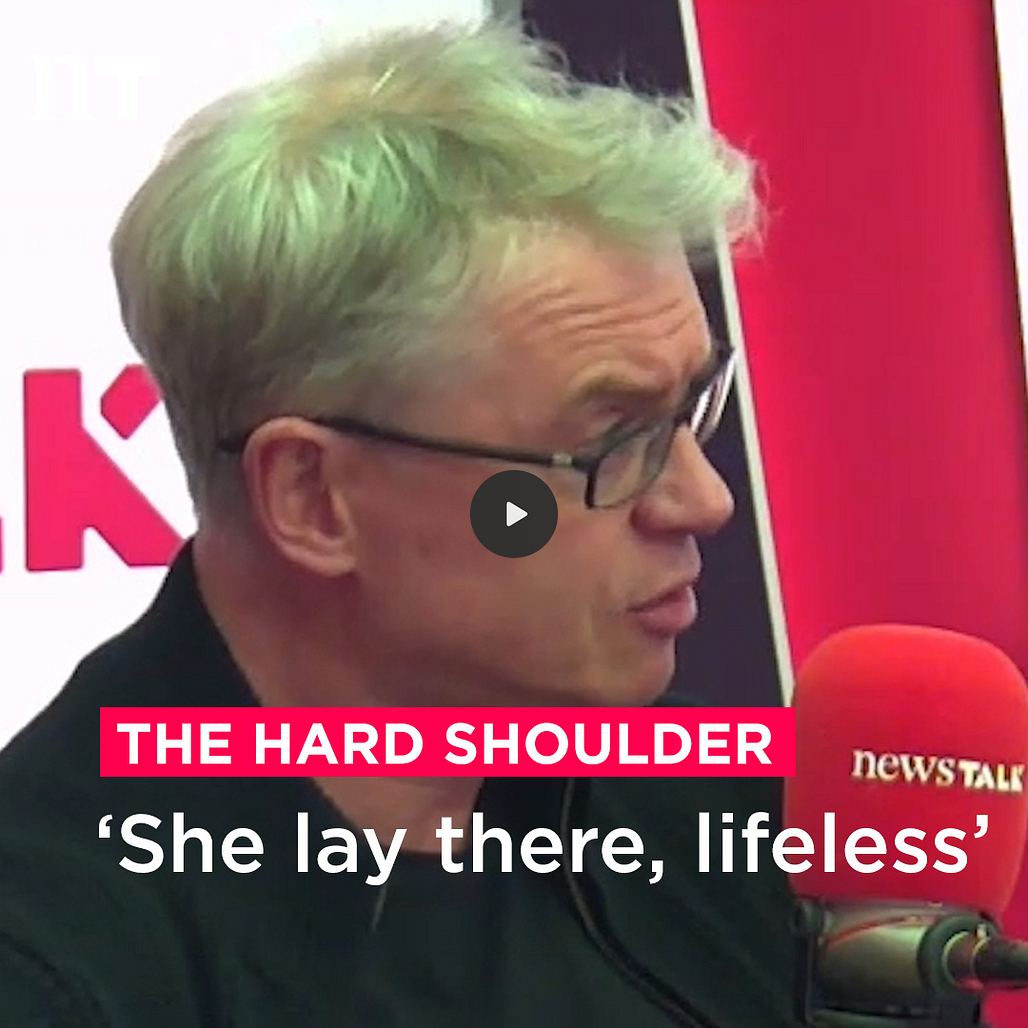
Whenever he’d been incapacitated, three women took it upon themselves to protect him (Brolly shakes his head in wonderment) and probably saved him because there was great anger at that stage, people were seeing the child, you know there’s huge crowds around there’s all the time, this very multiracial place, “he’s attacked a child”, so people were going for him, and these three women stoutly (defending him)…”
I don’t know how I would act in the moment of an incident like that, or how I would think about it immediately afterwards. It could be that it would haunt me forever and cause me to do and say and think all kinds of mad things - if it did, that would ultimately be the fault of the person who created that situation, i.e. the attacker. I have a lot of sympathy for the lady who said “we’re not savages” because I think that’s true, and important to remember that incidents like these stabbings are noteworthy in part because they don’t (or used not to) happen here. I get it. The same goes for Joe, who I don’t particularly like or ever agree with, but he saw what happened and I didn’t.
But Brolly describes a moral landscape that isn’t familiar to me - not least the way he seems to draw a moral equivalence comparison between people who wanted to attack a would-be murderer of children with a gang of racist thugs making an unprompted attack on an innocent. A similar problem arises in a piece that appeared in the Irish Times in the last few days, entitled “There was nothing ‘un-Irish’ about the violence on Parnell Square. Or the heroism” which argues that attacks of this type are historically normal in Ireland, which they are not. Again, it seems totally repellent and bizarre to me to seek to indirectly make excuses for a failed child murderer in this way.
These kinds of weird lenient responses and excuse-making are often understood as kindness, empathy, forgiveness and so on run amok, with the implicit criticism being that maybe sometimes a more hard-headed approach is appropriate. I disagree and I’m saying the attitude floating around in various places - in particular in the above Irish Times piece - is itself a sort of cruelty, and not kindness or empathy or anything like it.
The absence of discussion of Bouchaker’s punishment and whether it’s sufficient, and the emphasis instead on the idea of protecting him, isn’t ubiquitous but it’s common enough to be worthy of note. The people making these arguments strike a pose of empathy and care. But what do they say, morally, about our society’s priorities? A serious moral event requires a serious response. I don’t agree, and I think a lot of people don’t agree, that the justice system is solely about reform, mere restitution or facilitating forgiveness. Failure to make an accounting, through punishment, for the harm that was done is the society saying to itself it doesn’t know what the decent moral order is, and/ or doesn’t care, and that’s poison to people’s lives.
If someone does the kind of thing that happened here it is barbaric and cruel to celebrate that he was not punished in the moment, and then have a “there’s no point crying over spilt milk” view in the aftermath - as though the only option we are left with is to remove the perpetrator from the scene for a period of time and move on. I think many of the reactions here are delivered in an emotive tone but in practice evince an easy contempt for human life, vulnerability, and the reality of violence. A caring, loving society, one that centres kindness and empathy and so on as sacred principles, would regard trespass against those things (and giving comfort to those who trespass against them) as the highest crimes, and would seek to punish accordingly. On the other hand only a callous, shallow society that does not truly value empathy, or softness, or protecting the vulnerable would adopt the attitude we have.
I have mixed feelings about Forgiveness as an overarching moral principle but none of what I’ve said above is changed by the question of whether (say) the parents of the child forgive their perpetrator. It’s their prerogative to take any perspective on the crime they wish, even though I don’t fully understand it, and we’ve seen recent cases such as Austin Metcalf and Henry Nowak. Crimes of this type are societal, structural matters of interest to everyone, and reckoning with the impact of them is not owned by one person. One can forgive and still seek redress - the two don’t cancel each other out. It is in fact better and more meaningful to forgive from the other side of a just punishment, since forgiveness is meaningless (and when offered too quickly, callous and degrading) when tossed at someone who has given no sign of wanting it, as it seems in the Bouchaker case.
I note in passing that if the parents of the children in this case had demanded Bouchaker be stoned to death, there would be no rush to carry out their wishes. It’s only ever desirable to follow the demands of a victim’s parent when it requires less punishment of an inconvenient offender, not more, so the morality around that particular question is totally phony and repulsive. Again: I think we are too willing to describe this kind of attitude (leniency, a rush to unearned forgiveness) as excessive empathy, or misguided kindness. Seeking to forgive and move on before a proper accounting has been made, or seeking to use forgiveness as a pressure point to forestall such an accounting, isn’t cruel because it’s a misapplication of empathy. It’s just cruel.
This event is only a reminder of the centrality of a certain type of cruelty to our cultural life. Once you start looking for it you see it everywhere. To pick a random example, during July The Lancet published a study outlining how…
… USAID funding has significantly contributed to the reduction in adult and child mortality across low-income and middle-income countries over the past two decades. Our estimates show that, unless the abrupt funding cuts announced and implemented in the first half of 2025 are reversed, a staggering number of avoidable deaths could occur by 2030.
I am Elon Musk’s number one hater and am sympathetic to the idea that USAID was doing a lot of good, and that in many cases again ending it in a careless way has harmed people. But again - an analysis on the basis of cruelty is only applied to certain types of decisions. Was it cruel to inseparably mix practical essential medical aid with partisan political goals and boutique cultural projects that had no popular support, knowing that meant the aid would be massively rolled back at some point? I think it was, and it’s not an incidental cruelty either - I believe that this is an intentional political tactic, to entangle different types of political action so completely that unwinding them is reputationally impossible by anyone but a careless reprobate - who will come along in time. This approach is cynical instrumentalisation of people’s lives in order to indulge your own political instincts, is in itself incredibly cruel and careless. In this as in so many other cases people who attack impossible decisions as cruel are often people who have thrown you an unpinned hand grenade and then complain about the reckless way you’ve disposed of it.
My summary is that in general we’re too quick to accede to claims of cruelty, and definitely too quick to take claims to empathy, kindness, forgiveness and so on at face value. The worst thing you can do, and a trap I see people falling into all the time, is to say we place too much value on those things. I disagree, and I think doing that is ceding ground unnecessarily. All of those are positive and essential human characteristics but they come in a variety of flavours and it seems we’ve developed a sweet tooth for just one kind. We need to reassert the existence of others. So: unmanaged 2nd and 3rd order effects are cruel. Emotional self-indulgence at the expense of the safety and happiness of others is cruel. Creating an environment where predatory people are given moral cover to protect themselves from the consequences of what they’ve done is cruel. Creating an unsolvable problem and then passing it off to someone else to address and take the hit on is cruel. The list goes on. I’ve never forgotten that, but I am making a promise to remember it, and foreground it, in future.
Recent articles on similar topics
Empathy Isn't God

In Steven Spielberg’s new movie Disclosure Day, an analyst (played by Josh O’Connor) working for a shadowy quasi-governmental agency learns that highly intelligent extraterrestrials exist; the agency has been keeping this knowledge secret for decades, torturing and experimenting on the aliens and misusing their technology. He decides to expose this conspiracy and goes on the run with a bagful of evidence with a plan to bring it to the public via the main TV networks. This is one of many touching boomerisms contained in the movie - I guess he really wants to get this information to a microscopic audience of 80 year olds who have fallen asleep in front of their TVs.
Are Women More Empathetic than Men?

The purpose of this article is going to be to consider the different ways men and women experience empathy. I’m going to do that by exploring the empathetic styles traditionally associated with each sex, and what is often thought of as the moral superiority of one over the other - and the political and cultural implications of the differences between them.
US AID and the Theory of Mind Problem

Of all the thunderbolts emanating from the Trump White House in the first moments of his second term, none seems to have shaken the mainstream commentariat as much as the assault on US AID, officially described per Wikipedia as “an independent agency of the United States government that is primarily responsible for administering civilian foreign aid and development assistance.” Anyone who spent any time reading the Right - not just the American Right, but non-liberal or anti-liberal thinkers across the globe - immediately intuited the purpose, logic and importance of the attack.
Lots of fantastic stuff to unpack here, Conor. The myopic application of empathy is characteristic of our “enlightened” leaders. It’s noble, but often misguided and juvenile.
Liberals have become so indoctrinated with progressive ideology that they fetishize diversity, even celebrating Dublin as “a multiracial city” just hours after that diversity just unleashed barbarous cruelty upon citizen children who the government and community should be committed to protecting beyond anything and anyone else, including asylum seekers.
But the English speaking world is led , both politically and culturally, by people who think that denial of asylum to thoroughly alien people coming from wholly alien cultures is cruel without giving much thought to whether granting asylum to these people results is a cruelty that is downstream of the ruinous empathy that seems to have replaced cold-hearted reasoning.
I cannot follow these cases of violence against children too closely. They make me too angry. I've no experience with violence and couldn't say I'd kill the perpetrators of such crimes, but I know I would not intervene in their defence, and I would find it acceptable if they were killed on the spot.
The (overwhelmingly) women who stop such summary justice seem to have magical beliefs about the nature of violence, and ones that are increasingly ungrounded by belief in some redemption in the next life. It is not so much that one barbarian being killed or not matters, but that the attitude seeps into all law enforcement, and makes our lives more dangerous. Their lunacy must be stopped.