

This is the third of three promised round-ups/ updates on the Irish political and cultural scene. This will mainly focus on the anti-immigration riots that swept Belfast at the start of the month.
Previous updates are here and here.
—
On Monday the 8th of June, a Sudanese migrant who had come to Belfast via Ireland and Britain attempted to cut someone’s head off in the street; the incident was filmed and some footage made it online despite the best efforts of police and media. Protests kicked off immediately in loyalist areas, with black-masked young men setting fire to cars and public transport, and going door to door in order to intimidate immigrants out of their homes. Dozens of people were reported as being displaced; riot police, dogs and water cannons were deployed, travel was suspended and businesses were forced to close.
I’ve written before about the process of what I call Culture War tokenisation, meaning the way in which events in Ireland become disconnected from their local context and are misrepresented and misunderstood so they can be traded in a game being waged by different online factions for their own political, commercial and/or emotional purposes, regardless of what’s happening on the ground. This instrumentalisation of events is certainly not unique to Ireland - I see it happen with politics and culture of other European countries all the time - but the more distant from the imperial American core you are, and the smaller your population and your media market the more pronounced the effect. Whatever the reality of the situation in Belfast, this was a continuation of that trend.
The initial reports from outside Ireland on the riots failed to account for local differences in the north and placed these riots alongside recent ones in England and Dublin both in style and motivation. This was particularly pronounced on the online right. We see in the initial commentary on this from right wing American commentators like Megyn Kelly and Buckely Carlson here, pretty obviously not understanding (and not really caring) that these incidents were happening in loyalist areas, and unaware of how local pressures and historical context make these riots different from anti-immigrant activity that have been ongoing in Dublin.
Once commentators became aware that there riots were happening on the island of Ireland but that the rioters largely did not identify as Irish, the discussion somehow got even worse, as it then became part of the larger stream of anti-Irish content from the right that’s become endemic on Twitter in particular in the last two years. The key word in this fresh perspective was a misapplication of the term “Ulster” which many American commentators seem to believe means the same thing as “Northern Ireland” and “loyalist/ unionist/ protestant”. One recurring theme in commentary of this type was an ignorance about the relationship between paramilitary organisations and the state, and how paramilitaries might be influenced to act in situations such as these for material reasons that have nothing to do with immigration.
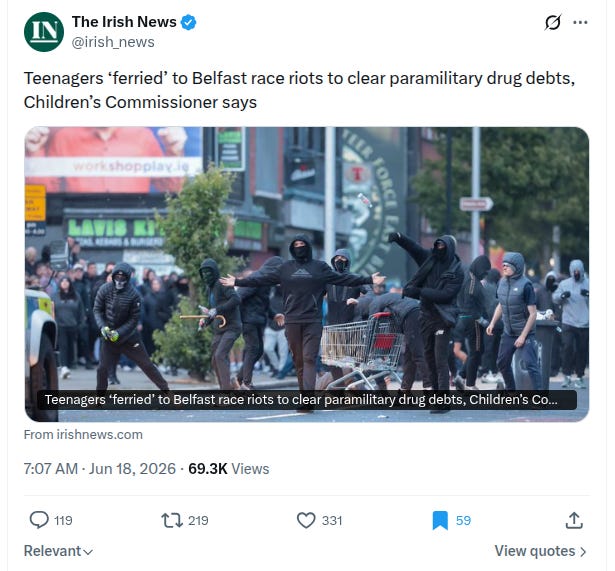
This led to some absurd tweets about the relative level of acceptance and encouragement of immigration amongst catholics and in the south. Ironically this is one area where the international online right and the respectable Irish in the Republic are as one. In the past five years the Republic of Ireland (and really, Dublin) has developed one of the most aggressive and coordinated street-level anti-immigration movements in Western Europe; the pace of development and organisation has been frightening. If anything, in tone, energy and tactics, the flow of influence has been from Dublin outward and to the surrounding territories and not vice versa. The Irish media are always keen to obfuscate that point and are determined to see Britain and England as a key source of anti-immigration rhetoric in Ireland. Both external right-wing observers and the Irish establishment continually seek to reinforce their comfortable but ahistorical sense that Irish nationalist movements are inherently left-wing and uniquely impervious to anti-immigration politics. At either end of the horseshoe, both conspire to create this false sense of where immigration sits politically in Ireland, and where street-level anti-immigration action in Ireland sits in an international context.
Aris Roussinos, writing in UnHerd, touched on the possibility that nationalist and loyalists could come together in the medium term on immigration as a topic.
in the aftermath of the North Belfast atrocity, there has for the very first time begun, though certainly not an alliance, then the first glimmerings of a tentative and distrustful rapprochement. The nightmare scenario for Sinn Féin would have been Catholics rioting against immigrants. That did not happen: instead, working-class Catholics merely turned out to watch their Protestant neighbors riot with an anthropological detachment newly devoid of open contempt.
I like Aris and don’t disagree with anything he’s written here but I think it’s too easy for people who have no familiarity with NI or Irish life or history to posit comings together without noting the roadblocks (in fairness to Aris he does do this, his article is filled with caveats on that point). When catholics and nationalists think about people in NI being intimidated out of their homes, they think of themselves, and reservations over immigration doesn’t overwrite that feeling. As Gerry Lynch, also in UnHerd noted:
Nationalists are still intermittently intimidated out of Loyalist areas, not just in North Belfast but across Northern Ireland — something almost entirely ignored outside the region… Northern Ireland Nationalists are also acutely aware that the Right-wing British figures expressing concern after a barbaric attack by a Muslim asylum seeker in one of their neighbourhoods are usually hostile to them, and rarely express any concern on the many occasions when the people attacking them are white Britons.
That’s just in NI - in terms of the idea that there could be a long term, all-island anti-immigration movement that sees loyalists and nationalists coming together feels to me like something that could only be proposed either by a person who has never lived in Ireland and is entirely ignorant of its history, or by a southern Irish person whose mind is fully internet poisoned, transgressing as this does some of the most basic red lines of electability that exist here. People who are on the immigration-restictionist side of the spectrum are so desperate to see signs of victory somewhere that they often fall into the trap of seeing them where there aren’t any. The riots were celebrated by some as an expression of justified popular discontent with immigration policy but I think very few voters or members of the public saw them that way. Most people work and live alongside immigrants who they like and who could easily have been on the wrong side of these riots. As such most will find the violence repulsive, threatening and politically illegitimate. The extent to which these riots represent an energy that could be incorporated into mainstream politics in a way that actually impacts immigration policy seems to me to be zero.
The press reaction in Ireland mainly centred on the way in which social media was perceived to have whipped up the situation. The Social Democrats are the rising force in Irish politics and TD Sinead Gibney appeared on multiple programmes to advocate for bans and fines; she said “if people can organise online and tell people where to go to disrupt society, those platforms need to be held to account as publishers”.
Fergus Finlay, a prominent member of the Irish Labour Party also appeared on TV, to note that people online were:
fomenting hatred day in, day out… one or two of them have tried to get a mandate and haven’t been able even in local elections but it doesn’t stop them… I find it hard to understand how they are allowed on social media, how they are facilitated by social media because… if you were to analyse the problem in terms of 90% of the fomenting of racism happens on one platform, but on social media generally… why sovreign and democratcially elected governments can’t put a stop to that boggles my mind. I don’t understand why X, for example, is allowed in Ireland.
IHREC, a government funded group, issued an open letter urging governments to turn off recommendation based algorithms, and both the Irish Times and Irish Examiner ran editorials agitating for social media bans. All of this was happening parallel to the proposed social media ban for under 16s in the UK. The two issues blended together, with the Irish government stating they admire the UK’s approach. The Irish Labour Party and the Irish government have appealed to the EU to help get a similar ban going, so they can piggyback on it.
As with many other culture war issues, people tend to look at social media bans as affecting their country or only driven by their local politics, when in fact similar discussions are happening everywhere as part of an opaque cross-country effort to exert control on the internet discourse that has disrupted every aspect of political Business as Usual. Having said that, there is a particular local flavour to the push against free expression within Ireland. This comes from an attitude you could call Consensus Illiberalism, a small-time horror about what the neighbours will think, and visceral hatred of boat-rockers and troublemakers. It rears its head as a sense of mortification whenever something controversial or unseemly happens in the vicinity of the Irish state, accompanied by a desire to throw a blanket over the controversy as soon as it’s happened, and before you even understand what it is. In real terms, it’s personified by purse-lipped curtain-twitchers like Fine Gael’s Patrick O’Donovan, who are very common in Irish life, always have been and probably always will be.
Something that characterised these discussions about the responsibility of social media was a total lack of reflection to why grisly videos even circulate online in the first place - that was, after all, what kicked off the whole affair. Part of the interest in these videos is simple prurience. But it is also a response to the Consensus Illiberalism which is so deeply embedded in the media and which, in relation to certain stories, causes journalism in Ireland often functions as a kind of anti-journalism - the role of people in the press is to not ask questions, to not draw conclusions, to terminate conversation when it looks like it’s going in an unseemly direction, to talk over your interviewees if it looks like their answer is going to be too close to the bone. It makes sense that in that environment the public will seek out the raw footage themselves to understand what is happening. The Gibney/ Finlay type desire to tamp down divisiveness is the thing that causes these videos to catch fire amongst the general public - who may not riot, and who really do hate racism and ethnicity-based violence, but are who are nonetheless interested in why things are the way they are, and where the country they live in is going.
The final question with a lot of this activity is where it leaves Sinn Féin as an all-Ireland party, and how it should react to these riots. Keith Woods wrote a good, long piece about how SF got to the position where it is identified as being synonymous with left-wing politics, and how that is going to be a difficult cul de sac to back out of if voter demands make it necessary to do so. And there are challenges to SF in its immigration policy long-term that are not voter-driven. As Pangur Bán pointed out, the immigrant groups arriving in Northern Ireland are much more likely to arrive with a British-only identity than an Irish-only one; understandably they have no historic connection to the idea of Irishness.
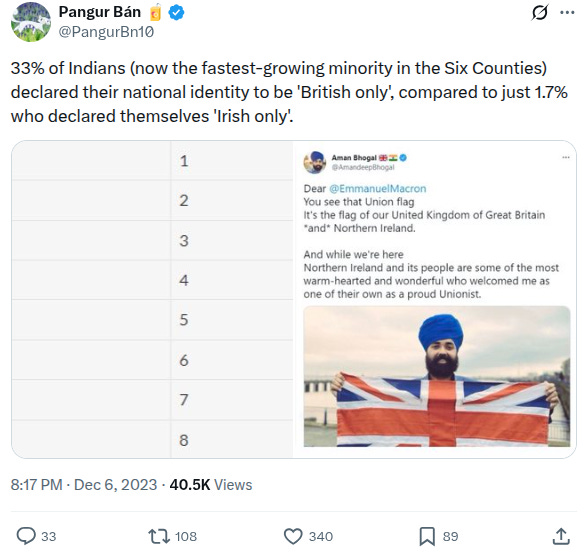
I have never seen any SF-associated nationalist grapple with the implications of these trends for the prospect of a united Ireland, which is theoretically it’s guiding principle. It’s easy enough to orient yourself in favour of immigration when the anti- side is so clearly thuggish and hate-filled, but the implications of demographic change won’t always be so easy to side-step.
As a final thought: migration and demographic change aren’t subjects of unlimited interest; I’ve tended to write them in the past because I’m interested in ideas and these trends have seemed over the last few years to be connected to the biggest and most important ideas, that were also being spoken about the least. I’ve noticed as I’ve gone on with these updates they’ve tended to flow in the direction of immigration. Maybe I’m just fixated? It could be - but I asked AI what the five biggest stories in Ireland during June were, its view was the riots in Belfast, the passage of the International protection act were two of them.
So I think the increasing convergence of Irish politics on immigration and demographic change as the core drivers of crisis is not just my conclusion. In a way that makes sense, and shouldn’t surprise us. After all everything that happens in Ireland (including the very existence of Northern Ireland itself) is downstream of a relatively small demographic change that happened almost a thousand years ago. A thousand years! There is a tendency in respectable politics to believe that if we could simply turn off the internet all this would blow over. I think that’s a denial both of how long the tail of demographic change tends to be, and how deep and fundamental the change of recent years is. Every aspect of the recent events in Belfast reinforces that for me. The people who think this stuff can be managed over a couple of years or even a couple of decades by massaging the conversation are as grotesque, reckless and reprehensible in their own way as the rioters are.
Other stories
A plant in Aughinish, Limerick hit the headlines when it came to light that it is a key source of Alumina for the use of Russia in their war effort against Ukraine. The plant is Russian owned and the material is exempt from sanctions. Lots of people took this as evidence that Ireland is uniquely and sinisterly pro-Russian in its orientation (“a russian colony in plain sight”).
Regardless of how one feels about the operation of the plant (which seems pretty bad to me) it’s worth pausing for a moment to consider what a flagrant and insane distortion of this truth this is. In response to the Russian invasion of Ukraine, Ireland immediately took in so many Ukrainian refugees that they currently constitute about 2% of our population. The speed with which the housing system was changed to accomodate Ukranians in comparison to the sluggish response to Irish people’s ongoing housing difficulties was so so over the top that it was central in precipitating the anti-immigration riots that flared up soon afterwards. It’s not untrue to state that the response of the Irish state was so extreme in a pro-Ukrainian direction that it has helped to permanently deform the Irish political landscape in a way it won’t recover from for multiple decades.
For his part Volodymyr Zelenskyy gave an order of merit to the content creator who mainstreamed the issue in the British and American right-wing press, but who had not actually done the real underlying reporting (that was done several months ago - and ignored outside Ireland - by the Irish Times and RTE, who got nothing). I think that says a lot about the Ukrainian leader in terms of where he gets his information, and the audience his public messaging is for.
The Irish government is introducing rules that a person must prove they are legally and habitually resident in the state before they can avail of social housing. The announcement of the change, which has been coming a while, set off a slightly strange and frantic reaction, with people claiming that on the one had such a change is not necessary because the numbers of non-nationals availing of housing are so low; but also that the negative impacts would be too great. The IHREC wrote to the government expressing concerns about the initiative, and questions were raised in the Dáil Éireann indicating that such a change would increase homelessness. The obvious way of settling some of the questions this has provoked would be to release granular data regarding housing and nationality, which the government has refused to do while simultaneously stating that speculation about the subject constitutes misinformation.
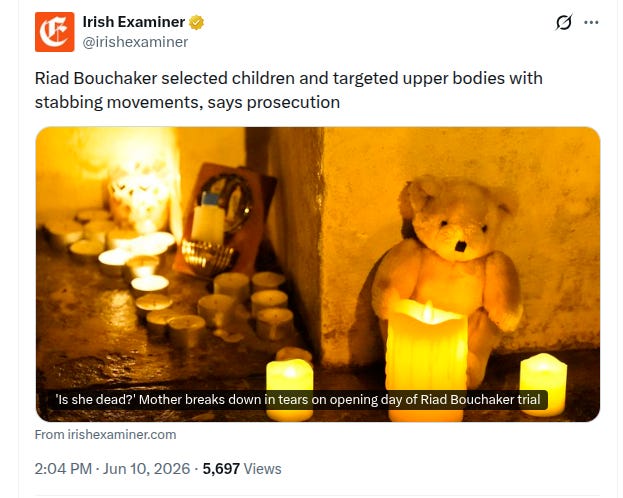
The trial of Riad Bouchaker, the Algerian man who stabbed a number of children in Dublin city centre in 2023, precipitating widespread rioting, began during the month. Many of the details that have come to light during the opening days are excruciatingly horrible and revealing; this includes the life-changing nature of the injuries suffered by the little girls assaulted, and Bouchaker’s alleged anti-Irish rantings moments before he carried out the attack. Thanks to AEIOU for pointing out that we also heard testimony of a recurrence of my favourite trend, that of people intervening to protect a violent aggressor with a cry of “leave him alone”. The note that “we are not savages” makes me feel very slightly sympathetic towards those who did it, though only slightly.
After the unremitting darkness of the above I wanted to try and include something if not positive then at least interesting in a non-negative way. This article notes how Beamish and Murphys, two popular brands of stout, are trying to chip away at Guinness’s dominance in the UK. I can’t speak for that market but I did note that on St. Patrick’s day here, every single one of my mutuals who posted a picture of themselves enjoying a drink did so with one of those brands, and not Guinness. Guinness have linked themselves in with a lot of the most overbearing elements of our current mini gaelic revival, and have adopted a relentless marketing approach that often relies on an unspoken assumption that have a sort proprietary relationship with Irishness, in a way that is not really appropriate for multinational which is not actually Irish at the end of the day, regardless of where it’s brewed. Their marketing annoys me sufficiently that I stopped drinking it a while ago. I’m getting a sense that others feel the same way and I think their popularity may decline slightly in the next few years though I admit that’s a hope with very little hard evidence to support it at the moment. Good luck to the other brands.
Thanks for reading, more next month.
Regarding Sinn Fein, someone needs to ask Gerry Adam’s if this was the Ireland he hoped for when he murdered Jean McConville.
Great piece. Hard to know if history has become meaningless now. I wonder how meaningful the struggle for independence is to the new generation? My guess is that it is pretty irrelevant.