
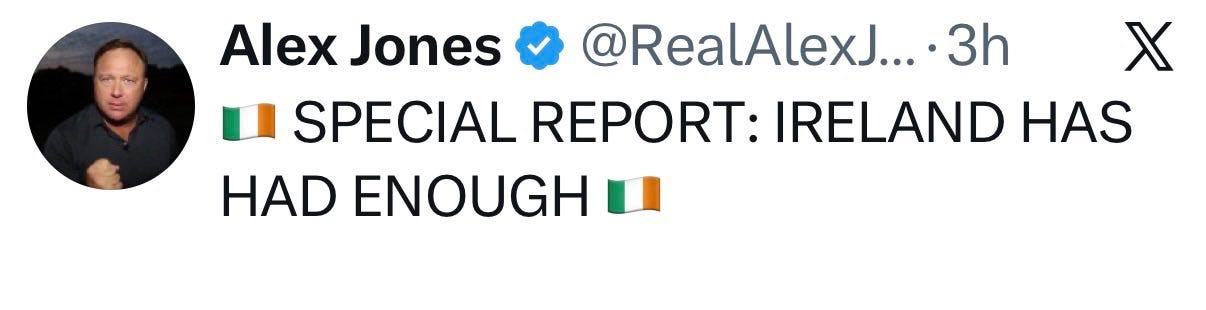
I put out a Substack note a little while ago asking if anyone was interested in seeing a monthly Irish politics and culture round-up, since the selection of Irish content on Substack is so poor, and so sparse. That got a positive response, so this is the first one - I’ll do at least three and we’ll see how it goes.
The content this month will be mostly about the fuel protests and the fall-out around that. It will probably be more varied and hopefully less haphazard in future months - bear with me while I figure out a format.
Protests
Quick rundown: starting on the 7th of April, hauliers, farmers, and transport operators staged a series of nationwide protests in Ireland as a response to increased fuel prices - a problem they believe is exacerbated by excessive taxation. Protestors occupied a portion of Dublin City Centre with tractors and other vehicles for 6 days, rendering it inaccessible to traffic, and also blockaded critical ports and fuel infrastructure around the country. This was eventually cleared in the middle of the night by Gardaí, after which the government announced an additional half billion package of relief measures. Blockades and protests are still going on intermittently in various places.
The best summary I saw about the political meaning of this action was from Keith Woods:
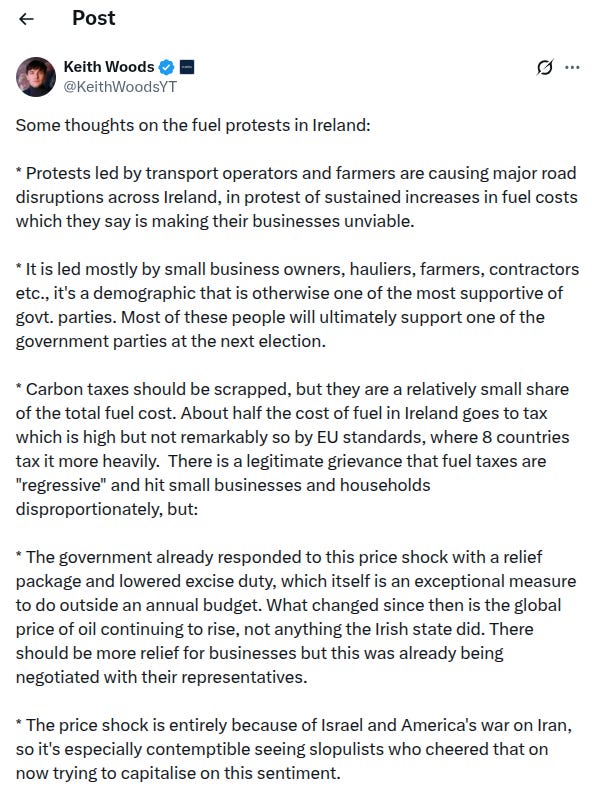
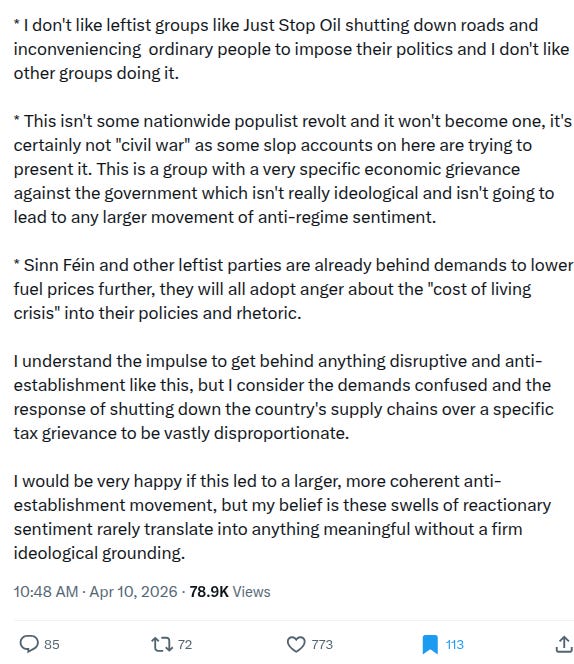
I don’t agree with each point here, and don’t know how accurate his assessment of the support provided to date is. But he’s absolutely correct that the people conducting this protest were Fianna Fáil/ Fine Gael or crypto FF/FG Independent voters and not revolutionairies with a deeper grudge towards the system and how it operates. They are members of a consensus- and propriety-conscious, risk-averse middle that forms the Cordon Saintaire around culture war issues. Keith is absolutely correct that ideas about cost of living, taxation and the distribution of public goods are important and can be threatening to individual politicians, but they form the safe space of Irish politics, the ground everyone is most comfortable on. Despite the efforts of people on all sides to capitalise on the decentralised nature of the protests to make it about their own hobby horse, there was no secret ideological core to the protests that could serve as the start of a larger philosophical change for the country.
Outsiders
Immigration is the only current political issue that truly terrifies official Ireland, and a key part of their reaction to events like these can be explained as a desire to keep it out of conversation, and prevent the general discontent from drifting towards that issue. On the other side, large numbers of people who have been unsuccessful at forcing immigration retsriction into the political conversation sought to use the protests to do so, unsuccessfully. Not all of these latter forces originate inside Ireland. Almost the instant protests began, Justice Minister Jim O’Callaghan raised the spectre of Tommy Robinson, a reliable one-man way of discrediting any protest in the minds of the public.
The best commentary I saw on this was from Gearoid Murphy:
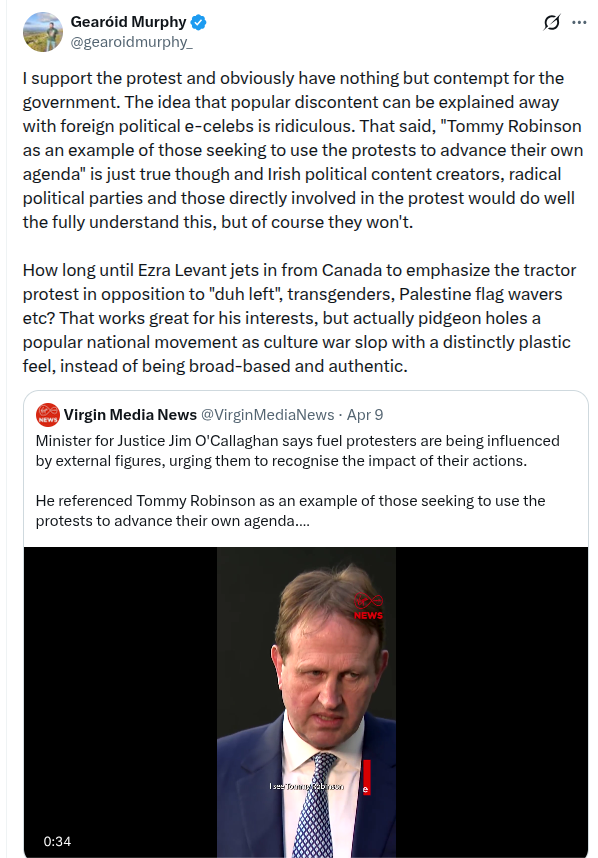
Ezra Levant did indeed arrive in Ireland later the same day. He was not alone. Soon enough a swarm of familiar locusts was buzzing around the capital with their mics and cameras.
I’ve pooh-poohed the idea of the foreign interference meme in the past, particularly as a lazy way of discrediting protestors by linking them on a spiritual level with England. I don’t feel my comments were wrong, but I do think I underestimated how far certain boomer-brained Irish right wingers would go in appealing to non-irish audiences and movements regardless of negative impact at home, even when that involved indulging people with an innate contempt for Irish people and Irish nationhood. Tommy Robsinon really did arrive in Dublin and here he is speaking with Levant, commenting on the action as though they are talking during a break in play at an NFL game
Robinson is a self-described Loyalist, and both he and Levant are staunch and vocal supporters of Israel. It would be impossible to cook two people up in a lab better designed to repulse the average Irish voter. They themselves must surely be aware of this, so the question is why even comment? People on the Irish right sometimes speculate this is a psyop designed to discredit them; I think the truth is both sadder and more sinister. For people like this, “Ireland” doesn’t exist except as a kind of token to be traded amongst players in a larger political game, to help their audiences feel either better or worse about what’s going on in their own countries, for their own reasons. That’s facilitated by Irish content creators who prosper by speaking in the language of, and appealing to the prejudices of, an international (mostly but not exclusively american) audience, and purposely misleading them about the nature of the situation here. Much of the “Ireland is rising” type content that circulated as the protest took hold were shots of unrelated and quite different immigration riots and protests from a few months ago. As Gearóid correctly notes, all of this is an active impediment to the development of any kind of challenge to cultural consensus within Ireland.
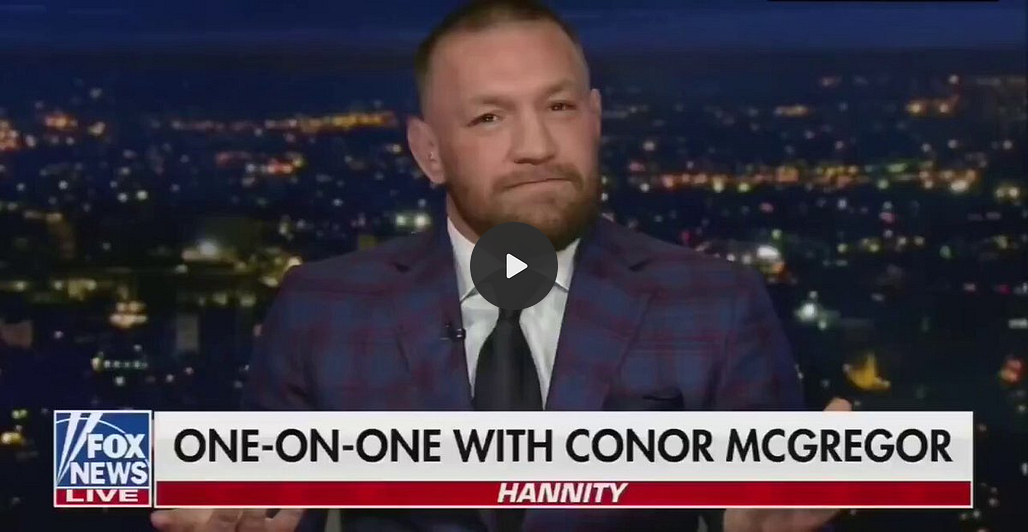
A familiar figure in this is Conor McGregor. McGregor’s pub distributed sandwiches to the protestors but he was otherwise not central to the action, which was disconnected from anything he normally speaks about. He nevertheless appeared on various outlets wearing an Ireland pin and talking in the language of being a “god-fearing patriot” - all of which is normal in right-wing American discourse, but again, unfamiliar and off-putting to any Irish person.

Fianna Fáil
While protests hit all government parties hard the biggest losers are thought to be FF. Justice Minister Jim O’Callaghan began their downward spiral by initially suggesting that the army would be deployed to clear the protest. Throughout the crisis, FF ministers and the FF-led government continued to speak in caustic terms about a protest that had the support of the majority of Irish people, and that seemed to become more popular as it went along. The government underwent and survived a no-confidence vote; the only surprise was the resignation of independent TD, Fianna Fáil gene-pool alpha-gombeen and largest landlord in the Dáil Michael Healy Rae. The three youngest FF TDs (all of whom voted in favour of the government) released a letter suggesting that the party was at risk of losing its mandate. There were a number of frantic party meetings and the occasional fringe claims that there would be an FF leadership challenge (there wasn’t, and won’t be).
I wrote in the past about how the lack of a strong ideological perspective can become a practical problem for modern political parties. I was talking at the time about Trump, but it’s FF’s problem too. Even if they were inclined to remove their leader - doing so would depend on their being someone in their ranks with a strong sense of what the party is for, or what Ireland could be, and a plan to take the party and the country in that direction. But FF have spent the last 40 years on a self-hollowing project, discarding their old clothing of nationalism and religion to become a purely administrative, steady-as-she-goes, status quo, incrementalist party. For them, Ideological thinking is done by people in Europe or America, by activists with access to government, and by smaller coalition partners. FF are not left or right; they’re nothing. There is no “ideas wing” within the party with a long-term vision, or that is interested in institution building or developing a new philosophical outlook, and so no sub-section of the party that could generate a leader that would do things differently.
Free Speech
Once the protests had died down, Patrick O’Donovan (a Fine Gael TD and Minister for Tourism, Culture, Arts, Gaeltacht, Sport and Media) decided to re-inflame the situation by appearing on at least three radio interviews to criticise the level of air-time the protestors had been given in comparison to the government during the crisis. He stated that he would be referring the matter to Coimisiún na Meán, which is government funded but which describes itself as “Ireland’s independent regulator for broadcasting, video-on-demand, and online media, regulating traditional media, enforces safety codes on digital platforms, and promotes media diversity.” It is not his role to do this, and it corrupts the Commission’s independence to threaten to do so.
The National Union of Journalists described O’Donovan’s comments as “sinister and deeply distrubing”. O’Donovan dropped out of sight, and the government dismissed the comments by stating they were no longer a review was not necessary, which side-stepped the question on whether it should have been proposed.
The NUJ predictably couched its criticism of O’Donovan by portraying him as Trumpist, and there were comparisons to the recently defeated Viktor Orbán, whom Fine Geal have been a constant critic of. The truth is that the government has gotten used to the main troublesome protesters in Ireland being people outside IPAS centres. Over the last while both FF and FG have been able to say quite extreme and authoritarian things about those groups because they are perceived by the public as scumbags, and because they are ideological enemies of journalists. Extreme and contemptuous statements about clamping down on protestors, curtailing basic rights in various ways, and using the semi-independent organs of the state to attack their beliefs at the root were either ignored, encouraged or explained away by the press. O’Donovan himself was asked recently about the undemocratic nature of how Ireland’s speech laws were formed and more or less told the reporter to shut up and stop complaining - no one in the media cared. So what happened here is that the government forgot that they were dealing with a different group this time round and that the press would not run cover for them in the usual way.
This relates back to the comments about the brainlessness of Fianna Fáil as a structural and practical weakness. When it comes to cultural conflicts, the press-enabled mainstream attempt to circumscribe the conversation has been very effective. That means mainstream politicians have never had to think very deeply about what is at stake on these issues, never felt pressure on the weak points of their arguments, never been forced to consider what an articulate opponent of their plans might say. Their arguments never go beyond the most superficial level that anyone who has spent five minutes thinking about the issue might make. They rely (as in this most recent example) very heavily on the fact that, when push comes to shove, they can use a supine media along with the threat of the law to silence people and chill the discussion. Aside from being deeply embarrassing (imagine participating in a democracy and believing that the only chance your views have of succeeding is with the implicit threat of arrest and prosecution) the result is that Ireland’s mainstream has an exceedingly soft intellectual underbelly.
The fuel protests haven’t stopped and I’ll pick up some of these stories next month.
Other Stuff
Here are a couple of other items of ineterst from during the month:
Protesters occupied a Mayfair bookshop owned by the Duke of Devonshire, on foot of a proposed 900% rent increase for sheep farmers on his estate in Waterford. The story had been well covered in Ireland but this was the first time it had broken internationally, to the amazement of many foreign onlookers. What amused me is it broke immediately after internet-poisoned embarrassment Simon Schama had voiced the opinion that the Republic of Ireland was established as a kind of Ultranationalist Catholic ethnostate. That’s an idea that’s become more common amongst anglo-american right-wing commentators the last year or two - I’ll leave you to speculate why that might be. Anyway, the idea of Irish sheep farmers paying rent to an English aristocrat in 2026 seems somewhat at odds with that claim. I still recall my surprise (to put it mildly) as a teen when my dad told me that my parents paid a nominal ground rent to an English landlord as part of their leasehold. For anyone interested in these issues I can semi-recommend the book “Burning The Big House” by Terence Dooley.
The Irish Government was reported as considering ending the ban on the use of nuclear power. The ban was introduced by a Fianna Fáil government in 1999. A number of people who were involved in the ban have quietly changed position on this without admitting it, most contemptibly current MEP Billy Kelleher. I suspect investment in nuclear power would probably require investment in the military as well for security reasons, making it doubly problematic. Regardless of the ban, Ireland’s use of nuclear power will increase with the completion of the Celtic Interconnector in 2028. To quote an eternally relevant phrase, that’s what you call an Irish solution to an Irish problem.
Tomás O'Reilly (who you should follow on twitter and elsewhere) wrote about the vote in the EU Parliament on the use of external Migrant Return Hubs. As Tomás highlights, Fine Gael’s Maria Walsh was the only member of the EPP to vote against the measure, illustrating how FG is becoming an increasingly out of touch outlier in a supposedly centrist/ conservative grouping - also an indicator of how out of touch Irish politicians are with the european mainstream on this issue, being wedded to a “Wir Schaffen Das” consensus that has evaporated elsewhere. Of the two Independent Irish MEPs elected on something like a right-populist ticket, one abstained and one wasn’t present. Shrug emoji.
“A 24-year-old man said he stabbed a garda and set the Black Forge pub in Dublin on fire last year as a message to the Government and to the pub’s owner Conor McGregor not to insult the Prophet Muhammad.” I don’t think it’s true to say this story went under the radar as it was widely covered in Ireland and elsewhere; but some of the details were really striking and I don’t think the Irish public have fully assimilated what they mean. Khan was explicit about being inspired by ISIS; at the height of the summer travel rush this man of uncertain financial status got consecutive flights from Belfast to Valencia to Rome to Leeds/ Bradford to Dublin in the course of three days, and it’s not clear how he paid for it. But I guess if we can memory-hole the double beheading that took place in Sligo in 2022 maybe the lack of curiosity isn’t that surprising.
My personal political highlight of the month is the 1926 Irish census was digitised, and access to it made available to the public. Ancestry records can be sparse in Ireland for economic and historical reasons, so this is a treasure trove. Author John Crotty (top Ireland defender on twitter - buy his books) noted that amongst other points that there were a total of just 430 people from outside Britain and Ireland living in the entirety of Connacht at the time.
Thanks for reading; more next month.
Sounds like the Irish equivalent of the Canadian trucker protests, with the same level of attention from Americans trying to make it about something it never was and drowning out the local discourse about it. Especially stupid in this case because America is directly responsible for what’s being protested.
I find the Irish political system almost incomprehensible as an outsider. From what I understand the two major parties are both formerly conservative and are now indistinguishably, blandly neoliberal and the only real opposition is a left-wing populist party. How did it get like this?
Just noting for transparency that I've updated this one (which was done in a bit of a rush) for clarity and fixed some grammatical/ spelling errors.