
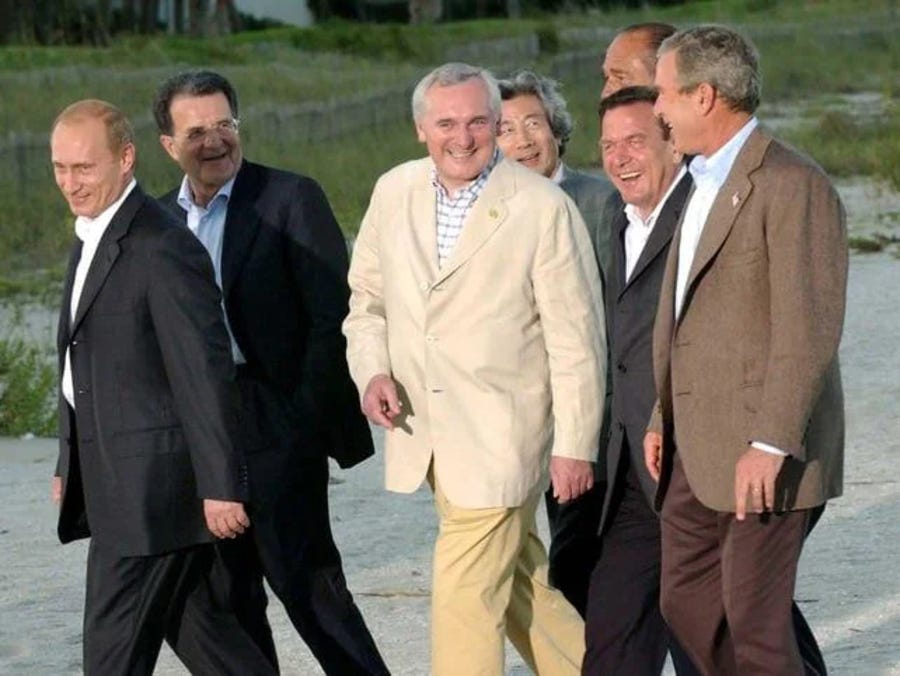
This is the second of three monthly updates I promised to do on noteworthy events in Ireland. Link to the previous update is here. This month is going to focus on the discussion about immigration and demographic change triggered by recent remarks from Bertie Ahern, and brought into sharp focus by the differing reaction to two deaths in Dublin.
Bertie Ahern
Finance Minister Paschal O’Donoghue resigned his seat in Dublin Central in November 2025 to take up a role at the World Bank; a by-election was underway throughout May to fill his seat. 74 year old former Taoiseach Bertie Ahern was secretly recorded on a doorstep while campaigning for the Fianna Fáil candidate, giving what constitutes some (in an Irish context) unusually blunt remarks about immigration from a mainstream politician.
… I think there’s too many coming in. We have to take some in. I’ve no problem with the Ukranians because in fairness Russia moved in and war in their country. A lot of the Ukranians are going back now, we still have a lot of Poles here. The ones I’m worried about are the africans… I agree with you on the Africans. We can’t be taking in people from the Congo, all these places. I think there’s too many from those places. I don’t worry about this generation of Muslims. The next generation, when the kids start growing up… that’s what I think the problem will be. I said this to (current Justice Minister) Jim O’Callaghan… (cough… sorry… me lungs) that’s where the problem comes…
When the video was leaked people immediately distanced themselves from Ahern and his remarks, including from within his own party such as the current Taoiseach and grandees such as MEP Cynthia Ní Mhurchú. The condemnation was stronger from left-wing parties and from the state-aligned activist groups. The Social Democrats termed them "absolutely vile," the Green Party called them "harmful and untrue," and Labour candidates accused Ahern of a shameful instance of "punching down on migrants".
There was an unusual level of pushback in support of Ahern in the way there wouldn’t have been in the past, a panelist here parsing Ahern’s remarks in a forgiving way (as usual, avoiding the key cultural and demographic questions that Ahern was really alluding to, and retreating to the safe space of resource allocation and stretched services). Here is the former Lord Mayor of Dublin noting that is his experience “to a man, people were saying fair play Bertie”.
Ahern himself was bullish in defending his position, apologising for singling out individual groups but not for his general remarks. He said he did not understand why his comments had been criticised. Micheál Martin amusingly stated that “we can’t physically stop Bertie Ahern from canvasing” which really summarises the decline of Fianna Fáil as a vital force in Irish politics.
FF once received about 47% of first preference votes in Dublin Central and look to have recieved about 4% in this most recent election, which ranks amongst their worst ever electoral results. As I have noted on many occasions the party and it’s candidates were once not just known for, but defined by, their electoral cunning and ruthless populist instincts. While the Social Democrats have won the open seat, anti-immigration vote (in the form of two independent two candidates, Gerry Hutch and Malachy Steenson) will end up comprising close to 20% of first preferences. That’s about the proportion the winning candidate will get, though of course in a transferable vote system victory is nowhere near that straightforward. In any case, it’s hard not to believe that the FF of the past would have found a way to peel off some of those voters and perhaps that would have been healthier for everyone.
As with the deaths later in the month (more on that below) the Ahern incident did show a strange disconnect between the media and activist class, how normal people see this incident and on the actual facts on the ground. What is the immigration stance of the government; how do the people feel about it; what is the political opportunity on the issue? Declan Lynch in the Irish Independent was typical in noting his view that Fianna Fáil risked tuning into an Irish version of Reform because of it’s drift towards a restrictive immigration policy; and that they should adopt a more apologetic and enthsiastic open-borders policy - that that was the untapped opportunity in Irish politics. This to me reads as a good summary of Respectable opinion on the subject but as a purely factual matter this is an almost total inversion of the truth.
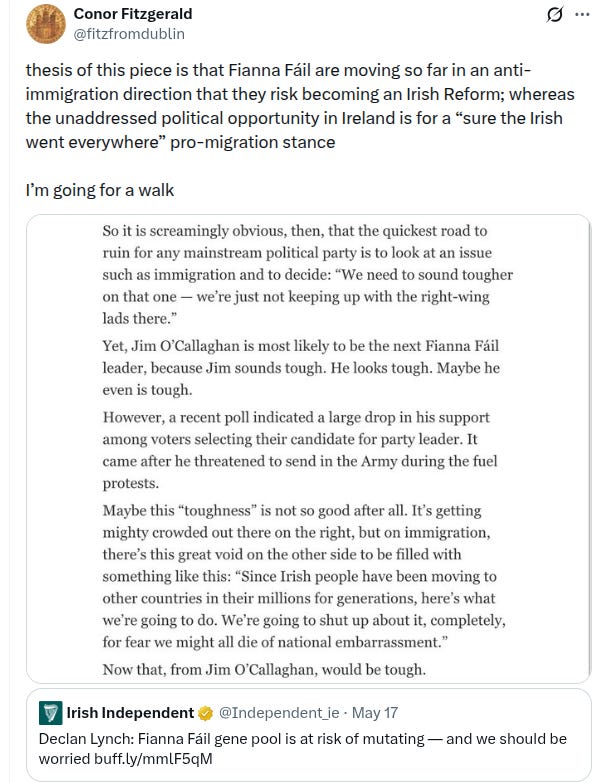
In terms of Fianna Fáil having a right-wing stance on immigration, Séamus Mac an Bháird (consistently a great resource for data and analysis) notes that Ireland granted seven times more citizenship than Denmark (a country with an actually restrictive immigration policy) in 2025. The Irish times noted this week that migrant workers accounted for 61% of jobs growth between 2019 and 2024. The same report notes that one third of the workforce was from outside the state by that date. Other commentators noted that the number of non-nationals working in Ireland grew by 50% between 2019 and 2024, the number of people from India in Ireland working in Ireland quadrupled during that period and the number of people from Brazil doubled. That doesn’t account for people moving outside the official system.
Polling has consistently shown that around three quarters of the Irish public are unhappy with the level of immigration and would like it reduced, and immigration is a top three issue of concern at all times. The only time it has ever been put directly to the public (via the 2004 referendum) mass immigration was decisively rejected. In practical terms a system close to birthright citizenship remains in effect in Ireland through asylum laws, a porous northern border, unenforced deportations orders and amnesties, along with a decision by all mainstream parties (and quite a lot of fringe minor ones) not to discuss the issue critically unless it can’t be avoided.
Tomás O’Reilly noted that in its relatively forgiving nature, and in the belief that demographic changes are sort of like the weather in they just happen and we have to live with them, the government parties are totally out of step with the wider European trend.
Let’s bring this back to the constituency in question. It contains both very deprived areas (including East Wall, epicentre of anti-immigration protests) leafy suburbs (Drumcondra, one of the prettiest parts of Dublin) as well as rapidly gentrifying mixed zones (Stoneybatter, our Brooklyn/ Hoxton variant). Parts of the constituency have experienced or seen vertiginous ethnic change in a few years, discomfort with which has found no democratic outlet.
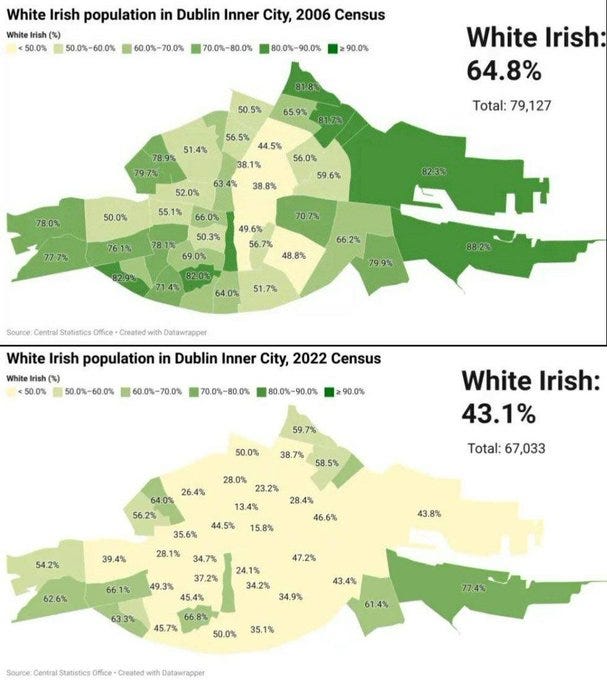
I can’t find the provenance of this chart but the numbers appear to be correct based on other reporting.
Even if you believe this every single change mentioned above is good and essential, it seems crazy not to note that this is a sudden and radical break with the past with externalities that need to be considered, that the government does not have a restrictive immigration policy - quite the opposite- and rhetoric aside shows no signs of developing one, and that there is evidence that lots of people are unhappy with this mixture and would like that addressed. Ireland currently has no integration policy; it lapsed in 2021 and has not been properly replaced. The record high levels of exemptions for the compulsory subject of Irish (which were almost unknown when I was in school - how I would have killed for one!) indicate things aren’t going well on that front. When you consider all of the above Bertie’s fumbling remarks start to look less like an unbalanced rant, and more like another exit ramp our system is in the process of blithely driving past.
Yves Sakila and Alex Coughlan
A couple of days after Bertie Ahern made his remarks, a Congolese man died outside of Arnotts, after being removed and restrained by 5 security guards. Arnotts is a well-known department store, located in the Dublin Central constituency. Footage of the incident circulated widely on social media threatening to transform it into a George Floyd type incident, and in fact one could feel a vast apparatus of activism activating for that purpose almost immediately. Arnotts was soon surrounded by protestors, and a larger demonstration (numbers vary but around 200 people seems to be the consensus) took place outside the Leinster House.
The incident caught the attention of the international media (Corbynist outlet Novara media here, Reuters here, Channel 4 in the UK here) who sought to portray Dublin as enraged and aflame with racial tension in a way that, to this writer’s eye, is simply not the case. It has become common for this kind of thing to happen in the other partisan direction - as I noted in my last update, foreign right-wingers misrepresenting what is happening in Ireland for their own ends, and Ireland being traded as a culture war token distinct from the facts of the matter, is an established pattern. This is one of the first times I’ve seen it happen in the other direction. As I write, there is not a single story about this event on the front pages of either the Irish Times or RTE news websites.
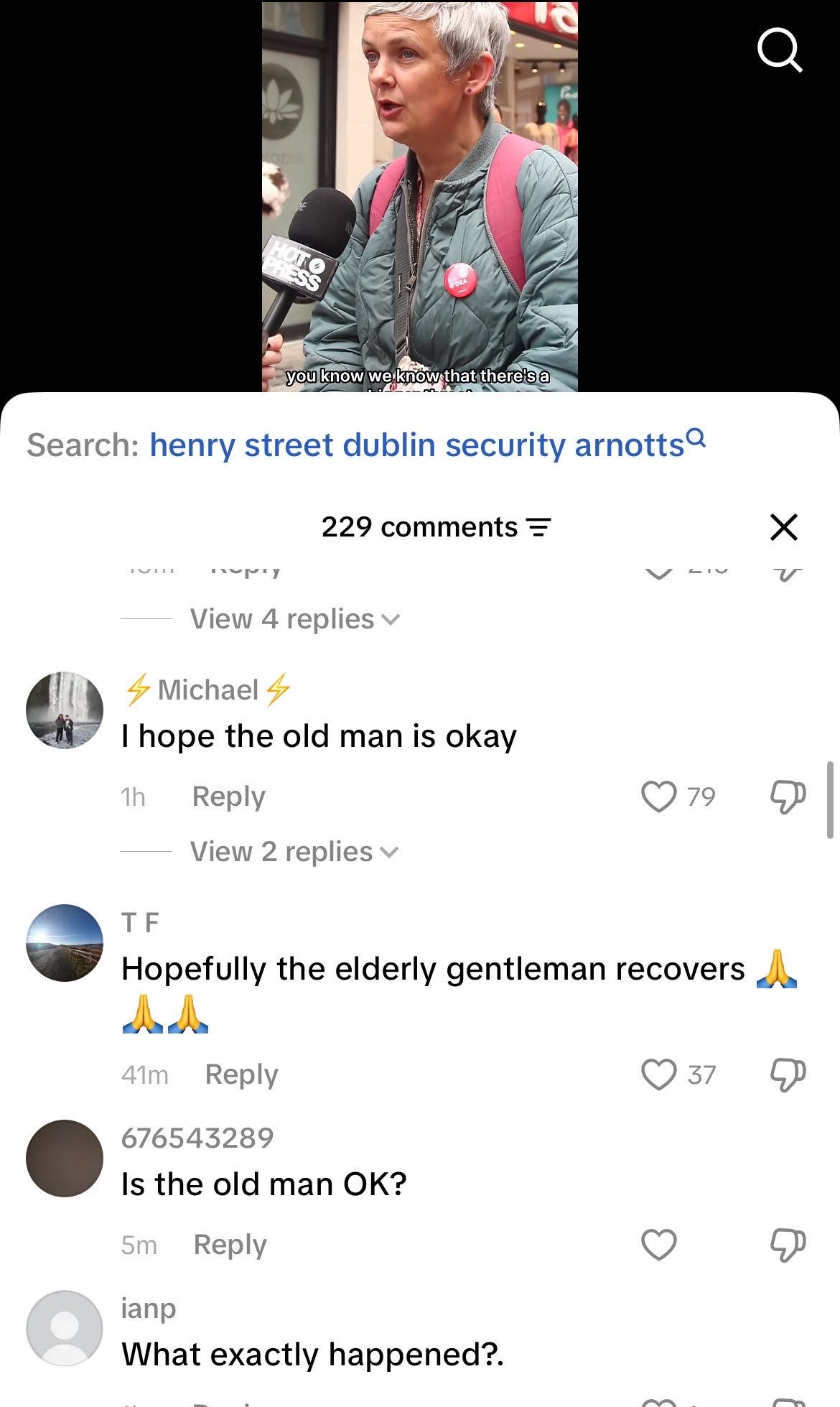
George Floyd’s death happened during Covid and caught the Irish imagination, leading to some very strange protests here and one absurd incident where some statues were removed from outside a famous Dublin hotel because they were perceived to celebrate slavery (they didn’t, and were soon replaced). Despite the best efforts of the activist class, the death of Sakila hasn’t caught fire in the same way. Even on relatively left-wing leaning platforms like Tik Tok the response has not been sympathetic, with people emphasising Sakila’s immigration status, his previous interactions with police and the reports (confirmed by Gardaí) that an older Irish man, a bystander, had been knocked down and injured during the incident.
This whole chain of events was thrown into relief by a similar case that seemed to unfold simultaneously. In the Dublin suburb of Blanchardstown, a man named Alex Coughlan was
… filmed on his knees, crying and pleading with his teenage attackers before he was fatally assaulted, it is alleged. Two 16-year-olds are accused of carrying out a violent, unprovoked assault on the “defenceless” man as he pleaded for help. A court heard the Alex died from his injuries in hospital following an assault and robbery in west Dublin on Sunday.
As with Sakila’s death, the footage circulated widely online. There was speculation on foot of the video about the migration status and ethnic backgrounds of the attackers.
Despite the similarity of the incidents, it seemed only one was to be allowed to have political utility. No semi-state apparatus clicked into place to make a political tool of Coughlan’s death. There seemed to be an expectation that the public would draw racial and cultural conclusions from one case and put them into action immediately, but a parallel expectation that they would not ask similar questions in relation to another. This cognitive dissonance didn’t make the papers, but people have noticed, and it coloured the online reaction.
Between the two incidents, there probably hasn’t been a better example of how Ireland has created an activist layer of national life on culture war issues, with participants who often seem to have a direct line to local press and international media, who can summon protestors and activists at a moments notice, and can expect to have their voices heard and listened to on every platform, and at every point in government. This isn’t new: there are certain issues (I suggest Savita Halappanavar’s death) where the sudden mobilisation of activists and media is broadly aligned to some underlying public sentiment (in that case a desire to see abortion legalised and legislated for), and follows a parallel track. But on other issues the movements of this layer seem to be totally distinct from and bear no relation to what the public want or and what they think. On these occasions, reading and watching the official reaction, and then looking around you, can feel as though there’s a verison of Ireland that exists only in the media and has a political life entirely distinct from the one we actually live in day to day. If only they remained distinct, but of course the public square one can often impose it’s will on the real one, and may still do so in this case.
Other Stories
An attempt by the Social Democrats to remove the mandatory waiting period for someone to avail of an Abortion failed. This gives us an interesting checkpoint to see where abortion, for so long a a fraught issue in Irish politics, sits in 2026. With the exception of Aontú, who were formed as an anti-abortion splinter party from Sinn Féin and have two TDs, there is no indication that reducing abortion rights is a key voting issue for any party. Many participants in the system seem to believe that reigniting a dormant culture war issue by changing the status quo when there’s no strong public demand to do so either way can only result in a loss for them. The government allowed a free vote on the subject and there were 36 abstentions, which is a lot.
The latest edition of the Reporters Without Borders world press freedom rankings placed Ireland at 7 out of 180 countries, which is actually a drop of 6 places but leaves them inside the top ten. The drop is attributable to concerns about future funding for the Irish media. The placing certainly doesn’t seem to account for the issues I highlighted last month involving the implicit weaponisation of an independent press regulator to try and silence anti-government criticism during national fuel protests. Left-wing outlet The Ditch did some follow up reporting on that issue during the month, and discovered the problem was worse than initially thought.
Another item I mentioned last month was in relation to Nuclear Power, the use of which is currently prohibited by law in Ireland. There had been some loose talk about changing that - I thought it was fanciful but a bill has indeed been introduced to change the existing law. Some members of government including the taoiseach have welcomed the discussion. I’m still suspicious; I think the long time horizon associated with the development of nuclear power provides the opportunity for the government to look like they’re doing something on energy while actually doing nothing, so I still don’t think this is very likely to come to fruition, but the shift in tone is interesting.
Thanks for reading - more next month.
Enjoying these! On this point: "On these occasions, reading and watching the official reaction, and then looking around you, can feel as though there’s a verison of Ireland that exists only in the media and has a political life entirely distinct from the one we actually live in day to day." What do you make of the argument that this is the same trend you would have seen a lot of in 70s and 80s ireland where civil society was de facto assumed to be liberal Catholicism, rather than the progressive liberalism we have today?
That G8 photo has a Reservoir Dogs vibe.