
A link to the last Ireland update is here.
Mayo won the All Ireland Football Championship for the first time in 75 years in July, and yes, before you quibble, this absolutely was a seismic event and the biggest thing that happened in Ireland in the last few months. This isn’t a sports blog or even really a news one, but I’m going to talk about the game because there are few events that have occurred in the last decade that tie together so many strands about Ireland’s cultural/ demographic past, present and future in such a complex knot. The story was the top one on the Irish news for the two days after the match, and the alarming depth of feeling about the match in Ireland was a reflection of something elemental having been stirred in the Irish psyche. This joy and fascination was accompanied by an unarticulated, melancholy sense that this may have been the last gasp of an essential Irish monoculture.
Part of what gained the story international recognition is the idea that the team was suffering from a curse; legend had it the previous winning team of 1951 disturbed a funeral on their return home and would not win another championship until the last member of that team had died. This RTE story summarises why the curse history is phoney - the evidence being that no one mentioned it until the 1990s, no one who was present amongst the 1951 team was able to recall the events described, and various other verifiable factors that make it practically impossible (there were no funerals in the area during the relevant period; the team didn’t arrive home until late at night, long after any funerals would be over, etc etc). If the existence of the curse myth is testament to anything it is that Mayo’s run of losses in the final was so inexplicable, and an All Ireland victory so deeply longed for, that a supernatural explanation was demanded. I keep thinking about the fact that there’s a guy out there who cooked the story up; in order to perpetrate the bit effectively, his name and identity have been lost to time and he’s had no presence in the celebrations this week. Even if he revealed himself, who would believe him? Anyway: here’s to him.
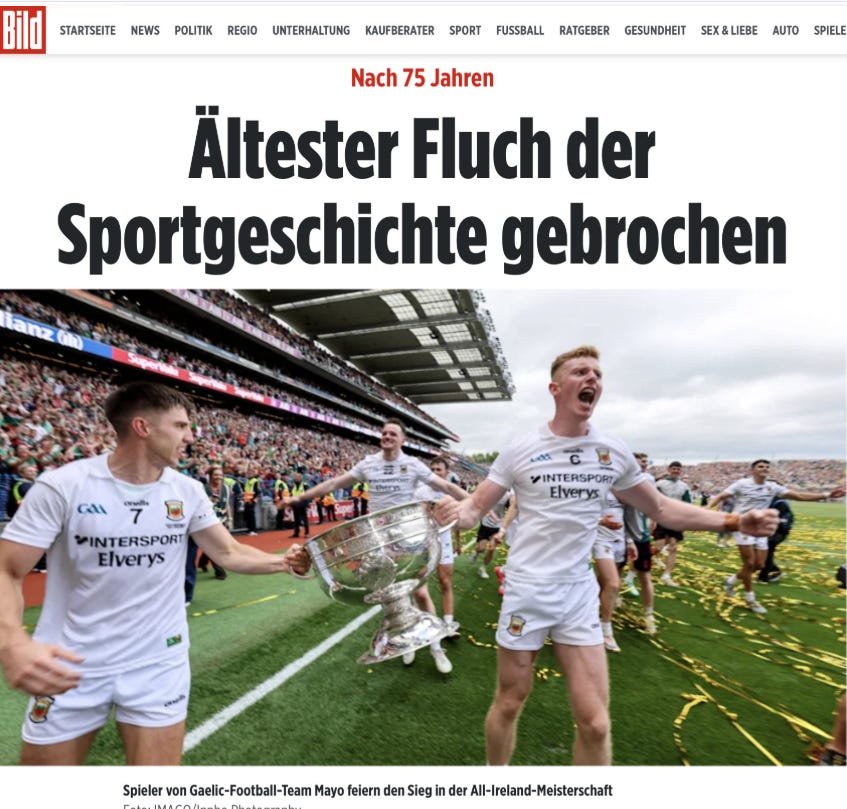
The victory gained an unusual amount of international coverage, driven by the depth of feeling about it, some wild local radio commentary (“the curse is dead, press the nuclear button”), the lurid nature of the myth, and an unfamiliar sport suddenly pumped into people’s timelines. A lot of the external commentary got basic things wrong (I kept seeing people mis-state the number in attendance, what the sport actually was, the compensation offered to the players and so on). Here is coverage from The New York Times, German tabloid Bild, Australian TV station 7 News Sydney, as well as commentary from Joe Biden and Mark Carney.
The dilemma the game and the reaction secretly highlighted is that the GAA is the kind of essential and unique institution that modern Ireland desperately needs but cannot build, and is by default gradually dismantling. It was founded as an explicitly nationalist project (“Irishmen must choose between Irish and foreign laws” said founder Micheal Cusack). Over time it has removed or watered down some of it’s most overtly exclusionary tendencies - those include rule 27 which forbade members from playing or watching of foreign games, and the extant but sometimes suspended rule 42, which prohibits GAA infrastructure being used to host foreign games. The latter includes Croke Park, where the recent final was held. But this ethos - that the games represent something that is specific to Ireland that needs to be protected, prioritised and maintained - is still embedded in the organisation and is key to the public appreciation of it.
It can be hard to relate to an outsider the extent to which the 2200 GAA clubs, the billions of euros of value they generate, and the cradle-to-grave participation they represent forms a ubiquitous and essential part of Irish life. It is one of the key things that gives Irish life an essential texture, context and meaning. The ubiquity of GAA jerseys everywhere from Tronoto to Sydney to Koh Samui indicate that it’s the thing that Irish people take with them when they go abroad, and most keen on introducing foreigners to. Something that is understood but rarely articulated is that on a national level the GAA serves as essential proof of the reality of Irish national independence, a continuous reminder that Irish people dedicated their efforts to creating something that was unique to us, and purely ours, that was entirely uncompromised to the interests of outsiders which not only survived but became a national and historical success. This emotional attachment is regularly reflected in surveys in which the GAA appears near the top of the list of things people are proudest about in Ireland and that gives them the greatest sense of national pride.
Since the GAA and the sport it controls are so cherished and deeply woven into Irish life, and we live in a time of intense demographic change that demands stable pan-national institutions to serve as fixed points of identity - why not create more institutions like this? The dilemma the Mayo victory and its rapturous reception have highlighted is that we need the social cohesion that such institutions represent, and pay tribute to it, but would be repelled by anyone who proposed such a culturally specific and implicitly exclusionary project or organisation today. The official antipathy towards unique symbols of nationhood has become a recurring theme in the last few years; it includes Micheál Martin’s statement that the government “want nothing to do with a backward-looking idea of sovreignty” (as opposed to a multicultural conception of the same thing), the massive rise of Irish exemptions in education, and the panic at the reemergence of the tricolour as an nationalist symbol. Everyone understands that on the one hand, keeping the country stable and functioning as it changes requires GAA-type institutions, but on the other that the people who oversee that change are fearful and contemptuous of the feelings those institutions rely upon.
The reality of the GAA and cultural change in Ireland is that the latter has mostly been bad for the former, and presents an unresolved challenge to its existence. The press routinely report on forced club closures and mergers in small towns; this is at odds with the fact that we are in the middle of a population boom and is explained by the fact that, with notable exceptions like the Ó hAilpín’s, Lee Chin and Jason Sherlock, people from what are called non-traditional backgrounds are mostly not taking up hurling and football - despite the best efforts of the GAA itself. And realistically - it’s logical that an Irish nationalist sporting project would have limited appeal to people with shallower ancestral connections to the country. The other side is that the people who traditionally play these games are disappearing through internal and external emigration. That’s bad news for the institution itself, but also for a country that more than ever needs popular fixed points of common identity to hold on to as it changes.
To get back to the Mayo game for a moment. A thought kept occuring to me as I watched the international coverage, and that thought was this: “Ireland is real”. Despite the ongoing quest (sometimes from within, sometime from without) to deny the existence of Ireland as a historic nation, we are real, our culture is concrete, organic and vital and you weren’t crazy to think that it was. That rankles some people; one of the things that people highlighted in the aftermath was the England vs Argentina world cup match got higher ratings than the All Ireland final by a couple of thousand. While that seems to be true, I think that only someone not living in the country who didn’t witness the outpouring of emotion and the way it seemed to come up from some deep pit to envelope every part of national life, could think that meant the two events were remotely similar in their significance. One of the most exasperating things I saw was the tweet below, of some reacting with scorn now-famous footage of the man crying and collapsing to his knees at the final whistle.
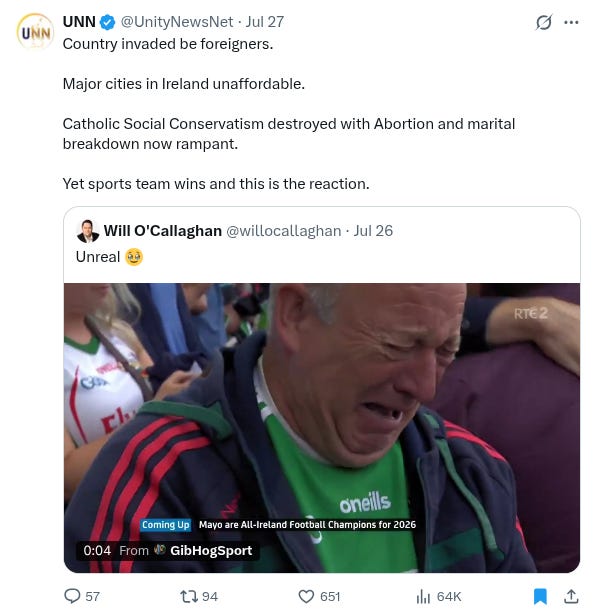
This one example - there were a few like this. It is a familiar right-wing complaint about Sportsball and how participation in it represents a deracinated, anesthetising modernity, and a way to compensate or distract from the decline of meaningful identity and connection. This is a very basic misunderstanding. The GAA is probably the most powerful, vibrant, and beloved unique institution in Irish life. It *is* the Irish culture you’re talking about, in sporting form. If other country’s national games are run by oil billionaires from oriental tyrannies, if the bureaucracy of their sports have been taken over by psychopathic eurocrat conmen, if the people who play for their local teams have no interest in the locality, no connection to it, no love for it - that’s a You problem, as an Irish person I absolutely cannot relate. I’m sorry the connection between love of place, love of local culture, and sport has been disconnected in your country. It hasn’t in mine: not yet anyway. That’s not to say the GAA is in rude health: the idea that this was the last gasp of it is in the air, and that’s very sad. The crisis of Ireland is that we seem to have decided to change some very basic things about our country, and in order to do that we are burning through a millennium of accumulated cultural capital - the replacement of which is not only not happening, but at an official level the idea of doing so kind of scorned and looked down upon. The inevitable loss this will lead to is not going to go unnoticed, or unfelt.
Other news stories that caught my eye this month:
Seems like someone (“someone”) tried to cook and eat a dog in Ballymun.
A gang of teens (“teens”) rampaged over the Dublin seaside town of Skerries; an american woman living in Ireland was murdered in Kerry, and her killer fled to Jordan. On foot of the latter incident, the Taoiseach, with his trademark silver tongue and keen ear for the public mood, noted that the statistics on the murder of women in Ireland are “not going in the right direction”. These events were amongst the ones that prompted me to write this article during the month, which highlights (in spite if the taoiseach’s words) the grand, empty statements governments make about ending violence against women, while in fact doing everything they can to not only tolerate but encourage every type of social disorder with their policy decisions.
NAMA, the government agency established to dispose of property repossessed from developers during the crash, was finally wound up.
Oscar-winning singer-songwriter and mainstay of the Irish music scene Glen Hansard died in a motorcycle crash at 56 years old. His death was mourned by the usual Irish figures like Christy Moore and Bono, but also by international ones like Bruce Springsteeen and Barack Obama. I can’t say I was a fan of his music; his death resonated with me because he first came to prominence in Ireland playing the role of Outspan in the 1991 movie The Commitments (“Outspan” was a brand of orange, so that was a joke about his hair). As I commented previously about its sequel The Snapper, The Commitments was made 35 years ago but feels like it’s from 60 years ago, and to watch it is to experience a kind of melancholy cultural vertigo about the pace of irreversible change in Ireland in every area in that period.
Excavations continue at the mother and baby home in Tuam, Galway. I can’t help but compare the ongoing focus on this matter with the ongoing total disinterest in the current problem of children missing from care, and the fact that we know adults are lying about being children and placed in care alongside vulnerable kids. Is there something about Irish society that trends towards institutional abuse, cover up and societal denial, that the church (at its worst) was an extreme example of rather than a cause of? I think there is, but no one else seems to care, the people who are critical of the legacy of catholicism least of all.
More great work from Tomás O’Reilly this month, with this story noting that at least 35% people availing of the “Help to Buy” housing scheme are from outside Ireland. The significance of these statistics are that the government has continually adopted the contradictory positions that the impact of migration on areas such as housing and crime is not worth worrying about, but also that there’s no effect, and that data on it is not being gathered. This proves at the very least that the latter part is an intentional falsehood, which is being perpetrated because of how bad it looks, and because of what the government would be asked to do if they acknowledged the truth.
Articles on similar topics
“Sinners”, and the Use of Irish Identity in the Culture Wars

What with it being December, People are composing their “best of” lists of movies for the year, and on many of them Sinners will be close to the top. The action-horror movie about vampires in the early 1930s deep south caused a big splash on release; fo…
Steve Bannon Isn’t Going to Win Power With an "Irish MAGA" Party and Neither Is Anyone Else

Towards the end of 2025, the Trump administration published a revised National Security Strategy, outlining how it will implement America First policies in a world of competing regional interests. Politico spoke to Steve Bannon about it, resulting in the following interview, in which he seems constantly on the cusp of blowing himself (I actually like Bannon a lot so I think that’s mainly a result of a snide editorial voice, but it’s still funny):
The View from Nowhere

The Irish government has made a distinct turn in how it talks about immigration and asylum in the last few months, becoming noticeably more critical. The change has been caused by a number of issues, the proximate one being the high spoiled vote percentage in the Presidential election. The negative impact of that phenomenon fell hardest on the legacy parties in government, who interpreted the result as a grave threat (“our voters are pissed off about this and it’s quietly killing us”), but also an intriguing opportunity (“there are votes in this if we play our cards right”).
Just looked at the RTE highlights on YT.
The commentator says at the start "It's a celebration of Irish culture, a celebration of who we are, and indeed where we're from". And they are from Ireland, not Algeria or Ukraine.
I can see why this would be annoying for the globalists, but it's probably too big an event for them to critique as 'problematic'. I suppose NGOs may start complaining that new Irish are absent due to 'exclusion', but, as you say, they most likely exclude themselves as it is Irish culture and the migrants haven't moved there for the culture.