
The hit Apple show Ted Lasso, which has returned for another season, is unusual in that it’s a programme about men doing a quite male thing - playing and managing in professional sports - and mostly written by men, but for women. As well as a mjority female audience, it skews towards the 35-49 age range, and is more white, coastal and highly educated than average (despite being about football it’s popularity in the UK is limited, so that’s coastal America).
So the gap between who watches the show and its frequent subject matter makes it worth studying. White, educated, younger-to-middle-aged women in cities are the practical and spiritual core of progressive politics. What do they think men’s problems are, what do they men should be, and what is the type of man they will accept?
As a main character, Ted himself is a folksy people-pleaser, emotionally attuned, gentle and encouraging. In season 4 he exists to enable the women around him; the plot is that he returns to his old club to coach the women’s team. Here is a review that accurately, I think, summarises what the season is about:
Among the most crucial is the chance to celebrate and champion women’s sports, while raising awareness of misogyny and gender gaps that athletes face in the real world. Five episodes in — in ways big and small, serious and lighthearted — writers thoughtfully address underfunding, lack of resources, pay disparities, low media attention, and other cultural biases.
You could fill two Internets with what Ted doesn’t know about coaching a second-division women’s football team, but he doesn’t doubt for a second that women are just as capable and worthy of playing the game as men. That unwavering belief, plus his relentless positivity, empathy, tenacity, and self-acknowledged “deeply ingrained white male privilege” make him an ideal coach and ally — not savior — to an underdog team with so much to prove.
These themes are of a piece with previous seasons; I went back and had a look at episode recaps of Season 2 to remind myself what it was that bothered me so much. There’s a the focus on therapy as a panacea (Ted is skeptical and uncooperative at first but the language of the show is crystal clear that therapy is universally applicable and good); the focus on social justice activism as a key motivator for the team as a whole and for individual players; the teary over-emoting and locker-room group hugs from players and male staff, for instance when one character breaks up with his on and off again girlfriend, or when another has an argument with his abusive father.
All of this is fine; if it’s written in a tone and covering subjects that women generally prefer, despite in the main being about men, then honestly who cares. But as a man, when I’ve watched the show, I constantly find myself thinking “no one would react like that, especially a hairy-arsed footballer”, and feeling that the show is referring to a moral outlook and set of priorities that is off-putting and unfamiliar to me; even as someone is at the least macho, least aggressive and most sensitive end of the normal male spectrum. Whatever the merits of the show as a piece of entertainment for its chosen audience I certainly wouldn’t recommend selling its vision of men as an idealised political programme to men themselves, and if I’d lost hold of them as a group it wouldn’t be the way to reel them back in.
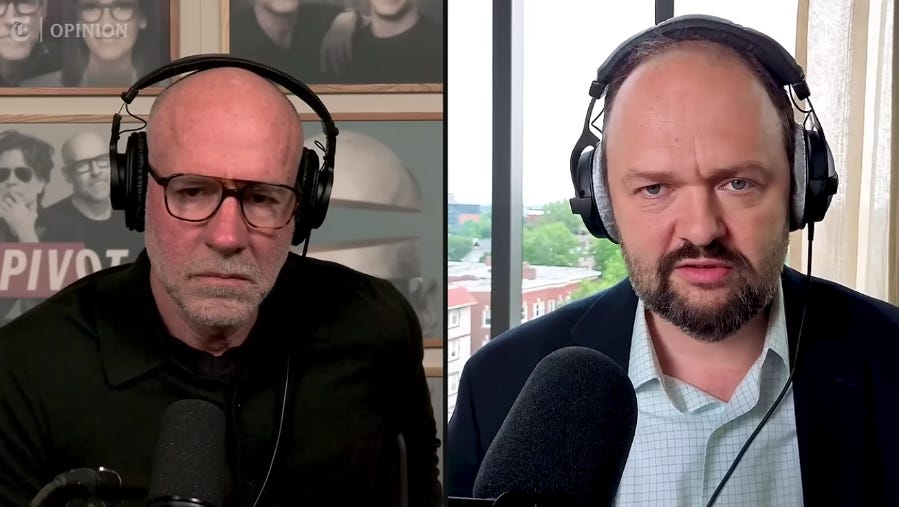
I thought about Ted Lasso and my dislike of it quite a lot as I listened to Scott Galloway’s recent appearance on Ross Douthat’s podcast Interesting Times. Galloway is a businessman, investor, academic and podcaster who has lately made a role for himself as one of the chief commentators working the “Crisis of Masculinity” beat and proposing political solutions to it. Not unlike the writers of Ted Lasso this means presenting the preferred solutions of Progressive people and, being American, those of the Democratic party as applicable across the board. He presents himself as being concerned for men as a group, and while I take him at face value - there’s no reason to assume he’s being false - but he is also a party man, and all of his words have to be seen in that context. His question is never simply “how can we help men” without also being “how can we as progressives present a vision of men that fits them back into our standard policy platform and outlook”. It’s the clash of the two competing priorities, and their irreconcilable nature, that’s interesting.
In talking about how he came to the conclusion that men needed help, Galloway mentions something that you often hear from Richard Reeves, which is that he engaged with the Democratic party and found that men were the one group who were not taken seriously as a special interest, and in fact that there was active resistance toward doing so. Reeves talks about his version of this here. So Galloway mentions going to the Democratic convention and hearing people talk about every slice of society as worthy of uplift and attention except men, who must be excluded because of their historic privilege and because of Patriarchy. It’s self-evident to him that the thing to do is to slot men into the progressive moral system in the same way as other groups. He doesn’t ask what happens when someone's worldview is not not primarily based around wanting help or liking it - the idea of such a thing is nonsensical, or sinister. As a party man, his belief is never that a progressive outlook doesn’t suit men, and that it would need to change or change focus to better accommodate them. In the podcast he steers around and cannot confront the question of whether there is something that is psychologically deleterious to men to be thought of as a problematic, passive mass to be fixed or held up by a system.
Some specific examples. Around 12 minutes into the podcast he tries to define how men’s declining material fortunes as a problem that needs to be addressed. “The truth is… Beyoncé could work at Kentucky Fried chicken and marry Jay-Z, the same is not true of the equivalent man… women are judged unfairly on their aesthetics, young men are unfairly evaluated on their economic viability.” I’m certain that’s not true of Beyoncé, but let’s put that to one side for one moment. I’ve heard this argument a variety of times as an application of the Progressive outlook to men’s issues but have never heard Galloway or anyone similar ask the basic essential question - do men themselves believe it to be unfair to be judged in large part on their personal and economic achievements, and would they want it to be otherwise? I have never encountered a man who felt that way, or who felt comfortable complaining about this set up, no matter their circumstances. It’s not comparable to how women feel about being judged about their looks or femininity.
Men, in the main, think it’s fair to be judged on these things, or if they don’t think it’s fair they think it’s how the world is, and feel it’s proper and dignified to roll with it. They either want to be better at these things, or they have accepted grudgingly and perhaps with a certain amount of heartbreak that maybe they didn’t measure up to what they nonetheless feel is an objectively correct standard. This is a philosophical point, but it’s not a trivial one for Galloway or any other Progressive interlocutor. Men are happy to stick to their own moral standards, and they only object when the different standards of others, which are alienating to them, are universalised, and when they are asked to celebrate those standards as true. This may be more of a presentational problem than a structural one, but it’s important either way. I don’t feel Galloway or anyone else in his position has their arms around it.
If men think that being understood as a victim-stakeholder and passive recipient of aid is a degrading position, they don’t generally don’t protest about women’s position in a progressive system that sees them as a such a group, that because men think women are happy being thought of and treated that way; that’s women prerogative, and women’s problem if it’s wrong. Naturally most modern men also understand that there are really historic disadvantages women suffered from that still linger. What would men be like if they didn’t feel this way? Galloway protests (correctly) during the podcast about the patheticness of the incel movement (I don’t agree at all that it’s a movement - but whatever), and the way that its participants create an identity around helplessness, resentment, blaming the others for what are often your own problems. But I think he fails to acknowledge that for men at least, Inceldom and Progressive thought compliment each other perfectly and that there even may be a relationship between the two.
Men are unsatisfying subjects of a Progressive worldview, and that comes through when you look at how Galloway talks about them and women, and how differently he views the purpose of politics for each. A couple of references from the podcast. At 17:03 he notes how good it is that men have played a role in uplifting women and that “men should take pride in that and be the afterburners for our mothers and sisters and daughter’s success.” He later notes that he orients his conception of healthy manhood around Service and an idea of Surplus Value, which is that Men truly come of age when they are providing more to others than they are taking. It’s of course true that when I look at the happiest and most worthwhile and fulfilled men around me, they are people who have oriented their strength in service of others. But of course the same is true of the happiest, most fulfilled and worthwhile women I know, and we would never speak about women in these terms, or speak about women’s participation in politics as purely being about what they can provide to others. Later, Scott is careful to note that “women don’t exist to service men” - which again is true, but the contrast is interesting.
Finally, Galloway speaks of “Protectiveness” as a key characteristic that men should be encouraged to build in order to improve their lot, noting that “it’s a tragedy that that women don’t feel safe on the subway… women shouldn’t feel they need to cross the road when they see a young man, they should cross the road to get to a young man. Your job is to protect. Who breaks up fights at bars? Big strong men. Who starts fights? Insecure people who don’t like themselves.” This is all fine on one level - I hate violence and I don’t even disagree that being protective of others is a key way that men can provide value to others and thereby fulfill themselves. But again we see the occurrence of a key problem - equating strength only with protectiveness of others is a way of side-stepping the dilemma of what men want for themselves, and how progressive outlook can address that essential question.
The problem is not the idea of service and usefulness which holds a very strong appeal to men; the problem is that in a progressive world-view the purpose of politics is a therapeutic one of allowing marginal groups space to gain power, self-actualise and fulfill themselves for their own sake, not as a way of serving others. Men are still an historic oppressor group to be feared despite their recent failures, so a progressive outlook can never speak directly to their happiness, their fulfillment, their success except where it provides for women or some other group more worthy of consideration than men themselves. Even where men are targeted as a voter group it can only ever be done in a way that puts a philosophical burden on them - that burden being that political solutions tailored for them are only valid to the extent that they can be positioned as providing relief and support to other, more marginalised and historically oppressed (and therefore politically legitimate) groups.
There are a number of different places where we see this natural tension bubble to the surface - that of seeing men as both an oppressor group that progressive politics exist to liberate others from, but also as a voter group that progressive candidates can’t succeed without. Galloway keeps highlighting the biological inadequacies of men, in a way he never would with another group, and I can’t help but feel he does it with a degree of relief. So during the podcast we’re reminded that boys are less mature, have brains that develop more slowly, and are “less educationally fit” than girls. When I note he would never point out these kinds of basic biological limitations with women, it’s not a complaint - it’s just that it’s interesting and revealing. To be able to articulate men’s inadequacies comes as a relief because they allow a Progressive activist to position men as a victim class, but still one of inferior quality. Men can then be deserving of help but not in a way that is disruptive of the philosophical status quo, in which a member of an oppressor class being capable makes them dangerous.
Our modern conception of politics is that it’s about you, your success, your fulfillment - a cross between liberation, self-help, and self-love expressed through the ballot box. For the oppressed groups Progressive thought is oriented towards, it offers them support, endorsement, encouragement and nurturing and a confirmation that yes, everyone is against you, yes you deserve the world, no nothing is your fault. Everyone gets a fragment of that treatment, and it’s part of why that type of politics is successful - but men, by definition, can’t share in that. Now - no one knows better than men themselves that male strength and vitality is frightening, and that it does need to be corralled into some useful shape. Often that does come in the form of duty, self-sacrifice, obligation. And of course it’s true for most people that they find fulfillment by placing a centre outside themselves. But men are the only political group where their focus is expected to be on service alone, and I think it’s blinkered of people like Galloway (I’m less sure of Reeves) to think that men won’t notice that a double-standard is being unfavourably applied to them. The one thing that red-pill gurus and drop-shipping self-help scammers and online shitlords of various types understand is that flexing your strength (in whatever field) for its own sake is important, and can bring joy into one’s life. That’s not all there is to life, but it’s not nothing.
Galloway ends his appearance with some general blather about the need for men and women to put aside their burgeoning political differences and come together. Let’s not dwell on how we got here, where political tendencies are diverging; there’s plenty of blame to go round, and he tells us that “the genders have each done a great job of blaming each other for their own failures”. Oh really? I find this feint at evenhandedness, and treating men and women as equal political actors within a progressive framework that by definition must regard women’s political interests as more legitimate than men’s, a bit infuriating. If Scott says (or implies) with confidence that women blame men for their own failures, perhaps he can give us some examples? He can’t, of course. “Women aren’t going to flourish if men are flailing” is his final appeal as to why we need effective solutions to male-specific problems. But why should another group be your point of orientation, in a political worldview based around personal fulfillment and liberation? I’m sure Scott would agree that greater female inclusion in the political process was and still is about giving women room to self-actualise and be happy and gain their due share of power, and men’s function in the political process is to… what - help women do that? I don’t even care if it’s true, it’s just an unpersuasive message and men won’t be drawn to it. It’s a problem that is not easily solved.
Articles on Similar Subjects:
Odysseus’s Modern Manhood

Christopher Nolan’s movies are about fathers and sons. In Batman Begins, Christian Bale is driven to live up to the example of his father and tortured by the idea he has failed to do so; he’s kept on track by surrogate father Alfred who reinforces the moral lesson of his dead dad, and pulled off track by false mentor Liam Neeson. In Inception, Cobb’s central motivation is to get back to his kids - the story clearly comes from the mind of someone whose dad was away on business a lot when he was young, and who is also guilty that he’s spending all his time on location worrying about lens choices and not driving Sebastian to school (I have no idea what Nolan’s kids are called or what age they are). Don’t get me started on Interstellar - the key scene is literally a parent who ascended to the heavens watching from above as his most beloved child grows up without him. Jessica Chastain plays a daughter but it’s an
Men and Progressive Culture on "The Pitt"

In Season 2, Episode 8 of Hospital drama The Pitt, the Emergency Room doctors stitch up a party girl who has bitten a chunk off her own tongue while drunk. Even as they sew she dips in and out of consciousness, but she is aware enough to confirm she’s an everyday drinker. As we watched at home, my wife and I speculated how this would play out in an Irish hospital… with an exhortation to cop yourself on and stop being an idiot, some grudging admiration for being such a character, maybe a lament from the doctor that they haven’t had time for a pint recently themselves. We were certain it wouldn’t end with the girl being referred to rehab, which is what happens in the show - an hilariously American reaction. These little cultural quirks and tics of The Pitt are one of the things that keep you watching; but attitudes to alcohol are not the biggest or strangest of it’s blindspots, not by a long shot.
The Different Challenges of Male and Female Online Radicalisation
In April the UK’s New Statesman published an article entitled Angry Young Women, which uses new polling to
It seems like they've learned nothing from the Tim Walz 'sitcom dad' debacle.
During the brief Kamala honeymoon the left were convinced that Tim was someone most men would admire.
There was also the 'Man Enough' ad. Had to double check it wasn't a spoof.
https://www.youtube.com/watch?v=jLzYPbtklGs
It seems to be a theory of mind problem.