
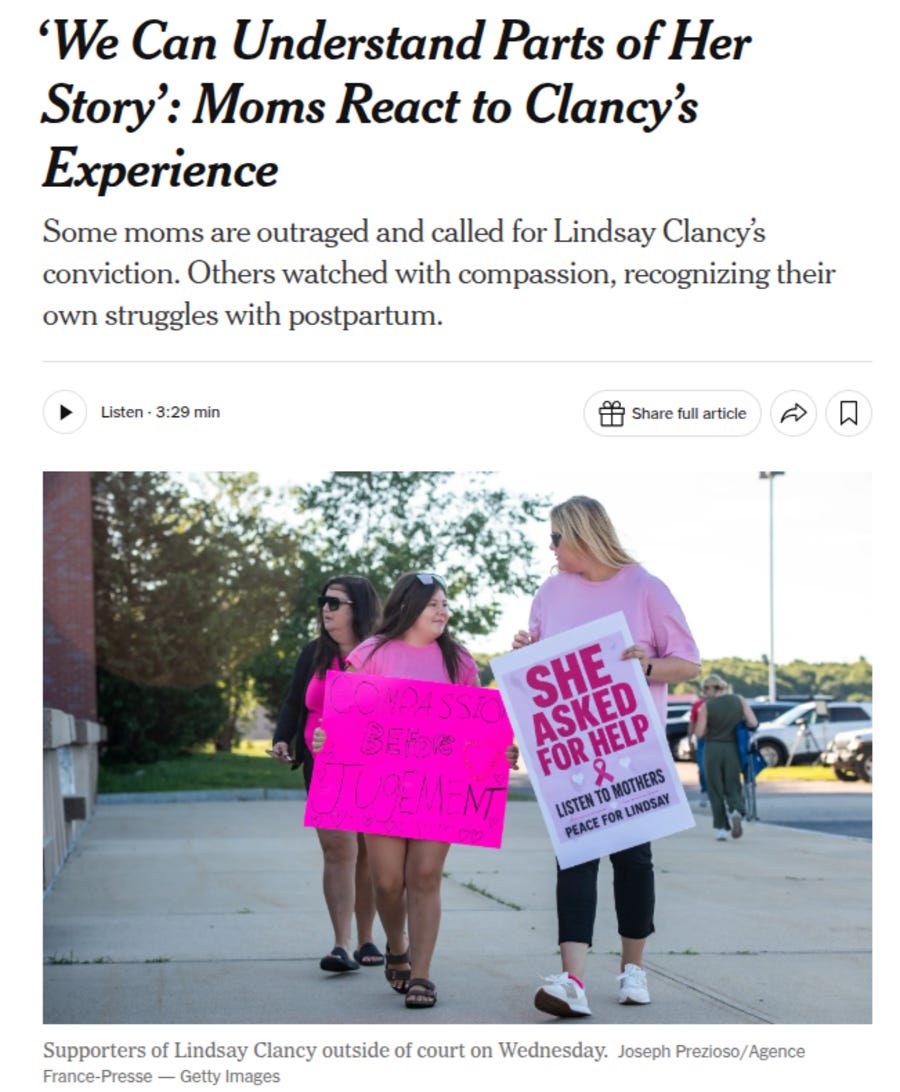
Irish political commentator John McGuirk has started a new substack and podcast with long-time collaborator Sarah Ryan, both of which can be found here. One of the first pieces, written by John rather than Sarah, is about his feeling that his initial take on the Lindsay Clancy case was wrong. Clancy (if you’re one of the few people on the planet who doesn’t know) is a mother from Massachusetts who was on trial for murdering her infant children in 2023, though the specific details of the case are so much worse than even that implies. Clancy has admitted the murders but in her defence claimed that she was driven to it by severe post-partum psychosis and bi-polar disorder, both of which she alleges were mismanaged in various ways. (She and her husband have filed malpractice claims against her medical providers.) As I write this, the judge has just declared a mistrial; it seems a single juror was refusing to vote with the others. I know nothing about the intricacies of insanity pleas or reasonable doubt in Massachusetts law, so you can read presumably more informed takes on why the case fell apart here and here.
John’s article notes that a lot of the online reaction against Clancy from the right was based on an instinctive contempt for liberal women, and amplified by the nuttiest exculpatory takes on the case, which mainly revolved around claiming that her husband was the real killer. As any good or interested commentator should, he steelman’s the case for supporting Clancy rather than attacking it at its weakest, and finds that there’s something there. He also notes what he believes is the hypocrisy of commentators who minimise the role of her medication her case, who often were people who were most critical of the role of big pharma in exploiting covid for profit. I don’t agree with all the points that he makes but they’re all worth considering and I’m grateful he gave me pause before I pressed publish on an article I had already been planning to write.
However, at the start of his article he says of the public and vocal support Clancy garnered:
… to a great many people, including me initially, this seemed obscene: There are lots of things in this world that you can spend your energy and money on, and it instinctively seems a little strange to spend it on the defence of somebody who, by her own admission, killed three toddlers. Your sympathy, I thought, should be with the dead kids who met awful deaths than with the woman who killed them.
I hope John takes this in the jovial spirit in which it’s intended but, to quote Spinal Tap, there is such a thing as way too much fucking perspective. Getting down into the specific details of this case does cause one to lose track of what’s actually important and interesting here, which is why we should ask these questions at all, since we never normally would for a crime of this type? People lose their grip on sanity and do terrible things all the time, and we can and do accept the complexities of what led to them to that point without seeking to celebrate them as loving, heroic, and wronged; we never make their defense into a pink festival of girl power as her supporters, who are not small in number, did in this case.
In general where a person has murdered their infant children or committed an equivalent crime and it’s clear they are guilty, people tend to be too self-conscious about appearing impious about a tragedy to be too supportive of the killer. It’s good and normal to be repulsed and weirded out by that breach of normal human decency, and the only interesting thing about this wretched affair is to ask why in this case that taboo was broken so widely, unashamedly and casually. It’s unfortunate that due to well known online incentives, the worst examples of very normal and mainstream people identifying with Clancy in an inappropriate way were curated by chud accounts on twitter, tiktok and other platforms, but this doesn’t make them any less true.
All this becomes clearer when you look at other, similar cases of people murdering infant children where mental health issues were at play. Two that have attracted attention online post-Clancy were those of John Battaglia and Timothy Ray Jones Jr. In the case of Battalglia (who murdered his daughters aged 6 and 9 - he was convicted and executed very quickly):
… there actually was a significant suggestion that he suffered from bipolar disorder, and it was a major pillar of his defense team’s strategy. During the punishment phase of his 2002 trial, multiple forensic psychiatrists testified that Battaglia had suffered from bipolar disorder since his mid-to-late twenties. His defense experts argued that the killings occurred while he was experiencing a “psychotic rage” or a severe manic episode. Even the state’s rebuttal psychiatrist conceded that Battaglia likely had a mild form of bipolar disorder, alongside antisocial and narcissistic personality disorders
The case of Timothy Ray Jones (who murdered five children between the ages of 1 and 8 in 2014, and is now on death row) is even more similar. In that case:
… the defense presented extensive evidence that Jones had a severe genetic predisposition to mental illness (his mother had been institutionalized for schizophrenia for decades). Experts testified he had schizoaffective disorder and was experiencing a severe manic break.
(Both the explanations above were provided by AI.)
Again - the question is not whether we should be more sympathetic to people who kill their young children, but why some would choose to do so extravagantly in the Clancy case when we didn’t do in ones such as those quoted above. One answer is that there were extenuating circumstances in the Lindsay Clancy case, and I get that, but don’t find it persuasive. Every horrific and tragic crime is horrific and tragic in its own way; by definition, (I mean this in a human sense and not legally) a person who does this is not right at some fundamental level. The fact that you can locate some important complication suggesting that someone should receive more leniency and understanding than we’re inclined to give them is not that surprising. In the Jones case described above, for example, his wife pleaded for leniency despite her children being murdered because she seemed to recognise that his underlying mental health issues had been exacerbated by his attempts to self-medicate. Many of these cases highlight why cases of mental illness are so troubling, which is that they inflame our sense (which is necessary to enable us to process the reality that such evils occur) that an identifiable individual must always be to blame, which means in turns that they can be caught, punished, made to suffer and so on. All that is fine, but again: that dilemma is present in the Clancy case it’s because it’s present in all such cases. There remains a standard that one does not wish to appear too understanding of the killer, as it implies a lack of piety or seriousness around the death of the child as the overwhelming moral consideration. That seems to have been disapplied in this case, and it’s why it repulses so many people.
The two cases I quoted above were men, and Clancy is a woman, so let’s talk about the gendered aspect of the reaction. Many videos and articles have already been made speaking to this; it’s unavoidable given how her supporters present themselves (carrying babies, dressed in pink, emphasising the commonness of negative experiences of motherhood). There are lots of cases of men providing the perpetrators of distinctly male crimes with support. If and when the recently-arrested Andrew Tate goes to jail or on trial, he will probably have his cheerleaders; Johnny Depp had plenty, so let’s steelman the idea that women are only doing something that the boys have been at for a long time. The difference is that anyone who supports Tate (for example) is/ will be a total loser, in purely factual terms. Any support he gets will be largely online and anonymous, or from disreputable grifters.
There are various reasons for that, but one of them is simply that people would be ashamed to show their support publicly for him because they are aware that it is low status, and are aware they have views that deviate so greatly from the normal structure of victimhood and sympathy that they’re only willing to speak them under cover of darkness. There are other factors at play too of course - it could be that in these cases, the personal stakes are lower, so there is less of an impetus to get together in real life and protest or to speak up under your own name. But that’s just a single factor and doesn’t overwhelm the entire point. The respectability of the people who have spoken out on behalf of Lindsay Clancy, and their unabashedness, and their sheer number is what is alarming, and needs explanation.
So I think there are a couple of things happening here. One is the relentlessness of online life, and the way it turns everything into a performance of dedication to one’s own ingroup, the more extreme the dedication to that group the better - it has it’s own incentives. This impacts in different ways on different groups. The perceived negative impact of this process on boys and men is well known; there is a whole sector of the economy dedicated to exploring that problem and addressing through often quite intrusive interventions, which are celebrated as a public good (see my article on the show Adolescence, linked below). But the fact that those think tanks exist, and that the attitudes of boys and men are such a focus of the misinformation industry (for example) is an indication that the powers that be think they know the texture of this problem as it relates to one gender, and are trying to get their arms around it.
What about women? If online toxicity causes them to behave in repugnant ways (as we know it does with everyone) - are we ready for that? Are they? In particular, are we ready for the way in which the native toxicity of the online environment interacts with women’s changing (that is to say improving) status as economic, cultural and political actors? We aren’t, and I think that most grotesque reactions to The Clancy case are morbid symptoms of that. It seems to me that Clancy’s most strident supporters are attempting to leverage an assumed entitlement to be thought well of, and to deserve sympathy, that in turn rests on an assumption of marginality and oppression that is not aligned to how the world sees them. The clash between the rising power of women as a group, the desire to leverage the cultural kudos of being powerless, and the willingness of other groups to tolerate that you doing that, presents a fluid situation. That’s why I think otherwise respectable commentators (for clarity I am not talking about John McGuirk) feel entitled to make arguments in favour of Lindsay Clancy, or to make excuses for her in a way they never would for any other child killer, because being a woman, she’s different. The dangerous unasked question is whether society at large still feels that way; because if it doesn’t, the reputational consequences will be very serious. Say what you want about men, but the toxicity of their online discourse is baked into how we see them and how they are treated by society. Unforgivable behaviour isn’t excused, it’s just already priced into their public reputation. Women on the other hand have a good name to lose by being seen to violate an existing, healthy moral hierarchy. The whole case feels to me like a tremor of a larger earthquake that has not yet hit.
Articles on similar subjects:
War on the Quiet Boys

Because of the kinds of people I follow online, most of the reviews I’ve read of the Netflix internet sensation “Adolescence” have been pretty negative. Despite the quality of any individual reviews, I think that’s a little unfair. Both things are true: that it’s a well-made show with important ideas, but also that it has been instrumentalised for cynic…
The Different Challenges of Male and Female Online Radicalisation
In April the UK’s New Statesman published an article entitled Angry Young Women, which uses new polling to
“The Great Feminization” Is Here to Stay, and We Are Going to Have to Learn to Live With Each Other

Following on from a widely-viewed speech she gave at a National Conservative conference, Helen Andrews published an article in Compact on “The Great Feminization” (henceforth TGF). Articles don’t really go viral any more, but this one did; between the two pieces she’s clearly caught on to something. Her overall thesis is that what has been termed wokeness is just the increased cultural power of women, which she positions as a problem - a catastrophe, in fact.
You will occasionally find British progressives suggesting that female prisons should be abolished, even for murderers, on the grounds that women only commit horrendous crimes in circumstances where it isn't their fault. The Carla Foster abortion case, in which a pregnant mother eventually walked free after deciding to illegally abort her daughter well into the third trimester, was one such example, and indeed Britain has changed the law so a woman can never be convicted for inducing an abortion, even if she did it on the way to the delivery room. Personally I respect women enough to throw a few of them in jail.
I am surprised by how upsetting I find the support for Clancy. I think she’s likely innocent under the applicable law, but that’s not why her most passionate supporters are giving her the Mangioni treatment.
20 years ago, she would have had no support ( see Casey Anthony) , but times have changed. Your theory that the relentlessness of online life is the primary catalyst for this ominous development is probably correct. My darker theory is this is the logical extension of the hyper-feminism that itself is a subcategory of contemporary social justice politics. In the darkness of their hearts, women who zealously support Clancy do so not because they think she was legally insane, but because they believe motherhood is oppressive, that women should have the right to choose to no longer be a mother at any point from conception through each trimester through infancy through toddler stages and maybe beyond.