
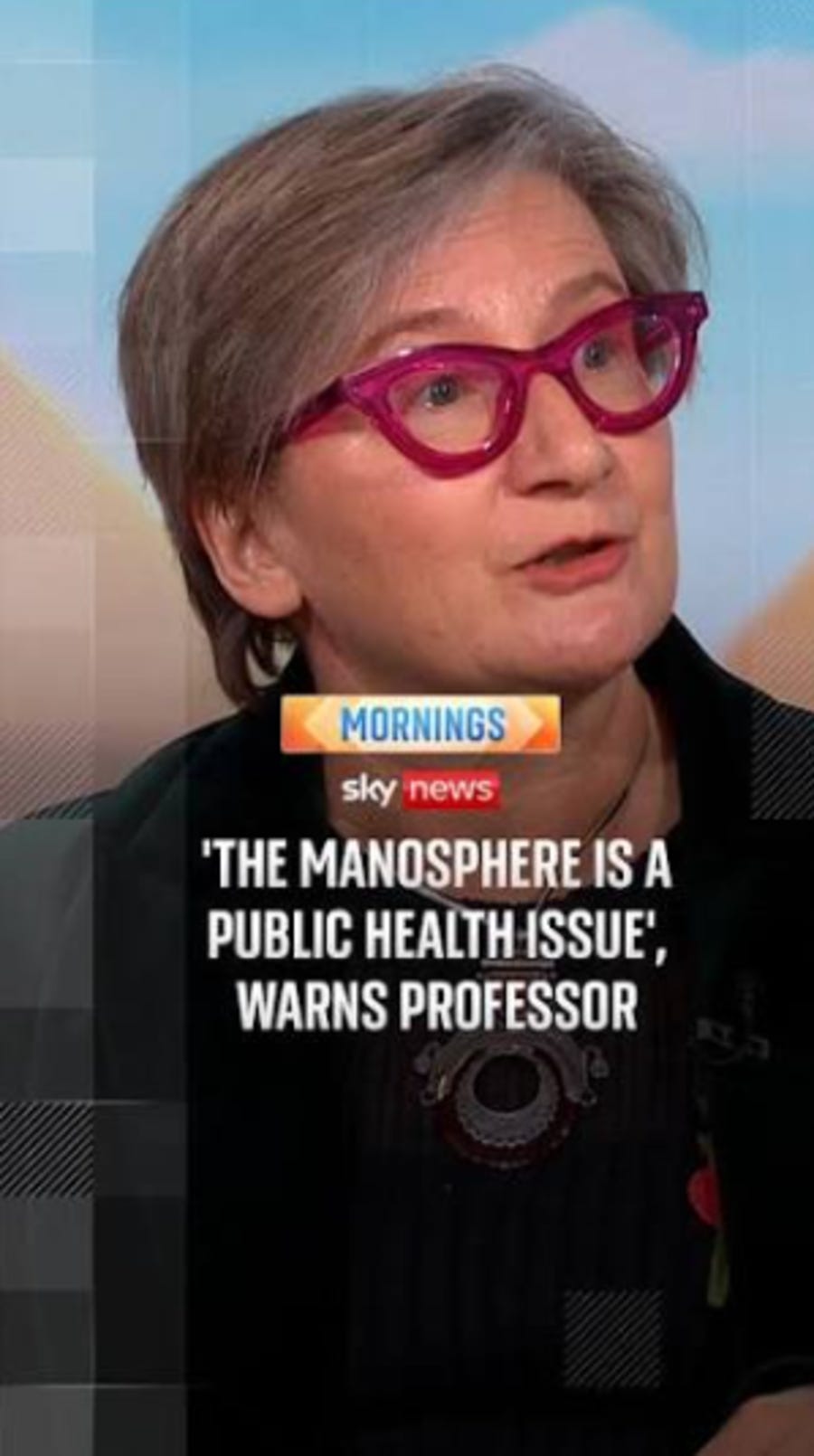
So, do men like progressive politics now? Or to ask the same question another way - does progressive politics like them? Something must have changed, since one of the notable trends coming out of the recent American elections was the total collapse in the right wing male youth vote. The elections aren’t the only datapoint through which we can consider this issue - there’s also this editorial in The Lancet last week, in which various academics urged governments to treat the Manosphere as a public health crisis, which garnered a great deal of international coverage. I have no idea whether these proposals will be adopted but it’s of a piece with how activists have approached their relationship with men in the recent past; it can throw some light on whether this most recent turn is something they can solidify and build on, or if there is an underlying problem in the relationship between men and progressive liberalism that the recent American results are only papering over.
The authors make six recommendations on how to achieve their goal:
First, the upstream conditions that shape vulnerability and engagement should be addressed, including educational marginalisation, social exclusion, and isolation in boys and young men…
Second, multisectoral collaboration between health systems and other front-line sectors that routinely engage with boys and young men should be strengthened, particularly education…
Third, communications strategies should be developed to avoid framing masculinity as inherently toxic or boys and men as inherently problematic…
Fourth, platform regulation should be considered analogous to other public health regulation strategies….
Fifth, governments should invest in monitoring, research, and evaluation to track evolving digital ecosystems, assess the effectiveness and impact of interventions, and identify unintended consequences…
Working with the legal, educational, economic, and community institutions and systems through which positive norm change can operate at scale, and confronting the well funded anti-gender and anti-rights movements that actively contest the evidence base for gender equality, obstruct international commitments to social justice, and support the political conditions in which the manosphere thrives….
While I’m sure a lot of recommendations made in the article are sincere and well-intended, I think the main point of the article is to sell the general public on the idea that this issue needs to be a political priority. It’s not just a policy prescription but a piece of evidence in itself to refer back to later, so how the persuaders present it seems important to me. Hence I’m going to look at it through the lens of this RTE article.
The article notes of the authors of the report, that…
They argue the movement (ie the mansophere)- which centres around a so-called crisis of masculinity and a shared conviction that feminism has systematically disadvantaged men - has contributed to many health harms…
Something that all of the copious mainstream reporting on the subject of Men’s political alienation notes and agrees on, whether it’s from RTE or NYT or the BBC, is that there really is a Crisis of Masculinity, so the use of the phrase “so-called” here is indicative. After all, if the report itself isn’t an attempt to address the outcome of such a crisis, then I don’t know what it is. This is the first indication of a pattern in this report we’re going to see repeated, that you might refer to as the Manosphere Parallax, after Michael Anton’s Celebration Parallax. In Anton’s term, “the merit of what is said depends on who says it (that is, a thing is acknowledged to be true when someone praises it but denied when someone criticizes it).” A repeated problem one comes across when reading these proposals is that Manopsherists and the report authors often agree on the essential facts of the situation, denials to the contrary notwithstanding. It’s a troublesome and frustrating phenomenon at the best of times, but doubly so when one end of the parallax is advancing a solution against the other, and enlisting the help of the state to do so, without acknowledging this dilemma.
The report refers to the problematic aspects of the Manosphere being that it…
… Delegitimises the idea of boys and men seeking help...(suggests) men’s problems are framed as the result of feminism rather than structural conditions, and masculine identity is commodified through products and paid content that normalise and reinforce health-harming and performance-oriented masculinities. Efforts to regulate or moderate content are frequently framed as threats to men’s autonomy, restricting political space for intervention.
This reflects a psychological tic you see replicated in all Progressive commentary on men as a troublesome sub-group, which is the assumption that independence and a desire to preserve personal space as inherently pathological. This is compounded by the claim that attempts to impose on this space are “framed” as threats to men’s autonomy, as though that wasn’t a simple statement of fact.
The idea that women becoming more culturally, economically and politically powerful changes men’s social position in a way that can create difficulties for men is an accepted progressive principle and regarded as a morally justified and desirable outcome, resulting from men’s historic oppression of women. Not liking those facts is a subjective political conclusion that cannot be forbidden, and that a government has no role in overseeing or talking people out of; it’s against basic liberal principles to try to do so. The fact that the report contemplates doing so reveals that the point is not to help men or protect women but to set the limits of public and private belief in such a way as to make a non-progressive outlook is officially illegitimate and sort of illegal. It also reveals that the report is based on Progressive conceptions of a hierarchy of oppressed groups being the determining factor in how government acts, rather than liberal principles of live and let live.
They said factors such as educational marginalisation, social exclusion and isolation in boys and young men must be addressed in various ways. This, it said, includes boosting employment, skills to improve access to jobs, re-engaging boys in education and ensuring “equitable access to mental health and other frontline health services” designed to reach this group.
This is familiar stuff: if men (in this case) are dissatisfied it is because they don’t have access to enough of or the right kind of public goods, and that giving them those things will make them happy or perhaps a better way to say it is it will give them nothing to complain about. In the thinking of the report the only way to draw men into the respectable system is to conceptualise them as one of many oppressed client groups who need to get their share of attention from a parental state. It’s probably unsurprising that the authors of the report, who either have civil service jobs, jobs in semi-state institutions, or are otherwise dependent on government funding and have therefore built careers around the largesse of the state, should feel this way. The report was not explicitly government funded or commissioned by them, and I’m sure the authors would claim independence; the organisations involved are Global Health 50/50, University College London, Monash University Malaysia all of which are either funded by governments (Australia and the UK) or reliant on grants supplied by them. The authors of the report have both previously worked for the UN or organisations connected to it, in other words are part of the transnational governmental ecosystem. The report therefore reflects the preferences of western governments or the bureaucracies that run them, and the people who work in them, for whom populism and illiberalism - which appeal to men more than women and are therefore conceptually connected to the Manosphere - have been greatly disrupted to the ability to do business as usual unmolested.
But as well as a governmental and economic outlook, I think it also reflects a psychological disposition. The report itself establishes that the “Manosphere” exists because Men like being left alone, and need to feel they can solve their own problems. One could say that the answer to solving the problem of the Manosphere is right there, and go no further. If we conceptualise men as a stakeholder group and ask how this apparently deep need of theirs had been accomodated in the report, the answer is it hasn’t, and the report itself can’t envision that, because its authors commitment to progressive principles is an overriding one. The nature of Progressive outlook is that it regards its adherents to be on a moral crusade, so dissent is illegitimate and threatening, and a true believer can therefore only address a problem by stepping in, not stepping back; by breathing down your neck ever more heavily, rifling through more of your drawers, passing more laws, entangling you ever more in the levers of the state (which are run by them on their assumptions and so support their way of looking at the world, not yours). You can’t ask a missionary to stay home.
By the same token, while this report is certainly a political instrument, the quest to define the Manosphere as public health threat also has a therapeutic function for the report authors and it’s intended audience, to make those people feel better by reassuring them that a way of looking at the world that they feel alienated from is being actively managed out of existence by the state. The report is alive to the possibility that men will feel they are being targeted for political and emotional micromanagement by people who don’t like them and therefore…
… They suggested communications strategies should avoid “framing masculinity as inherently toxic or boys and men as inherently problematic”...
After everything the report says, I find this funny - and, again, familiar. It reminds me of politicians saying they don’t support open borders because they’ve never said that exact phrase or included it in their campaign literature, and it’s often true, they haven’t. Sure, they want to deprioritise border enforcement, pass regular immigration amnesties, resist publishing statistics that would prompt the public to support stricter immigration laws, and their funding of the public square is entirely related to giving more money people in favour of loosening of immigration laws and none to people who oppose it; and sure, they characterise any specific instance of immigration restriction in practise as fascism, denigrate integration into the host cultures as oppressive, and so on - but they have never actually said the phrase. In the same way, people talk about mouth platitudes about supporting good versions of masculinity and not claiming it is inherently toxic - but no one can articulate a non-toxic version of maleness that is distinct from femaleness, and every version you can articulate is toxic. You could call this political approach “everything but the thing itself”. It’s important to be clear no one is actually fooled by this but it is nevertheless important to maintain as an official position, since it enables every other type of state intervention.
The manosphere offers boys and young men belonging, identity and an explanation for why life feels hard. Those needs are real. A response that only removes the manosphere, without offering something credible in its place, will fail. We need to offer boys something better, not just tell them what to avoid.
An interesting point to note is that the report does not define precisely what the Manosphere is. I don’t think this is by design, but I also don’t think it’s a problem for the report authors. If the purpose of the report is to provide grounds on which to restrict the speech and interfere with the opinions of others, the hard-to-grasp nature of what constitutes the Manosphere is a blessing, since it allows maximum flexibility. I don’t, for example, consider myself a Manospherist, but I write on a similar list of topics; as someone who critiques mainstream culture I inevitably end up picking at some Progressive ideals, and I charge for my content - the commercial nature of the business models being an item specific concern in the report. So if someone wanted to tag me as Manosphere and drag me into the realm of increased government oversight envisioned by this report they could definitely have scope to do so. On that basis - why shouldn’t I (or you as a reader) take a report like this personally? Why should I see incursions into my private psychological sphere as legitimate - especially if, like most men, incursions into my personal space are something I already worry about and dislike?
Here’s how the authors themselves position the report:
Fellow co-author, Professor Kent Buse, affiliated with the Department of Global Population Health at Monash University Malaysia, argued boys and men are not the problem, but rather the business model set up to target them. “Outrage and grievance are good for business, so the system rewards the most extreme content. Professor Buse said boys and men “are not the problem”, adding: “The problem is the conditions that leave them isolated and without a secure future, and the companies that profit from their anger and insecurity.”
I find the idea grievance is an indicator of political pathology, and which must be battled, to be pretty galling, and a textbook example of the parallax in action. On any given day, newspapers are replete with examples of the way resentment is not merely tolerated but encouraged in progressive life and is in fact a central plank of all mainstream politics. As to the problems that leave them “isolated and without a secure future”, I think you have to look at the job figures for young men and the jobs that were created by the Trump administration and how many of those went to them. I don’t think it’s unreasonable for young male onlookers to conclude that there are occasions where mens loss is womens gain. One can argue (as I’m sure the authors would) that grievance on the part of disadvantaged groups is legitimate, and that women gaining at men’s expense is often merely a justified rebalancing, and that’s fine but again, I note we’re not actually disagreeing on the facts.
Knowing that makes the idea that the Manosphere is a public health crisis feel like a flag of convenience. That feeling is compounded when the report acknowledges that actual evidence for such a position is thin on the ground. Part of the evidence is that the Manosphere reinforces a help-seeking stigma - I don’t doubt this can be negative in some instances but the report glosses over to what extent this is a normal and integral part of male psychology. The authors could not admit such a thing - instead they begin by assuming that any mindset which puts a citizen in tension with progressive thought must be malign, and proceeds as though that has been established. The report relies on the assumption of a presumed link between the manosphere and violence, does not (for example) deal with the research carried out by William Costello which indicates that men who self-identify as Incels have a low propensity toward violence; that incidences of incel violence are far rarer than media reports suggest; and that the main danger these groups pose is to themselves as a result of their self-hatred. If you set the academic veneer to one side, this report is simply an anguished from a group of academics who have seen a lot of mansophere content on social media, are morally inflamed by it’s contradiction of their outlook and personal preferences and can’t believe that such a thing can be legal, but also believe as good progressives that it could only exist because of an insufficient application of progressive principles.
To get back to the six recommendations for a moment. A feature of them, despite how they are phrased, is that they all focus on using coercive state power in hard and soft forms not merely to make it impossible to believe things that the state doesn’t believe, or want you to believe, since the manosphere and an ideologically progressive state basically accept the same set of facts. The focus is on ensuring that male citizens feel positive about those facts. That seems to me to be tyrannical, invasive and insane. And self-defeating; for example the educational interventions proposed include
… pre-bunking—which builds resilience to harmful content more effectively than reactive counter-messaging—and are best delivered through trusted peer and community messengers.
The Manosphere, if you take the most malign iterations of it, is not very nice, and I understand the wish to control it or root it out. But there are a couple of problems. The main ones are that this sphere exists in part as a reaction to, and an escape from, intervention, oversight and interference. By definition that problem cannot be solved by forced re-education, “prebunking”, heavier censorship, public advertising campaigns or the report’s other prescriptions. I cannot, in fact, think of something more likely to make the problem worse. To the extent men are suffering shocks in the labour market I’m ok with governments taking steps to address that and it seems like a valid and good thing to do, but it has to be done in a very careful manner. Men do not want to be seen as a group that needs a handout, and they implicitly understand that they can never truly benefit from the largesse of Progressive ideology as other groups do. Progressive politics (all politics really) runs on grievance, but men understand they cannot by definition have a legitimate grievance because they will at best only ever be a tolerated enemy within. The good news is they don’t like having grievances, and don’t want to be tolerated or handed out to. Men view the world, on average, slightly differently to women, and have a slightly different set of moral priorities that are nonetheless both explicable and legitimate To the extent that in the manosphere these impulses emerge in malign or pathological form is something that results from the realities of technology and not the underlying malignancy of those outlooks - we know because the same thing happens with women. Dealing with men as a problematic political group will require admitting and accepting all that, and despite the progressive orientation of the report’s authors, it requires the one quality they assume they have in abundance but actually lack, which is empathy.
Articles on similar subjects
Odysseus’s Modern Manhood

Christopher Nolan’s movies are about fathers and sons. In Batman Begins, Christian Bale is driven to live up to the example of his father and tortured by the idea he has failed to do so; he’s kept on track by surrogate father Alfred who reinforces the moral lesson of his dead dad, and pulled off track by false mentor Liam Neeson. In Inception, Cobb’s central motivation is to get back to his kids - the story clearly comes from the mind of someone whose dad was away on business a lot when he was young, and who is also guilty that he’s spending all his time on location worrying about lens choices and not driving Sebastian to school (I have no idea what Nolan’s kids are called or what age they are). Don’t get me started on Interstellar - the key scene is literally a parent who ascended to the heavens watching from above as his most beloved child grows up without him. Jessica Chastain plays a daughter but it’s an
Men and Progressive Culture on "The Pitt"

In Season 2, Episode 8 of Hospital drama The Pitt, the Emergency Room doctors stitch up a party girl who has bitten a chunk off her own tongue while drunk. Even as they sew she dips in and out of consciousness, but she is aware enough to confirm she’s an everyday drinker. As we watched at home, my wife and I speculated how this would play out in an Irish hospital… with an exhortation to cop yourself on and stop being an idiot, some grudging admiration for being such a character, maybe a lament from the doctor that they haven’t had time for a pint recently themselves. We were certain it wouldn’t end with the girl being referred to rehab, which is what happens in the show - an hilariously American reaction. These little cultural quirks and tics of The Pitt are one of the things that keep you watching; but attitudes to alcohol are not the biggest or strangest of it’s blindspots, not by a long shot.
The Different Challenges of Male and Female Online Radicalisation
In April the UK’s New Statesman published an article entitled Angry Young Women, which uses new polling to
What will we do with all these wacky pycho-ologist PHD eggheads?
One novel idea was to put them out into fields of rural farms to do some real work LOL