
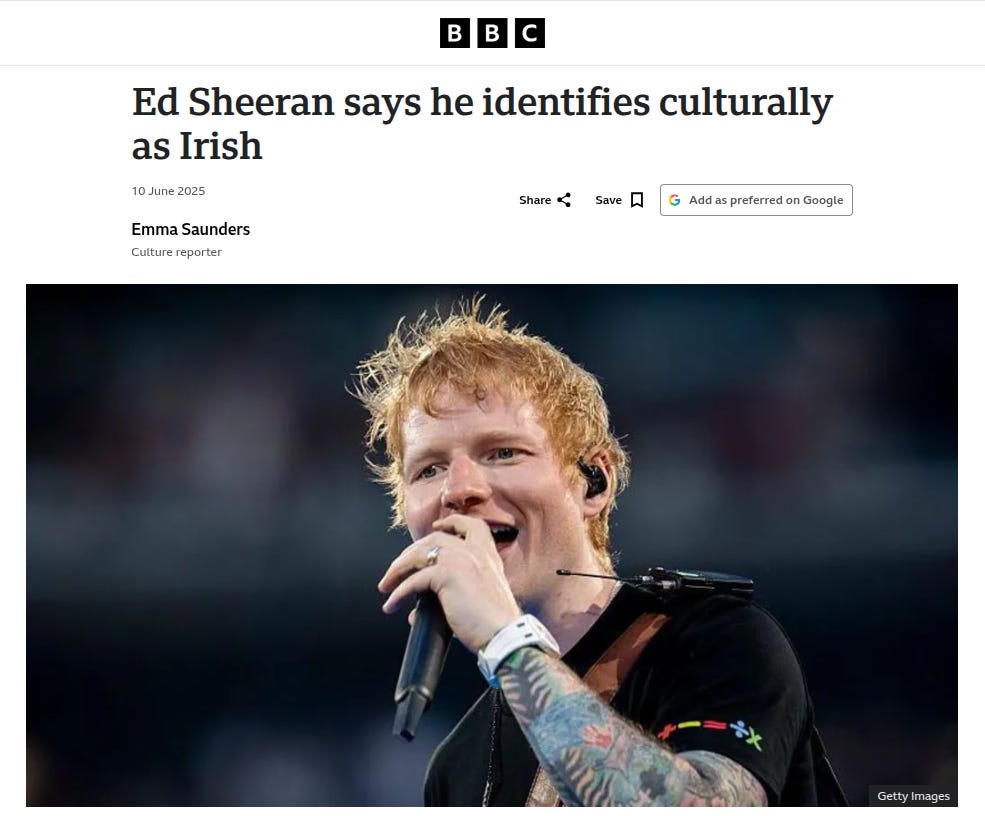
Pop Star Ed Sheeran’s career is imploding in real time; the whole saga is too convoluted to go into here, basically one of the support acts on his tour made some pro-Palestine statements on stage and was dropped. Ed let that happen, all of his other support acts and his band decided they didn’t want any part of this and walked away. In the past week he’s become the dreaded main character of social media, seen as a fairweather supporter of the key social cause of our era/ crypto-genocidaire (pick your angle) and is losing lots of followers.
The majority of the support acts were either Irish or had strong Irish connections; Ed is from England but has made a big deal about his relationship with us - emphasising his familial roots, employing Irish musicians, recording Irish songs, calling himself culturally Irish, the list goes on. Part of the turn against him on social media has been Irish content creators who had previously welcomed him revoking his green card, emphasising his englishness etc etc. Irish identity is policed and gatekept in a way other identities aren’t; I don’t like the way it’s done, many of the people who do the gatekeeping, and the subjects that cause them to fulfill the role, but I’ve come around on the idea that the gatekeeping instinct itself is right and important; I get it. Ed’s situation is a good entry point to talk about the surrounding complexities.
There is a lot of cultural capital tied up in being Irish. Part of that is that Irishness allows certain white people to participate in a world where to be marginal is a requirement of being seen as substantive, real, and dignified. Ireland and Irish creators have always had an outsized voice in popular culture, but the actual local Irish media market is very small and limited in reach, as are individual Irish-owned media outlets. Internationally, knowledge and interest about day to day life in Ireland is also limited. Any content creator who tries to make a living thinking, talking or writing about Ireland from an Irish point of view discovers there’s a hard floor (if you do it well) but also a hard ceiling to those activities, unless you can shape your output to suit the political and cultural agenda of non-Irish people. Sometimes the people you are shaping for actively dislike Ireland and are weaponising/ using interest in it in a careless, insincere and cynical way.
What you end up with is people in the diaspora who don’t have any living links to or experience with Ireland, and very little interest or knowledge in the country especially as it is now, speaking to Irish experience or representing Ireland. There are extreme versions of this at either end. On the benign side you get someone like Joe Biden, coming to Ireland and selling the Irish American experience back to Irish people as Irishness, coming out on stage to the Dropkick Murphys. Guinness is an example of the way this can happen at an organisational rather than individual level. The drinks brand, which is not Irish owned or a public utility, continually seeks to make its interests, imagery and history indistinguishable from Irishness. I stopped drinking Guinness a while ago because it bothers me so much that they act like they have ownership over Ireland as a brand and a feeling, and they don’t.
On the less benign side you see people using a tenuous (granny they never met, Irish surname) and unfelt connection using that to criticise Ireland and Irish people. This is a bit of a thing in America but a much bigger thing in the UK. I’ve met and know tons of English people with connections to Ireland and interest in it are deep and real and who seek to understand whatever they don’t know about it. But I’ve encountered a lot of the other types, too. I absolutely can’t stand the term “Plastic Paddy” because I always suspected it was invented by people who wanted to denigrate the idea of a diaspora identity, but if there’s such a thing as a Plastic Paddy then there is also it’s opposite that we don’t have a term for, which is people who claim a fragment of Irish identity they don’t truly feel, in order to express a loathing of Irish people. Many, many such cases.
So to summarise, on one side Irish Identity is politically and culturally to people who (at worst) don’t truly know and/or care about Ireland, and on the other side actual Irish voices will always be outnumbered and outgunned in any debate they find themselves in, so gatekeeping makes sense. That doesn’t mean any way you do it is ok. Leaving aside Ed and the middle-east for the moment, I’m not a fan of Conor McGregor but there’s meme of portraying him as English that is really stupid - buttressing our own identity by denigrating someone else’s in an unprompted way is really gross, and that’s aside from the fact that it misses the exact problem with McGregor is that he orients himself towards an audience slice of America, not the UK; if his behaviour is un-Irish it’s in an American rather than English direction. The flipside of that is that Irish Americans are the primary target of gatekeeping on a day to day basis and the tendency to bad mouth them as a matter of routine is mean-spirited and unfair as well.
So let’s apply this to Israel/ Palestine and Ed Sheeran. I absolutely can’t stand the former topic because it combines a subject that is, to me, just objectively not very interesting, and that people are uniformly hysterical and pedantic bores about, with the maximum social cost if your discussion of it falls the wrong side of an invisible and ever-shifting line. My life has only been improved by not speaking or writing about it. Here I go anyway, I guess, being an idiot.
One good voice on this was Goat_poaster on twitter, consistently one of the most interesting Irish accounts. He objected to the treatment of Sheeran and to some of the way that people were speaking about it, because he felt that certain partisan interests were seeking to make their political obsessions qualifying criteria for Irishness. This is a good way of putting the problem and I agree but I also think there’s another angle. I think his not actually being from Ireland led him to misunderstand how the people around him would react to these events. The artistic community in Ireland is very pro-Palestinian, and the nature of pro-Palestinian activism is you can never be a little concerned about it.
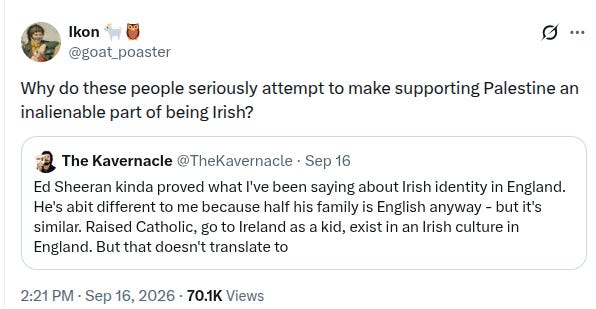
This is the world in which Ed has embedded himself, that he has stated he is emotionally bound to, and that he has chosen to use as a key step in his career ladder. His own band are founding members of something called Irish Artists for Palestine which describes itself as “(operating) as a unified collective across Ireland to platform Palestinian voices, coordinate fundraising events, and advocate for an immediate ceasefire and political sanctions”. On the issue of Palestinians Irish people tend to be divided between a small number of activists of this type, some of whom are not nice, and a large group of people who don’t care about the issue on a moment to moment basis but who, for cultural, historical and humanitarian reasons that are both explicable and logical (whether I agree or not) will come down on a pro-Palestinian side pushed lightly, or put in a position where they have to choose. This includes people who find the discourse around the middle east irritating, draining and irrelevant. There isn’t a pro-Israel caucus in Ireland of any great size and there won’t ever be. I think this is really important.
The people who do the gatekeeping in Irish life are motivated by an identical busy-bodying/ curtain twitching/ “what will the neighbours think” impulse that once animated their church-going ancestors, though they are the exact people who also hate the church and it’s legacy the most. In any case the comparison is instructive. After all, if the Church in Ireland was tyrannical it was a popular tyranny, reliant on a core of heartfelt sympathy and devotion amongst the populace. Despite how it’s remembered, it wasn’t something that squatted on top of the people despite recent protestations. Its most objectionable qualities (and most objectionable enforcers) were an extreme, malign manifestation of popular sentiments that were not themselves malign, and also of the reverence for the true Irish god of moral consensus. That’s why the most busybody-ish and self-aggrandizing forms of Pro-Palestinian activism in Ireland is so familiar, and that’s why it can’t just be dismissed. Support for the Palestinian cause is a logical elaboration of how regular Irish people feel about their history, the world, and basic morality. There is a lot of social and moral capital to be extracted from extreme opinions and behaviour on this topic because there is a quite high level of underlying support from people who are well-adjusted and not activist in a pejorative sense.
My point is that Ed Sheeran approached this with an English person’s understanding of the issue and not an Irish person’s. As a simple matter of fact, to be politically neutral on the subject of Palestine in Ireland means being quite pro-Palestinian by international standards. All of this matters to someone who has made Irishness an explicit part of their appeal and has been “gatekept in”, for want of a better term, on the basis that they are aligned to what Irish people are like.
I want to sympathise with Ed. The tactical purpose of what Macklemore (who seems like a shitty friend) did, let’s be honest, is to put Sheeran in a position where he has to either co-sign or suffer social death. Activists always demand speech on the basis that the message you are to deliver is that of being a decent human, and that delivering the activist message is more important than whatever you’re doing in that moment. But that logic can then be applied (and is) to any and every moment; and every activist cause can be portrayed as being in the spirit of being a decent human being. The end effect, which is intentional, is to make creativity a subcategory of activism, and a slave to it. In that sense activism is fundamentally a philistine impulse, and an enemy of creativity, because inherent within it is a refusal to accept it can be of a lesser importance to creativity even in creativity’s own home. My point is I sympathise with Sheeran, because I don’t like this stuff.
As with many others Ed himself has tried to parse this issue by speaking of himself as a non-political person. This is a mistake on two grounds. Even a politically engaged person can reasonably assert they don’t want to speak about a particular thing at a particular time; all a creator has is their own voice and the ability to use it where they wish. If you accept that can be surrendered under social pressure, you’re fucked. Even leaving creativity aside, on a human level it’s totalitarian and insane to demand that there is never any moment, even if one is (say) delivering a eulogy, or having a staff meeting in the office, or giving a half-time speech to your eight year-old’s soccer team that you can be asked to make or co-sign a political statement. This totalising quality is part of every type of activism that relies on social opprobrium, and the idea can be applied equally to wearing remembrance poppies, or condemning antisemitism, or saying black lives matter, or waving pride flags or any number of other things. But the Palestine people are definitely better at it.
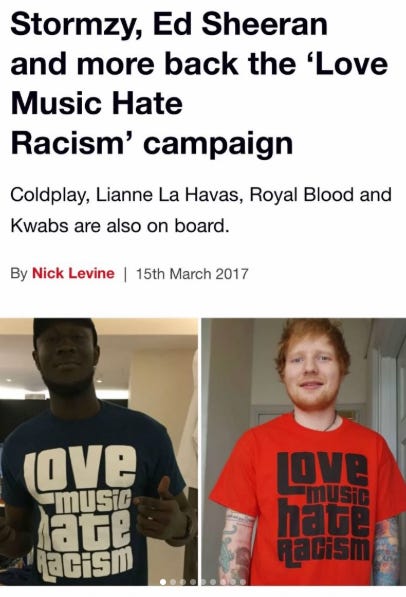
The other factor that makes this situation difficult for Sheeran is that he himself chose Macklemore as a support act; the rapper is a tiresome windbag and moral busybody of a very recognisable type who habitually uses his content as a way of endorsing and agitating for social causes in a clumsy and inartful manner. It’s not realistic to think that he would restrain himself from turning his presence on a big stage towards making a political statement. Sheeran himself has been very keen in the past to mingle his brand with social activism, it takes a very minimal amount of googling to find pictures and headlines of him with Ukrainian and pride flags criticising Brexit and so on. In part his error here arose because he forgot what taking a “non-political” stance means. It doesn’t mean “not political”, but only “not socially costly”. In Ireland there is no social cost to aligning yourself with the Palestinian cause, and potentially a big one from not doing so, or from aligning yourself against it. The world is becoming more like Ireland on this topic. Social status is the most important factor in human affairs so that’s probably something to bear in mind if he wants to base his appeal on being Irish or Irish adjacent - though I think that phase of his career is over for now.
Similar articles from me
“Sinners”, and the Use of Irish Identity in the Culture Wars

What with it being December, People are composing their “best of” lists of movies for the year, and on many of them Sinners will be close to the top. The action-horror movie about vampires in the early 1930s deep south caused a big splash on release; fo…
The Life and Death of an Irish Consensus

A couple of things that I’ve read recently have got me thinking about the idea of consensus collapse; “everybody knows” and agrees on a limited set of facts, resisting or questioning those facts gets you punished, until suddenly one day that’s not true anymore and no one believes it and never did.
We Learned Nothing

During July an Indian man was reported as having been assaulted in Tallaght, a large outer suburb of Dublin; the details of the attack (see screencap below from RTE news) meant it made national headlines. In turn that unleashed a torrent of similar stories,
What did he expect by hiring a has-been, never-was, shite-loader like Macklmore? LOL
I grew in a Irish named USA family who promoted the culture heavily, I learn to play the music and was taught the history as a child. But I always use the word "Celtic" to describe the culture. I did this when I had a real Irishman dispage my "Irishness" and called me a "Yank". I know for certain I knew more Irish music and history than he did, but nonethless I respected his bigotry and complied LOL.
But you cant take away my CELTIC heritage.