
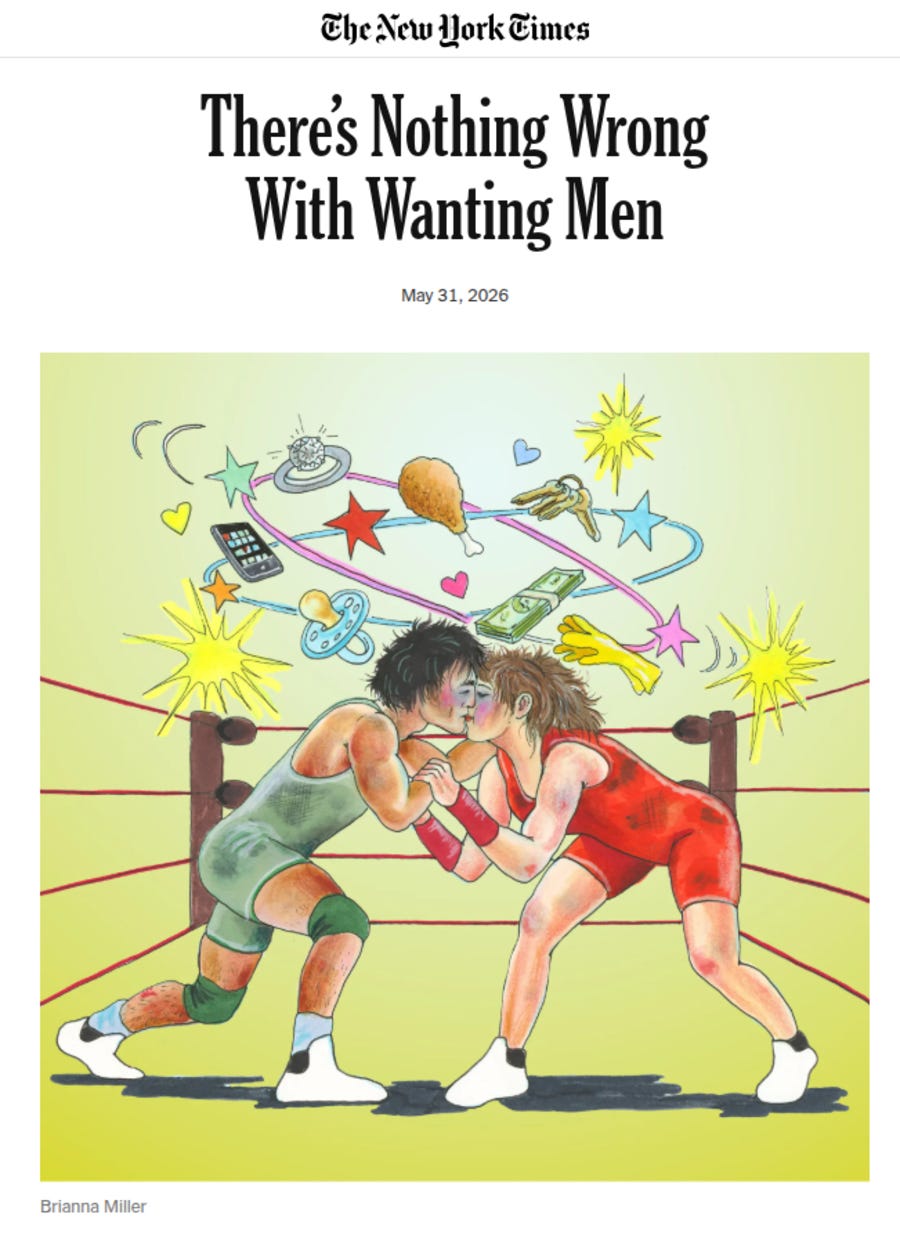
The NYT just published this guest essay a few days critiquing the idea of “Heteropessimism”, a term previously popularised by the Times (though it originated elsewhere) and describing the increased negativity of straight women towards relationships with men - really, towards men in general. Heteropessimism is the genteel face of an often not very genteel an internet-led increase in content about the awfulness of men which I described previously:
… in the last decade or so, expressions of contempt and disgust towards men have become an endemic feature of mainstream popular culture (in a way they weren’t previously). This is especially true of social media content aimed at young people but certainly not exclusive to it; a "Men Are Trash" aesthetic and attitude has become so common on sites such as Tik Tok that we don’t notice it anymore. It's also become more common in considered spaces (see "Mankeeping" and "The Burden of Wanting Men"). The central theme is female heterosexuality as a kind of horrible and embarrassing burden because of the association with men that it necessitates, thus the term "heterofatalism".
The NYT article itself is fine, but as is often the case when I see this issue discussed what I consider the most obvious and consequential factor driving the trend isn’t referenced so I want to linger on it here.
Denials to the contrary notwithstanding, the most powerful force in human affairs is not love or kindness but social status. Desiring it, hoarding it, making it, displaying it, obsessing about it - that’s what life is all about. If you notice a sudden increase in a particular cultural habit or tic it is almost certainly the case that social status considerations are what’s driving it, and so it is here.
Women show a pronounced in-group bias, about 4 to 5 times stronger than men’s; there is a documented effect across societies that both sexes tend to ascribe more positive traits to women than to men, though this fades as societies modernise it doesn’t fade as much for women. The explanations for both the phenomenon and it’s resilience are obvious enough, and rational - including that women are more likely to have developed praiseworthy interpersonal soft skills than men, that they have a stronger sense of their own vulnerability and seek to bond with each other as a protective measure and so on.
In any case what it means is that liking, praising and valorising women is a way for women to gain and keep in-group social status. We then feed this habit through the mincer of social media culture in which 1) there is profit in performing the desired values for their own social group to the utmost and at all times and 2) happiness writes white - go on twitter or any other platform and see how many of the top posts are about hatred, negativity, anger, bitterness, fear and so on and so forth. I love social media because it’s enabled me to get my writing out there but it’s addictive and “always on” qualities make it relentless, and it runs on our most instinctive and visceral emotions, which are not the light or conciliatory ones. The sum of all that is that there is a surprising amount of social capital to be made online by talking about what pieces of shit men are. What happens online is just the tip of the iceberg, and we see little fragments of the same impulse across society working in less direct, less explicit ways. It’s certainly one way of explaining, for example, the large number of women identifying as queer, non-binary or not fully straight who nevertheless only ever have straight relationships. (I don’t suggest in-group social status is the only factor at play here.)
Political polarisation is important in the increase in tension between men and women as social groups. The article itself touches on this when it states
Women are getting more and more liberal; men, increasingly conservative. That mismatch is indeed something broader than an awkward first date, a gap widening among the younger generation…
Of course that’s not quite true, since polling shows that the movement is more on women’s side than men’s. Either way, politics here is a proxy for social status. There are plenty of Progressive men, but there is something about Progressivism in it’s current form that is alienating and foreign to men on a gut level. That’s a problem, because Progressivism is the upwardly mobile ideology of our time in terms of the relationship of its adherents to educational attainment, career progress, income, class, and social capital - and women on the whole do find it to be a congenial outlook.
Men are more likely to be associated with downwardly mobile political ideas such as Conservatism or Populism - or at least with weaker commitment to upwardly mobile Progressive beliefs. Progressivism itself applies a lens of emotional empathy to all issues, making it difficult for people who subsrcibe to it to sympathise with or even understand one’s opponents. The side effects of all these factors together are well-known, polling data that shows up to 50% of single women report being less inclined to date someone with opposing views; and also that men therefore either pretend to agree or disguise disagreement in order to get along with women. What is at issue is status, not policy outcomes. The nature of the social media panopticon and the continuous performance of values it entails, means it is socially costly for women to be associated with men in a way that is not true in the opposite direction. When you view things in this way it makes sense that “Having a Boyfriend Feels Republican”.
The article presents online gender wars and “heteropessimism” as a two-sided problem - a male and female side, with each contributing in their own way.
Heteropessimism isn’t just for women. Men like the white nationalist Nick Fuentes and the Tate brothers — influencers who are accused of human trafficking and rape — also promote a form of heteropessimism. Their basic argument is that women are not worth the time or are something to dominate and discard, that there is something wrong with them and men are better off alone. These manosphere figures are far less thoughtful and far more hateful in their wording than feminist heteropessimists, but their argument is functionally equivalent. Both groups argue that the other half is just bad. Give up, they tell us. Both are willing to let the cycle of loneliness and atomization continue.
Some of that’s true, but also kind of not true. The internet is a magic mirror that exaggerates the worst characteristics of all groups that peer into it. Certainly it underlines the existing negative associations we have with men; that they are mean, violent, unempathetic, crude, bullying and misogynistic and so on. The worst incel stuff (which the author notes is not very popular anyway) is an intensification of the most negative tendencies we already saw in men.
But the negative social signalling it is coaxing out of women is kind of new, and constant visibility of it is a new and different problem. We all already agree that men are irredeemably awful. As I noted above and have also said else where - being an incel, or someone who hates women or is resentful towards them, is a low status belief; no one wants to be around a person who acts like that. Such people still exist but that provides a natural limiting factor to that belief system or perspective - because people don’t want to be losers. No such limiting factor exists on the other side, so the female contribution to the Heteropessimism is a lot more uncertain and destabilising in it’s effect on women and how they are seen than the male one is on men.
I’m very lucky in that all of this dating market stuff is entirely theoretical to me; I met my wife 20 years, right as the age of internet dating was beginning, and when I reflect on the state of things today I often feel like I feel like a guy who got the last chopper out of Vietnam, hanging on to the skids, legs dangling in the air as the city collapses below me. My interest here is an anthropological one of understanding the cultural changes that have become so visible across my various social feeds the last couple of years, which is the changed tone in which men are spoken about.
But it’s important to say that it’s easy to confuse the conversation with the thing that the conversation is about, and it’s easy to confuse cultural representations of life with life itself. Focus on the discourse creates the illusion that people in the dating market are forced to confront every structural dilemma, and bear every burden of that market simultaneously and at all times. My recollection of my feelings during dating life were not anything structural but only how lonely I was and what a relief it was to finally find the right someone, so I could step out of this world forever and not think about it again. My perspective at the end of my dating years was (I mean this jokingly) that of a world war one soldier, immersed in the mud, blood and smoke, rather than that of world war one general who is surveying the whole battlefield and the whole war at once. I feel sorry that in 2026 the meta nature of the discourse means we ask all of the participants in the dating world to be both the general and the soldier at once, and to broadcast their feelings about it at all times, and it’s not a surprise that many of them buckle. It’s good to return to the core truth, which the article does get right, that relationships are good and make you happy, and you just need to be lucky once. The performance demanded by social media, and the resentment and hopelessness that engenders, shouldn’t fool us into forgetting that.
Other articles on similar topics
Men and Progressive Culture on "The Pitt"

In Season 2, Episode 8 of Hospital drama The Pitt, the Emergency Room doctors stitch up a party girl who has bitten a chunk off her own tongue while drunk. Even as they sew she dips in and out of consciousness, but she is aware enough to confirm she’s an everyday drinker. As we watched at home, my wife and I speculated how this would play out in an Irish hospital… with an exhortation to cop yourself on and stop being an idiot, some grudging admiration for being such a character, maybe a lament from the doctor that they haven’t had time for a pint recently themselves. We were certain it wouldn’t end with the girl being referred to rehab, which is what happens in the show - an hilariously American reaction. These little cultural quirks and tics of The Pitt are one of the things that keep you watching; but attitudes to alcohol are not the biggest or strangest of it’s blindspots, not by a long shot.
The Different Challenges of Male and Female Online Radicalisation
In April the UK’s New Statesman published an article entitled Angry Young Women, which uses new polling to
Men, Withdrawing From Work and Life

Darby Saxbe, a psychologist and Substacker, has been publishing a series on feminism and men (“Has Feminism Been Bad for Men?”), the most recent of which is here. They’re all worth reading. In this latest article she covers feminism’s impact on men in “culture, specifically education, male mental health, and misandry” and touches on this idea that men have withdrawn from certain parts of working and public life, and why that is.
This all seems downstream of the reluctance among high-status progressives to admit that they are high-status, at minimum in respect of their influence on The Discourse and usually in terms of finances and other things. Of course few people want to admit to being high-status, but for progressives there's a stronger motivation because they are supposed to be against hierarchies, and admitting you are at the top of one would necessitate climbing down. I on the other hand am in favour of all hierarchies I'm at the top of, and can rain abuse on loser men without compunction.
I’m a few years older than you, but I concluded when I was single that social status was all about finding a mate. Everyone was doing all they could to make themselves attractive to the opposite sex. Cars, money, exercise, hobbies, jobs, professional accomplishments were in the furtherance of attracting a spouse.
These days I suspect that is still mostly the case, but maybe less so in elite circles.