
Sometimes, while wearily sorting through the latest crop of “Masculinity in Crisis” articles, a thought will occur to me. It’s true that “Masculinity” as a term is both bullshit and cringe; but it’s also true there is something about being a man that is linked to men’s feeling of alienation from politics and culture. What is that though? With complicated issues like this, rather than looking at the problem directly, it can often be more helpful to start by applying the disputed frame to a different issue. So we’ll begin this question: why do we never hear about a crisis of femininity?
After all, there’s lots of evidence for it in every direction, for anyone inclined to count. If we consider a move toward the political extremes to be evidence of a crisis - which we do with men - women are drifting left with no end in sight, far more so than men are to the right. Alongside that, we often seem men’s failure to reach particular life milestones as a sign of crisis but women too are failing to meet many of the key milestones of adulthood, marriage being one example.
Women are way more anxious than they used to be, to the point that medication for anxiety is through the roof. Separate to anxiety, women’s overall happiness has steadily declined relative to men’s since the 1970s, and they’ve experienced an associated rise in addiction, alcoholism in particular.
An obvious objection here is that these changes are not directly connected to ideas of womanliness or femininity per se … but there’s plenty in that direction too. In the past 20 years Gender Identity has been adopted as the correct way of understanding sex differences (correct in the sense of being the one endorsed by academia, the state, the press, activists and so on). Lots of women - particularly younger and more educated ones - are not just comfortable with this but happy about it, and supportive of it, but plenty aren’t to one degree or another, and the decision to separate female experience from a concrete biological reality must surely have had some crisis-inducing impacts for some number of women.
Finally at the lowest level there’s evidence of crisis in the decline of relations between men and women on social media - in particular the great deal of online antipathy expressed towards men; if we regard dehumanising and contemptuous rhetoric directed from one sex towards the other as a sign of crisis (as we do when it goes in the other direction) then there’s another one. Some of the frustration expressed in this talk is rooted in men’s seeming withdrawal from women; anyone who has spent any period of time online in the last few years will have seen the trend of women reporting that they are no longer approached in public by men, and how depressing and mysterious they feel that is. Perhaps we could take that as an indication of crisis from without rather than within - it’s generally felt the decline is due to men scared off by #metoo, but it’s also possible they simply like what they see less than they used to.
My point is not that there is a Crisis of Femininity and I don’t believe there is one, any more than there is one of masculinity. My only purpose here is to show how easy it is to construct a sex-based crisis story, and to show how comfortable we are doing that with men but not with women. It highlights that there’s something cosy and self-serving about using the frame of Masculinity to talk about men and politics, something that conceals as much as it reveals.
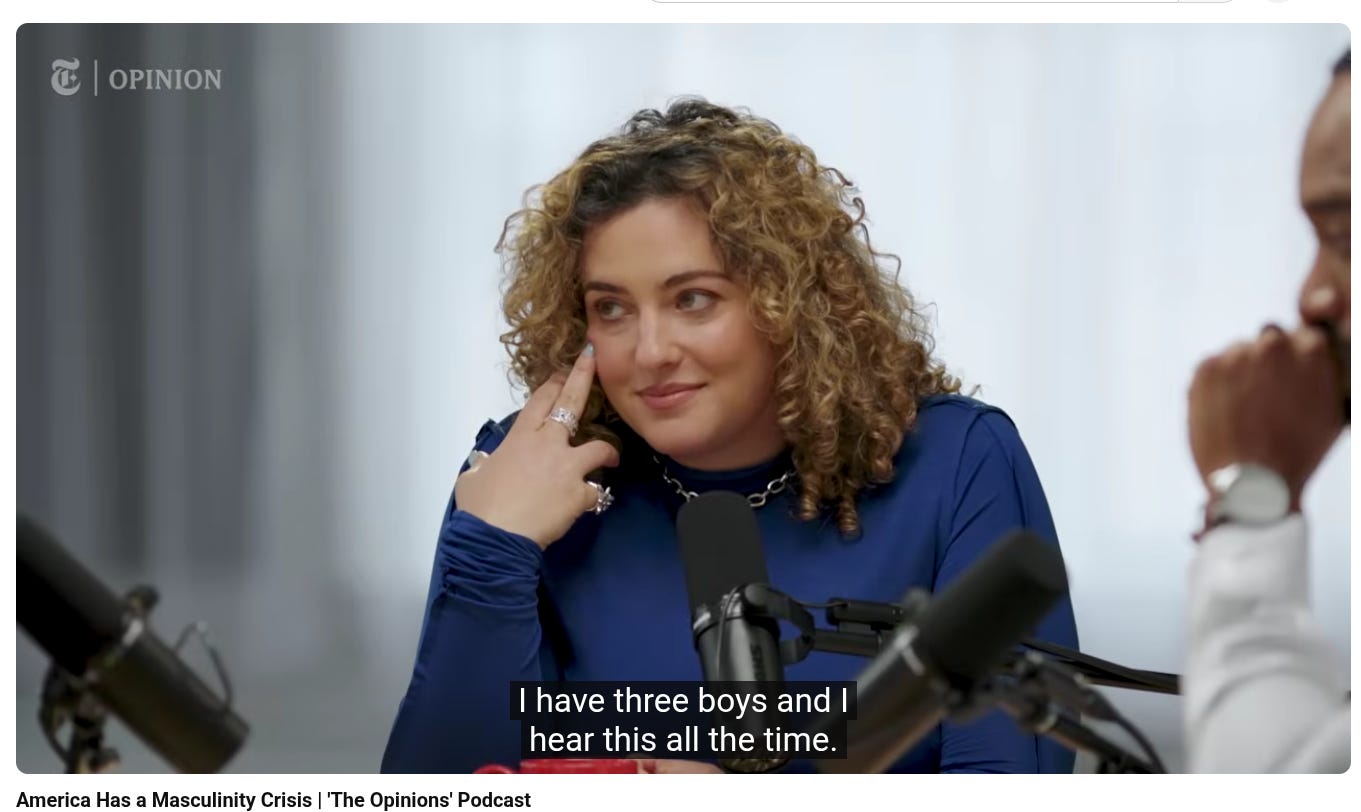
Another easy way to spot this is to listen to this widely referenced New York Times podcast episode on the subject, which was critiqued so extensively by LastBlueDog here. They give the game away in the first five minutes, with references to white supremacy, racism and patriarchy. Have you ever met a man who enjoys using these terms or encounters them with anything other than an eyeroll? And not just because people dislike being made the villain of the story (though of course - it’s under-remarked - why shouldn’t someone dislike that) but also because the point of view these terms represent is from a man’s perspective either false or incomplete, and is in any case one they don’t recognise. The safest path for liberal and progressive commentators is to keep all conversation and analysis in the zone of oppressed and oppressor, and never to ask if there is something to the very frame itself that limits understanding or drives the crisis.
This frame is the exact reason that you could never have an equivalent Femininity in Crisis debate in the manner I described above; because for an oppressed identity class the source of a crisis is never mysterious - it is always an external oppressor. To allow yourself to think otherwise would be to make those groups partly responsible and accountable for their fate, which in a progressive outlook is a category error, a contradiction in terms.
So these conversations are fundamentally talking about men in a foreign frame rather than trying to relate to men on their own terms; and are about finding pat answers that you’re comfortable with rather than challenging whether there something basic disconnect between men and the progressive worldview, something that you might have to change to reach or include them that you might have to challenge.
These podcasts will often talk about finding a positive version of masculinity, but that never seems to be more than men behaving (and most importantly voting) as women do, while still accepting group culpability as an oppressor class. The use of the term Masculinity itself is a way of side-stepping the question of whether men and women are different on average, and if so, how that needs to be accommodated in a progressive worldview.
I apologise in advance for getting all “dear diary” but the easiest way to understand how limiting a perspective Masculinity is, is to to take my own inner life as an example. I do not recognise myself in any of these conversations about this subject; I’m not aggressive or competitive, I have no real interest in technology, I think steaks are kind of overrated, I’m emotional and anxious, I’m mediocre with numbers and I love language and art and ideas. I have never felt any internal conflict about any of this.
But I think I’m a good example of how a traditional idea of masculinity is an unhelpful and inaccurate dividing line to draw between men and women. I was really interested in music when I was in my teenage years up to maybe my mid-20’s - theoretically that’s a gender neutral hobby, but if I told you absent of my sex that I often sorted my record collection by spine colour, genre, or date of purchase, I think you could guess I whether I was male or female with 90% accuracy. I played Warhammer and Dungeons and Dragons during that period as well, again certainly not something anyone would note as hyper-masculine - yet if you walked into a gaming convention in the mid-90s and took a deep breath through the nose you would be crystal clear that those hobbies skewed very strongly male and not female. All I’m trying to illustrate is this; there is lots of behaviour that we understand is very male, but not at all masculine.
The second point to go alongside that is that a lot of that “very male but not very masculine” behaviour is often an expression of the same root impulses as masculinity, just not in manner oriented outwards toward dominance or social status. It took me years to understand that my writing was driven by a desire (that I think is quite male) to systematise and categorise the world in order make it more intelligible for myself and others. I was never sure why issues around freedom of speech bothered me quite as much as they did until I realised that I thought of my imagination and intellect as a kind of territory that belonged to me, and attempts to limit my expression were intrusions on it by external forces, that had to be repelled in part because not to do so made me feel weak and preyed upon and I hated that. Part of the purpose of writing was a desire to prove that I was useful to others, and making a difference as a necessary part of the world. Naturally this is all only part of the story, but it’s a significant part.
The more I thought about my motivations and the things that made me the way I was the more I could see that they were often distinctly male-flavoured and that had a root cause that was the same as more classically masculine behaviour. Whatever those things were, they were essential and not socially constructed. Typically male traits and a characteristically male outlook aren’t found in the nerdy or the shy any less than in any other type of man. The masculinity that is spoken about in Podcasts is like an overcooked meal that you make out of the ingredients of maleness, but it’s not the ingredients themselves. That’s important because the ingredients drive the difference.
This has additional political complications. It means that men aren’t necessarily drawn to people who announce their masculinity (quite the opposite, since that’s so cringe) but it does mean that men are repulsed by people who undermine or seem to reject those pre-masculine traits. I’m not a strong observer of British politics but I can’t help noticing how recently deposed Prime Minister Keir Starmer he was at his most appealing when he was telling Donald Trump to fuck off (in his own tremulous way) in relation to war in Iran, and for attacking the memory dead British troops who had served in Afghanisatan and Iraq. On the other side his tendency to shrink from attacking his enemies, or defend himself when attacked, and his tendency to regard rules and procedure as a goods in and of themselves, were unappealing in a way that seems to have led to his downfall. It’s interesting to compare his response to an internal party leadership challenge to that of John Major when he was put in the same position; instead of meekly receding into the background with a tear in his eye, Major challenged his rivals with “put up or shut up”. God knows Major wasn’t a swaggering man of action anymore than Starmer was, but in that moment he was brave, and I’m sure that did reveal an appealing part of his character.
That’s a mixture of good news and bad for a progressive person concerned about men’s relationship to their coalition. You don’t need hyper-masculine candidates or advocates and in fact it’s better that you don’t have them, since that would be embarrassing. But Masculinity and “male” aren’t the same, so that’s not the end of the matter. Male voters don’t need candidates who are belligerent or aggressive but the absence of physical or spiritual courage is really repulsive, as is the tendency to see that absence as admirable or superior. They don’t need someone who ignores structural societal issues, but they do need someone who attempts to master or overcome those forces rather than complain about them. They don’t need someone to be stoic or hard, but emotional incontinence isn’t good, and again - making a celebration of emotional incontinence is really, really bad. They can be empathetic, but behaving as though emotional empathy is the master value of humans and the only legitimate way of experiencing the world is gross and weird.
But that’s difficult; it’s much easier to explain that men are internally broken and have to be entirely rebuilt outside of their toxic frame than to say “we know men don’t like this stuff so we will have to leave them to understand their own problems in their own ways,” or even to admit the most basic principle of a liberal society, which is “to each his own”, with all that implies. I would like to end this on a more highbrow reference but there is one quote I cannot stop thinking about in this regard which was from British male model David Gandy (of all people) who said that “We say we need men to talk, but don’t say anything that will offend us and don’t say anything we don’t agree with. So what do you end up doing? You don’t end up talking.” I think that summarises the point perfectly. If men and women see the world a bit differently on average, and those average difference are deep-rooted and essential, a sincere attempt to relate to men begins by seeing things entirely from their perspective, not someone else’s, and by accepting that it is entirely valid. I don’t guarantee that the natural tenions that such a step can provoke can be resolved but they are a consequence of attempting to have a difficult conversation, rather than enacting the performance of one.
Recent Articles on Similar Subjects
Men and Progressive Culture on "The Pitt"

In Season 2, Episode 8 of Hospital drama The Pitt, the Emergency Room doctors stitch up a party girl who has bitten a chunk off her own tongue while drunk. Even as they sew she dips in and out of consciousness, but she is aware enough to confirm she’s an everyday drinker. As we watched at home, my wife and I speculated how this would play out in an Irish hospital… with an exhortation to cop yourself on and stop being an idiot, some grudging admiration for being such a character, maybe a lament from the doctor that they haven’t had time for a pint recently themselves. We were certain it wouldn’t end with the girl being referred to rehab, which is what happens in the show - an hilariously American reaction. These little cultural quirks and tics of The Pitt are one of the things that keep you watching; but attitudes to alcohol are not the biggest or strangest of it’s blindspots, not by a long shot.
The Different Challenges of Male and Female Online Radicalisation
In April the UK’s New Statesman published an article entitled Angry Young Women, which uses new polling to
Men, Withdrawing From Work and Life

Darby Saxbe, a psychologist and Substacker, has been publishing a series on feminism and men (“Has Feminism Been Bad for Men?”), the most recent of which is here. They’re all worth reading. In this latest article she covers feminism’s impact on men in “culture, specifically education, male mental health, and misandry” and touches on this idea that men have withdrawn from certain parts of working and public life, and why that is.
We need a word for something that is distinctly masculine but not macho. Dork and nerd roughly fill the space, but are too pejorative.
Also steak is overrated, probably because too many manly men feel obliged to like it.
> Women are way more anxious than they used to be, to the point that medication for anxiety is through the roof.
It’s a data point but I’d be hesitant to confidently attribute more anxiolytic prescription to more anxiety.
For one a lot of the more modern active ingredients and also carrier formulations are rather new. “Medieval peasants didn’t suffer from depression, look how few SSRIs they took”
Additionally, a lot of medicine is driven by diagnostic hypes and pharma marketing. Medicine in general is the self-confident high-energy midwit profession par excellence as the recent AI ultrasound imaging brouhaha illustrated.
I’d bet cluster B(abe) patients are also very good at demanding things based on self-diagnosis.
> why do we never hear about a crisis of femininity?
They vote correctly; all there is to it.